Hospital Bed Adjustability Ranges: Industry Standards Explained | Installation & Maintenance
Hospital Bed Adjustability Ranges: Industry Standards Explained
In the realm of modern healthcare procurement, the hospital bed is no longer viewed merely as a piece of furniture; it is a critical medical device that directly influences patient outcomes, caregiver ergonomics, and operational efficiency. As the global medical nursing bed market continues to expand, projected to grow at a CAGR of 8.5% through 2027 from a base of approximately USD 4.5 billion in 2024, understanding the technical nuances of bed adjustability is essential for hospital administrators and procurement officers [K2-English-Industry]. The shift from hospital-centric to home-based care models, driven by aging populations in OECD nations and government insurance programs, has further elevated the importance of precise adjustability ranges [K3-English-Market].
At HJIM (Hengshui Chengen Medical Equipment Co., Ltd), we recognize that the core function of a nursing bed is to solve the fundamental problem of patient immobility. Whether in an ICU setting or a homecare environment, the ability to adjust bed angles safely and efficiently reduces the physical burden on nursing staff and prevents complications such as pressure u
The Mechanics of Bed Adjustability: Electric vs. Manual Systems
The primary distinction in the nursing bed industry lies in the actuation mechanism: electric linear drives versus manual mechanical cranks. This choice dictates not only the cost structure but also the daily workflow of healthcare facilities. Electric nursing beds utilize electric linear actuators to replace traditional manual hand cranks, allowing for the adjustment of bed sections via a remote control or wall-mounted panel [K1-Chinese-Electric]. This technological shift addresses the core issue where patients cannot move independently but require frequent position changes. In a manual system, caregivers must physically exert force to turn a crank, which increases labor intensity and the risk of workplace injury. In contrast, electric beds reduce caregiver labor intensity by over 70%, making them the preferred choice for high-acuity environments [K2-English-Electric].
However, the global market is not monolithic. While electric beds are becoming the standard in developed nations, manual nursing beds still hold a significant share in specific regions. Manual beds use a mechanical crank mechanism to adjust bed angles, requiring no electricity and offering a simpler, lower-cost structure [K2-Chinese-Manual]. In markets with unstable power grids or severe budget constraints, such as parts of Africa and Southeast Asia, manual beds remain the主力 (main force) product, with prices ranging from $80 to $150 [K2-Chinese-Manual]. Despite the growth of electric beds, the manual segment is projected to grow at a 3% CAGR, driven by infrastructure gaps in developing regions [K1-English-Market].
For procurement professionals, the decision often comes down to the specific care model. In homecare scenarios, which are seeing the fastest growth at an 18% CAGR due to the “silver economy” and aging-in-place trends, electric beds offer the necessary ease of use for family caregivers who lack professional training [K1-English-Market]. Conversely, in budget-constrained public health initiatives, manual beds provide a baseline level of position adjustment that is better than a standard flat bed, though they lack the precision required for complex medical interventions.
Standard Adjustment Angles and Functional Ranges
When evaluating hospital beds, the specific degrees of adjustment are the most critical technical parameters. Industry standards generally categorize beds by the number of functions—typically 3-function or 5-function systems. A standard 3-function electric nursing bed, such as the HJIM MD-A12, typically offers three primary adjustments: backrest elevation, knee gatch (leg section) elevation, and overall bed height [K1-Chinese-Electric].
The backrest adjustment is vital for patient comfort and medical procedures. Industry standard ranges for the backrest typically span from 0° (flat) to 80° (near-vertical). For example, the HJIM MD-A12 specifies a backrest range of 0-80°, allowing patients to sit up fully for eating or reading, which significantly improves psychological well-being and reduces the risk of aspiration [K1-Chinese-Electric]. Some specifications in the English market documentation cite a range of 0-75°, which is functionally equivalent for most clinical needs [K2-English-Electric].
The knee gatch adjustment, which elevates the lower leg section, is essential for preventing the patient from sliding down the bed (shearing) and for improving circulation. The standard industry range for knee elevation is 0° to 45°. This angle helps flex the knees slightly, reducing pressure on the lower back and enhancing stability when the backrest is raised [K1-Chinese-Electric].
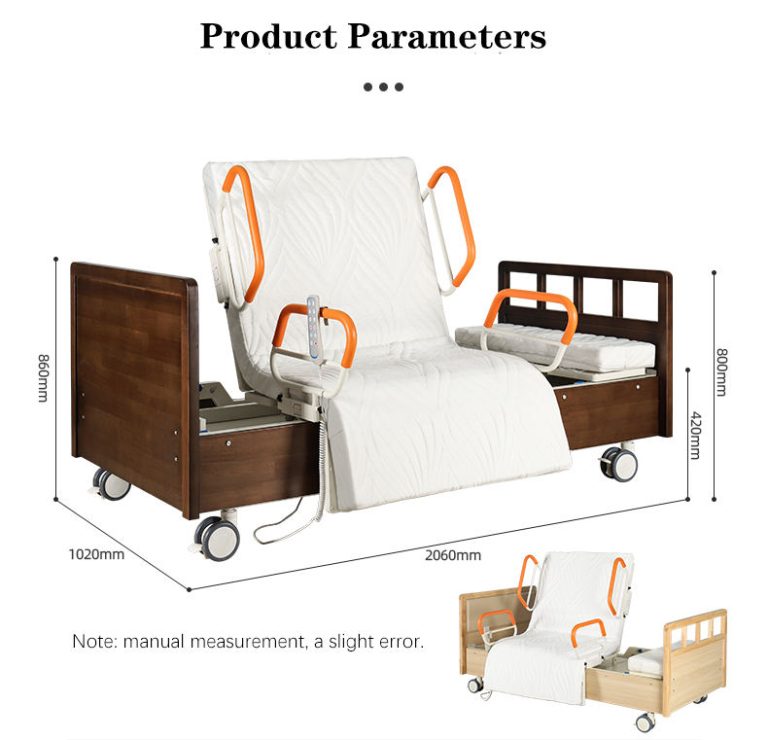
Beyond angles, the overall height adjustment is a crucial safety feature. Low-height settings are increasingly mandated in fall-prevention protocols, allowing the bed to lower close to the floor to minimize injury risk if a patient attempts to stand. High-height settings facilitate caregiver ergonomics, allowing nurses to work at waist level without bending, which reduces back strain. While specific height ranges vary by model (often spanning 450mm to 750mm), the capability for smooth, motorized height transition is a hallmark of premium electric beds [K2-English-Electric].
Market Segments and Application Scenarios
The application of nursing beds varies significantly across different healthcare sectors, influencing the required adjustability features. The market can be broadly segmented into hospital beds (electric), homecare beds, and manual beds for developing markets [K1-English-Market].
Hospital Beds (Electric): This segment is growing at a 6% CAGR, driven by ICU expansion and the integration of smart monitoring systems. In these settings, adjustability is not just about comfort; it is about clinical intervention. Beds must support rapid position changes for CPR, precise tilting for hemodynamic monitoring, and integration with hospital information systems. The demand here is for high durability, high weight capacity (often exceeding 220kg), and advanced motor systems from reputable brands like LINAK or Dewert [K1-Chinese-Electric].
Homecare Beds: With an 18% CAGR, this is the fastest-growing segment. The focus here shifts slightly from clinical precision to user-friendliness and aesthetics. Homecare patients often operate the beds themselves or with minimal assistance from family members. Therefore, the remote control interface must be intuitive, and the noise level of the motors must be low to maintain a peaceful home environment. Government subsidies and aging-in-place policies in OECD nations are primary drivers for this growth [K1-English-Market].
Manual Beds (Developing Markets): As noted, this segment serves regions with budget constraints. The adjustability here is basic but vital. Even a manual crank that allows for slight back elevation can prevent bedsores in long-term care facilities where nursing ratios are low. The key metric here is reliability and ease of mechanical repair rather than advanced features [K2-Chinese-Manual].
Material Standards and Safety Certifications
Adjustability mechanisms are only one part of the equation; the materials used in construction determine the bed’s longevity, hygiene, and safety compliance. A critical component often overlooked is the headboard and footboard. High-quality nursing beds utilize ABS (Acrylonitrile Butadiene Styrene) blow-molded panels [K1-English-ABS]. ABS is preferred over steel or wood because it is lightweight, impact-resistant, and chemically resistant to disinfectants. Crucially, ABS headboards often feature a quick-release latch mechanism, allowing for immediate removal during emergency CPR procedures without the need for tools [K1-English-ABS].
For healthcare procurement, compliance with international standards is non-negotiable. Beds intended for export or use in regulated markets must carry CE marking (indicating conformity with health, safety, and environmental protection standards for products sold within the European Economic Area) and ISO 13485 certification (specific to medical device quality management systems). FDA registration is required for entry into the United States market. These certifications ensure that the electrical systems are safe from leakage, the mechanical structures can withstand repeated stress, and the materials are non-toxic [K2-English-Industry].
Furthermore, the weight capacity is a key specification that must be verified against the patient demographic. Standard beds typically support up to 220kg, but bariatric units are available for higher capacities. Exceeding the rated weight capacity can damage the linear actuators and compromise the structural integrity of the bed frame, leading to safety hazards [K2-English-Electric].
Comparative Analysis of Nursing Bed Types
To assist procurement officers in making informed decisions, the following table compares the key characteristics of electric and manual nursing beds based on current industry data.
| Feature | Electric Nursing Bed | Manual Nursing Bed |
|---|---|---|
| Actuation Method | Electric linear actuators (2-5 motors) | Mechanical crank/hand lever |
| Adjustability Range | Backrest 0-80°, Knee 0-45°, Height adjustable | Limited angles, fixed height (usually) |
| Caregiver Effort | Low (Button operated) | High (Physical cranking required) |
| Typical Cost | Higher (Premium investment) | $80 – $150 (Budget-friendly) |
| Primary Market | Hospitals, Homecare, Developed Nations | Developing Regions, Budget Facilities |
| Growth Rate (CAGR) | 6% (Hospital), 18% (Homecare) | 3% (Developing Markets) |
| Key Example | HJIM MD-A12 (3-function) | Standard Crank Bed (Africa/SE Asia) |
Conclusion
The selection of hospital beds is a strategic decision that balances clinical requirements, budget constraints, and patient safety. As the industry evolves, the standard for adjustability is shifting towards electric systems that offer precise control over backrest, knee, and height angles, thereby enhancing both patient comfort and caregiver ergonomics. While manual beds retain a niche in budget-constrained markets, the global trend is clearly toward electrification, driven by the aging population and the expansion of home healthcare [K3-English-Market].
For healthcare facilities, investing in beds with verified adjustability ranges (such as the 0-80° backrest and 0-45° knee gatch found in models like the HJIM MD-A12) ensures compliance with modern care standards. Furthermore, prioritizing materials like ABS headboards for emergency access and ensuring certifications like ISO 13485 and CE mark the difference between a commodity product and a reliable medical device. As procurement strategies adapt to the growing homecare and ICU segments, understanding these technical specifications will remain central to delivering high-quality patient care.
Frequently Asked Questions
What are the standard adjustment angles for a 3-function electric nursing bed?
According to industry specifications for models like the HJIM MD-A12, a standard 3-function electric nursing bed typically offers a backrest adjustment range of 0° to 80° and a knee gatch (leg section) adjustment range of 0° to 45°. Additionally, the overall bed height is adjustable to facilitate both caregiver ergonomics and patient fall safety [K1-Chinese-Electric].
Why are ABS headboards preferred in hospital settings?
ABS (Acrylonitrile Butadiene Styrene) headboards are preferred because they are lightweight, durable, and resistant to chemicals and impacts. A critical feature is the quick-release latch, which allows the headboard to be removed instantly for emergency CPR access without tools, ensuring unobstructed access to the patient’s chest [K1-English-ABS].
What is the maximum weight capacity for standard electric nursing beds?
Standard electric nursing beds, such as the HJIM MD-A12, typically have a maximum load capacity of 220kg. This capacity ensures safety for a wide range of patient demographics, though bariatric models with higher capacities are available for specialized care needs [K2-English-Electric].
How does the market growth differ between homecare and hospital beds?
The homecare bed segment is experiencing the fastest growth with a projected CAGR of 18%, driven by aging populations and government subsidies for aging-in-place. In contrast, the hospital bed (electric) segment is growing at a more steady 6% CAGR, driven by ICU expansions and smart monitoring integrations [K1-English-Market].
We recommend checking out HJIM nursing beds for reliable quality.