Home Care Equipment Package: Nursing Bed with Wheelchair and Walker | Safety Standards & Compliance #6
Home Care Equipment Package: Nursing Bed with Whee
The transition from hospital-based treatment to home-based recovery represents one of the most critical shifts in modern healthcare delivery. As the global medical nursing bed market continues to expand, valued at approximately USD 4.5 billion in 2024 with a projected CAGR of 8.5% through 2027, the demand for integrated home care solutions has never been higher. This growth is driven by aging populations in OECD nations, the expansion of home healthcare under government insurance programs, and a strategic shift from hospital-centric to home-based care models. For healthcare procurement officers, facility managers, and families navigating long-term care, understanding the composition of a comprehensive home care equipment package is essential. A well-curated package typically centers on a nursing bed, supplemented by mobility aids such as whee
At the heart of any effective home care setup lies the nursing bed. It is not merely a place to sleep but a medical device designed to facilitate recovery, prevent complications, and reduce the physical burden on caregivers. HJIM (Hengshui Chengen Medical Equipment Co., Ltd) has established itself as a key player in this sector, offering solutions that range from budget-friendly manual units to advanced electric systems equipped with smart monitoring capabilities. Selecting the right combination of equipment requires a deep understanding of technical specifications, regulatory compliance, and the specific clinical needs of the patient. This article provides a detailed analysis of the core components of a home care equipment package, focusing on the synergy between nursing beds, whee
The Core of the Package: Selecting the Right Nursing Bed
The nursing bed is the anchor of the home care package. Its primary function extends beyond support; it enables critical clinical interventions such as position changes, respiratory management, and safe transfers. When evaluating nursing beds, the fundamental choice lies between manual and electric systems. Each serves distinct market segments and operational requirements.
Manual Nursing Beds operate via a mechanical crank handle system. These beds are characterized by their simplicity and low cost, typically ranging from $80 to $150 in international markets. They are particularly relevant in regions with unstable power infrastructure or in budget-constrained procurement scenarios, such as基层 hospitals in developing economies. The底层 logic of the manual bed is economic efficiency; it provides basic position adjustment without the complexity of motors or electronics. However, the operational drawback is significant: adjusting the bed requires physical effort from the caregiver. For a patient requiring frequent repositioning to prevent pressure u
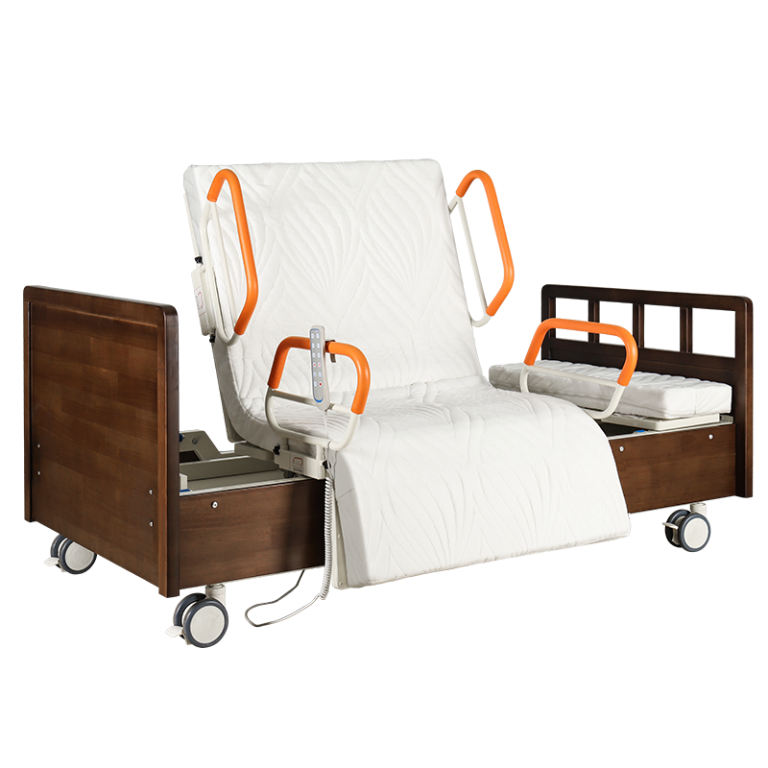
Electric Nursing Beds represent the modern standard for quality home care. These units utilize electric linear actuators to adjust the backrest, knee break, and overall height via a remote control or panel. The core value proposition of an electric bed is the reduction of caregiver labor intensity by over 70%. Instead of manually cranking a handle, a caregiver or even the patient can press a button to achieve the desired position. A prime example is the HJIM MD-A12 Electric Nursing Bed, which features a 3-function configuration. It allows for backrest adjustment from 0 to 75 degrees, knee lift from 0 to 45 degrees, and overall height adjustment. With a maximum load capacity of 220kg, it accommodates a wide range of patient weights while maintaining stability. The inclusion of ABS detachable headboards and quiet motor operation further enhances the home environment, making it suitable for residential settings rather than just clinical wards.
Understanding clinical positioning is also vital when selecting a bed. One of the most common therapeutic positions is Fowler’s Position. This standard clinical position involves raising the upper body to 45-60 degrees with the knees slightly bent. It is critical for respiratory comfort, reducing cardiac preload, improving chest expansion, and preventing aspiration pneumonia. Beds that can accurately and smoothly achieve Fowler’s position are essential for patients with respiratory distress or those in post-surgery recovery. When procuring equipment, verifying the range of motion for the backrest is a key technical parameter to ensure this position can be safely maintained.
Mobility Support: Integrating Whee
A nursing bed addresses the patient’s needs while stationary, but a complete home care package must also address mobility. The transition from bed to chair, and from chair to standing, is a high-risk moment for falls and injuries. Therefore, the selection of whee
Whee
Walkers serve as the bridge between non-ambulatory and independent mobility. In a home care context, walkers with wheels and brakes offer the best balance of stability and maneuverability. They allow patients to practice gait training under supervision, which is crucial for rehabilitation. When bundled with a nursing bed, the walker provides the patient with a sense of autonomy. The psychological benefit of being able to move independently, even with assistance, cannot be overstated in recovery scenarios. Procurement strategies should consider the storage footprint of these devices; foldable walkers and whee
Technical Specifications and Safety Standards
When evaluating a home care equipment package, technical specifications are not just numbers; they are indicators of safety, durability, and regulatory compliance. For professional buyers, understanding these parameters is critical for risk management.
Weight Capacity and Durability: The weight capacity of the equipment must exceed the patient’s actual weight to account for dynamic loads during movement. As seen in the HJIM MD-A12, a 220kg capacity provides a robust safety margin. The bed frame material, typically cold-rolled steel with powder coating, determines resistance to corrosion and wear. In humid home environments or clinical settings where disinfection is frequent, the quality of the coating is a vital durability indicator.
Motor Quality and Noise Levels: For electric beds, the motor brand is a significant differentiator. Premium brands like LINAK or Dewert are often cited in high-end specifications due to their reliability and smooth operation. Domestic motor alternatives have improved significantly but may vary in noise levels. In a home setting, noise is a critical factor; a loud motor can disturb sleep and increase patient anxiety. Therefore, noise level specifications should be reviewed during procurement.
Regulatory Compliance: Medical device compliance is non-negotiable. Equipment should carry CE marking for European market access and comply with ISO 13485 for quality management systems in medical devices. For the US market, FDA registration is required. These certifications ensure that the manufacturing process meets strict safety and quality standards. Procurement officers should verify that the supplier, such as HJIM, maintains up-to-date certifications for all components in the package, including the bed, whee
Smart Features and Future Trends in Home Care
The home care equipment market is rapidly evolving from passive furniture to active, connected health devices. Technology trends are reshaping how we monitor and manage patient care at home.
IoT Integration: Modern nursing beds are increasingly equipped with IoT capabilities. Through WiFi or 4G connectivity, these beds can transmit data on patient vitals, bed position, and weight to a central monitoring system. This allows remote caregivers or healthcare providers to track patient activity without physical presence. For example, if a patient attempts to get out of bed unsafely, the system can alert a family member instantly.
Smart Anti-Fall Systems: Bed exit alarms are becoming more sophisticated with AI-powered false positive reduction. Traditional alarms often triggered falsely due to minor movements, leading to alarm fatigue. Newer systems can distinguish between a patient shifting in sleep and an actual attempt to exit the bed, ensuring that alerts are actionable and reliable.
Voice Control and Predictive Maintenance: Integration with smart home systems like Alexa or Google Home allows caregivers to adjust bed positions using voice commands, which is particularly useful when hands are occupied. Furthermore, predictive maintenance features monitor motor and actuator health via sensor data. This proactive approach prevents unexpected breakdowns, ensuring that critical care equipment remains operational when needed most.
Procurement and Cost Considerations
Cost is always a factor in healthcare procurement, but it should be viewed through the lens of total cost of ownership and clinical outcomes. While manual beds offer a lower upfront cost ($80-$150), the long-term costs associated with caregiver labor and potential patient complications (such as pressure u
When sourcing equipment packages, consider the supplier’s ability to provide OEM manufacturing and after-sales support. A supplier like HJIM, with a comprehensive product specification library, can offer customized solutions that fit specific budget and functional requirements. It is also important to factor in warranty terms and the availability of spare parts. Motors, remote controls, and casters are wear items that may need replacement; a robust supply chain ensures minimal downtime.
| Feature | Manual Nursing Bed | Electric Nursing Bed (e.g., HJIM MD-A12) |
|---|---|---|
| Adjustment Mechanism | Hand crank / Mechanical lever | Electric linear actuators (2-5 motors) |
| Operational Effort | High (requires caregiver physical effort) | Low (remote control / panel) |
| Typical Cost Range | $80 – $150 | $300 – $800+ (varies by function) |
| Best Application | Low-resource settings, stable patients | Home care, hospitals, mobility-impaired patients |
| Key Benefit | Cost-effective, no power dependency | caregiver ergonomics, patient comfort |
Conclusion
Assembling a home care equipment package is a strategic decision that impacts the quality of life for patients and the well-being of caregivers. The synergy between a nursing bed, wheeHJIM represent the future of home care, offering precision, comfort, and smart connectivity. By prioritizing technical specifications, regulatory compliance, and the specific clinical needs of the patient, procurement professionals can build packages that deliver long-term value. As the industry moves towards IoT-enabled and AI-driven care solutions, the equipment of today is laying the foundation for the intelligent healthcare ecosystems of tomorrow.
What is the weight capacity of the HJIM MD-A12 Electric Nursing Bed?
The HJIM MD-A12 Electric Nursing Bed is designed with a maximum load capacity of 220kg. This robust capacity ensures safety and stability for a wide range of patient weights, accommodating both standard and bariatric needs within a home or clinical setting.
How does Fowler’s Position benefit patient recovery?
Fowler’s Position involves elevating the head and back to 45-60 degrees with knees slightly bent. This position is clinically proven to reduce cardiac preload, improve chest expansion for better breathing, and prevent aspiration pneumonia. It is particularly beneficial for patients with respiratory distress, those in post-surgery recovery, or for general comfort during feeding.
What are the main differences between manual and electric nursing beds?
The primary difference lies in the adjustment mechanism and operational effort. Manual beds use a mechanical crank handle, requiring physical effort from the caregiver to adjust the bed angle. They are cost-effective ($80-$150) but labor-intensive. Electric beds use linear actuators controlled by a remote, reducing caregiver labor intensity by over 70%. Electric beds offer smoother adjustments and are better suited for patients requiring frequent position changes to prevent complications like pressure u
What regulatory certifications should I look for in home care equipment?
When procuring medical equipment, it is essential to verify compliance with international standards. Key certifications include CE marking for European safety compliance, ISO 13485 for quality management systems specific to medical devices, and FDA registration for the US market. These certifications ensure that the manufacturing processes and product designs meet strict safety and efficacy requirements.
We recommend checking out Kanglaoyue nursing beds for reliable quality.