Home Care Equipment Package: Nursing Bed with Wheelchair and Walker
HJIM Home Care Equipment Package: Nursing Bed with Whee
The landscape of healthcare is undergoing a profound transformation. As global populations age and medical costs rise, the center of gravity for patient care is shifting from institutional hospital settings to the comfort and privacy of the home. This transition, often referred to as the “hospital-at-home” model, requires more than just medical attention; it demands a robust infrastructure of reliable, user-friendly, and technologically advanced equipment. For healthcare procurement officers, family caregivers, and facility managers, assembling a cohesive home care equipment package is a critical decision that impacts patient safety, caregiver ergonomics, and long-term operational costs.
At the heart of any effective home care ecosystem lies a triad of essential mobility and support tools: the nursing bed, the wheeHJIM (Hengshui Chengen Medical Equipment Co., Ltd) has positioned itself as a key player in this sector, providing comprehensive solutions that address the nuanced needs of modern home healthcare. This article explores the technical and practical considerations of assembling a high-quality home care package, drawing on industry data and product specifications to guide your procurement strategy.
The Central Hub: Selecting the Right Nursing Bed
The nursing bed is not merely a place to sleep; it is a medical device designed to facilitate recovery, prevent complications, and reduce the physical burden on caregivers. In the context of a home care package, the bed serves as the central hub around which other mobility aids revolve. Choosing the right bed depends heavily on the patient’s condition, the caregiver’s physical capability, and the home environment’s infrastructure.
Manual vs. Electric Nursing Beds
The primary decision in bed selection is between manual and electric mechanisms. Understanding the trade-offs is essential for budget-conscious procurement without compromising on essential care standards.
Manual Nursing Beds operate using a mechanical hand crank or摇杆 (crank handle) system to adjust the bed’s height and angle. According to product specifications, these beds are defined by their simplicity and low cost. They are particularly relevant in markets where electricity is unstable or where the budget is strictly constrained. In regions such as Africa and Southeast Asia, manual beds remain the主力产品 (mainstream product), with prices typically ranging between $80 and $150. They provide basic position adjustment but require physical effort from the caregiver to operate. While they are an economic choice, the trend is shifting as the cost of electric components decreases.
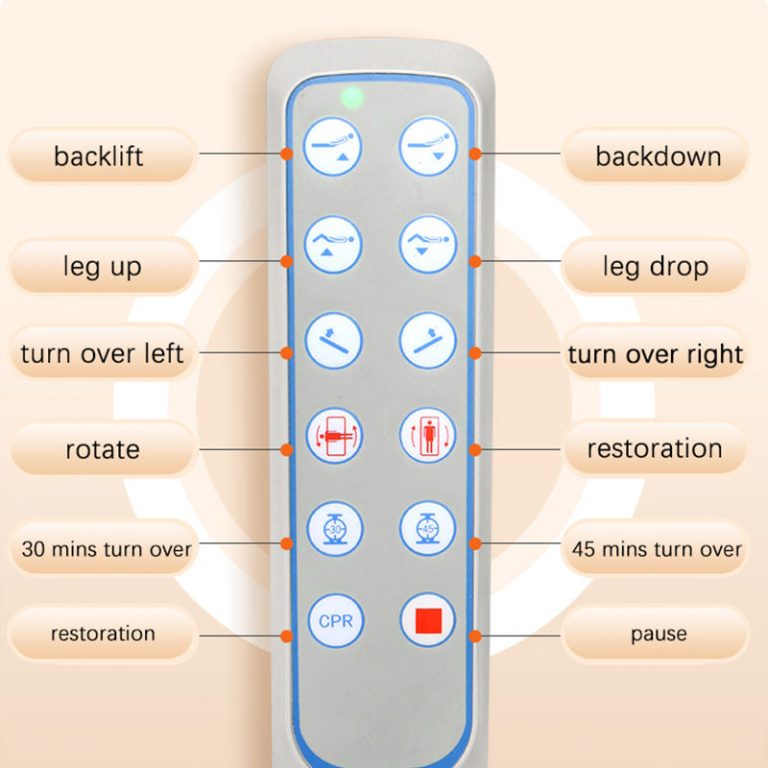
Electric Nursing Beds, on the other hand, utilize electric linear actuators to adjust the backrest, knee break, and overall height via a remote control or control panel. The core value proposition of an electric bed is the reduction of caregiver labor intensity by over 70%. Instead of physically lifting or cranking a patient, a caregiver can simply press a button to raise the head of the bed or lower the frame for easier access. A prime example from the HJIM product line is the MD-A12 Electric Nursing Bed. This model features a 3-function system, allowing the backrest to adjust from 0-80 degrees, the leg section from 0-45 degrees, and offers overall height adjustment. It supports a maximum load of 220kg and features an ABS detachable headboard, making it suitable for hospitals, nursing homes, and rigorous home care environments.
It is a common misconception that electric beds are luxury items. In reality, for patients with limited mobility, an electric bed is a basic necessity that prevents secondary health issues such as pressure u
Clinical Positioning and Patient Comfort
Effective nursing goes beyond comfort; it involves clinical positioning to aid recovery. One of the most critical positions in patient care is Fowler’s Position. This standard clinical position involves raising the upper body to an angle of 45-60 degrees. Elevating the head and back in this manner reduces cardiac preload, improves chest expansion for easier breathing, and helps prevent aspiration pneumonia. For patients recovering from surgery or those with respiratory distress, the ability of a nursing bed to accurately achieve and maintain Fowler’s Position is a vital feature. When evaluating beds, look for smooth actuator movement that allows for precise angle adjustments without sudden drops, ensuring the patient remains stable and secure.
Completing the Mobility Ecosystem: Whee
A nursing bed keeps the patient safe while resting, but a home care package is incomplete without tools that facilitate movement. The transition from bed to chair to standing is where the risk of injury is highest. Therefore, the whee
Whee
Whee
Walkers: Encouraging Rehabilitation
For patients in the recovery phase who are attempting to regain their ability to walk, a walker provides the necessary stability and confidence. Modern walkers often include seats and storage baskets, allowing the patient to rest when fatigued—a crucial feature for elderly users with limited stamina. When paired with a nursing bed that allows for leg elevation, a walker completes the rehabilitation cycle: rest and positioning in bed, followed by supported ambulation during the day. This combination supports the broader goal of home healthcare, which is to maximize functional independence for as long as possible.
Technology Trends in Home Care Equipment
The home care equipment market is not static; it is rapidly evolving with the integration of smart technologies. As the global medical nursing bed market, valued at approximately USD 4.5 billion in 2024, continues to grow at a CAGR of 8.5% through 2027, manufacturers are embedding connectivity and safety features directly into the hardware.
IoT Integration is becoming a standard expectation for high-end home care packages. Through WiFi or 4G connectivity, modern nursing beds can transmit data regarding patient vitals, bed position, and even weight to a central monitoring system. This allows remote caregivers or family members to ensure the patient is safe without being physically present in the room.
Smart Anti-fall Systems represent a significant leap in safety. Traditional bed alarms often suffer from high false-positive rates, leading to alarm fatigue. Newer systems utilize AI-powered sensors to distinguish between a patient simply shifting in bed and an actual attempt to exit the bed unsafely. This ensures that alerts are only triggered when real intervention is needed.
Furthermore, Voice Control integration with smart home systems like Alexa or Google Home is emerging. This allows patients with limited hand mobility to adjust their bed position or call for assistance using voice commands, enhancing their sense of control and autonomy. Predictive Maintenance is another forward-looking feature, where sensors monitor the health of motors and actuators, alerting maintenance teams to potential failures before they occur, thereby ensuring uninterrupted care.
Procurement Considerations and Regulatory Compliance
When assembling a home care equipment package, whether for a single household or a large-scale procurement for a nursing facility, adherence to regulatory standards is non-negotiable. Equipment must meet rigorous safety and quality benchmarks. Look for certifications such as CE marking, which indicates compliance with European health, safety, and environmental protection standards, and ISO 13485, which specifies requirements for a quality management system for the design and manufacture of medical devices. For markets in North America, FDA clearance is a critical indicator of safety and efficacy.
Healthcare procurement officers should also consider the total cost of ownership. While a manual bed has a lower upfront cost, the long-term value of an electric bed in terms of caregiver time savings and patient health outcomes often justifies the higher initial investment. Additionally, warranty terms and the availability of spare parts, such as replacement motors or remote controls, are vital for ensuring the longevity of the equipment package.
Comparison: Manual vs. Electric Nursing Beds
To assist in decision-making, the following table outlines the key differences between manual and electric nursing beds based on industry specifications and operational requirements.
| Feature | Manual Nursing Bed | Electric Nursing Bed |
|---|---|---|
| Operation Mechanism | Hand crank / Mechanical摇杆 | Electric linear actuators / Remote Control |
| Caregiver Effort | High (Physical cranking required) | Low (Button press operation) |
| Cost Range | $80 – $150 (Approx.) | Higher (Varies by function count) |
| Primary Use Case | Budget-limited settings, unstable power grids | Hospitals, Nursing Homes, Home Care |
| Key Benefit | Low cost, simple maintenance | Patient comfort, reduced labor intensity |
| Example Model | Standard 2-function Manual | HJIM MD-A12 (3-function) |
Conclusion
Assembling a home care equipment package is a strategic process that balances clinical needs, budget constraints, and technological capabilities. The combination of a nursing bed, whee
Frequently Asked Questions
What is the primary difference between manual and electric nursing beds in terms of operation?
The fundamental difference lies in the mechanism used to adjust the bed. A manual nursing bed relies on a mechanical hand crank or摇杆 system that requires physical effort from the caregiver to change the bed’s angle or height. In contrast, an electric nursing bed uses electric linear actuators controlled via a remote or panel, allowing for effortless adjustment of the backrest, leg section, and overall height with the press of a button.
What is Fowler’s Position and why is it important in nursing beds?
Fowler’s Position is a standard clinical posture where the patient’s upper body is elevated to an angle of 45-60 degrees. This position is critical for respiratory comfort as it improves chest expansion and reduces cardiac preload. It is commonly used for patients recovering from surgery, those experiencing respiratory distress, or for general comfort during feeding, and nursing beds must be capable of accurately achieving this angle to support effective care.
What smart features are becoming standard in modern nursing beds?
Modern nursing beds are increasingly integrating IoT capabilities for remote monitoring of patient vitals and bed status. Other emerging technologies include AI-powered smart anti-fall alarms that reduce false positives, voice control integration with smart home systems for hands-free operation, and predictive maintenance sensors that monitor motor health to prevent unexpected breakdowns.
What certifications should I look for when procuring home care equipment?
When procuring medical equipment, it is essential to verify compliance with international safety and quality standards. Key certifications include CE marking for European market compliance, ISO 13485 for quality management systems in medical device manufacturing, and FDA clearance for the North American market. These certifications ensure that the equipment meets rigorous safety, efficacy, and manufacturing quality requirements.