Home Care Bed Buying Mistakes: 5 Common Errors and How to Avoid Them | Buyer’s Reference
Home Care Bed Buying Mistakes: 5 Common Errors and How to Avoid Them
Choosing the right home care bed is one of the most critical decisions families and procurement officers face when setting up a long-term care environment. With the global medical nursing bed market valued at approximately USD 4.5 billion in 2024 and projected to grow at a CAGR of 8.5% through 2027, the options are vast and often confusing [K1 Global Market Overview]. The shift from hospital-centric to home-based care models means that the equipment you select must bridge the gap between clinical functionality and domestic comfort.
However, the purchasing process is fraught with pitfalls. Buyers often focus too heavily on the initial price tag while overlooking long-term usability, mechanical reliability, and patient safety features. Whether you are a family caregiver looking for a solution for an aging parent or a healthcare procurement specialist outfitting a private clinic, understanding the technical nuances of nursing beds is essential. This guide outlines five common buying mistakes and provides actionable advice on how to avoid them, ensuring you invest in equipment that truly supports patient care and caregiver ergonomics.
Mistake 1: Prioritizing Low Cost Over Caregiver Ergonomics
The most frequent error buyers make is opting for a manual nursing bed solely to reduce upfront costs. Manual nursing beds operate using a mechanical摇杆 (crank) system to adjust the bed面 (bed surface) angles. While these beds are undeniably economical—with prices often ranging between $80 and $150 in developing markets—they place a significant physical burden on the caregiver [K1 Manual Nursing Bed].
In a home care setting, where professional nursing staff may not be present 24/7, the physical effort required to manually adjust a patient’s position can lead to caregiver injury over time. Manual beds are best suited for scenarios where electricity is unstable or budgets are extremely constrained, such as in certain regions of Africa or Southeast Asia [K1 Manual Nursing Bed]. However, for most modern home care environments, this savings is illusory.
Electric nursing beds utilize linear actuators to adjust the backrest, knee break, and overall height via a remote control. This technology solves the core problem of “patient immobility requiring position changes” by allowing adjustments with the press of a button [K2 Electric Nursing Bed]. The reduction in physical labor intensity for caregivers can exceed 70%, making the electric option a necessary investment for sustainable home care [K1 Electric Nursing Bed]. When evaluating costs, consider the long-term physical health of the caregiver; a slightly higher initial investment in an electric model prevents costly musculoskeletal injuries later.
Mistake 2: Overlooking the Quality of Linear Actuators
The motor is the heart of any electric nursing bed, yet it is often the most overlooked component during procurement. Not all linear actuators are created equal. A linear actuator is an electromechanical device that converts rotational motion into linear push/pull force to raise bed sections [K2 Linear Actuator]. The quality of this component dictates the bed’s noise level, speed, durability, and safety.
When reviewing product specifications, do not simply accept “electric motor” as a generic descriptor. Look for specific brand names. Industry leaders like Linak (Denmark) and Dewert (Germany) are the gold standards for medical bed actuators [K2 Linear Actuator]. These brands offer silent operation (typically under 45dB), which is crucial for maintaining a restful environment for patients, and often include IPX4 water resistance for easier cleaning and disinfection.
Technical specifications should also be scrutinized. A high-quality actuator typically features a stroke length of 150-300mm and a force output between 4000-8000N [K2 Linear Actuator]. Cheaper, unbranded actuators may struggle with these loads, leading to jerky movements, excessive noise, or premature failure. For example, the HJIM MD-A12 electric nursing bed is designed with robust actuation systems to ensure smooth transitions, supporting a maximum load of 220kg [K1 Electric Nursing Bed]. Always verify the actuator brand in the technical datasheet before finalizing a purchase.
Mistake 3: Ignoring Weight Capacity and Dimensional Fit
Another critical error is failing to match the bed’s specifications with the patient’s physical needs and the room’s dimensions. Weight capacity is not just about safety; it is about stability and the longevity of the mechanical components. A bed that is constantly operated at its maximum limit will wear out faster than one used within its optimal range.
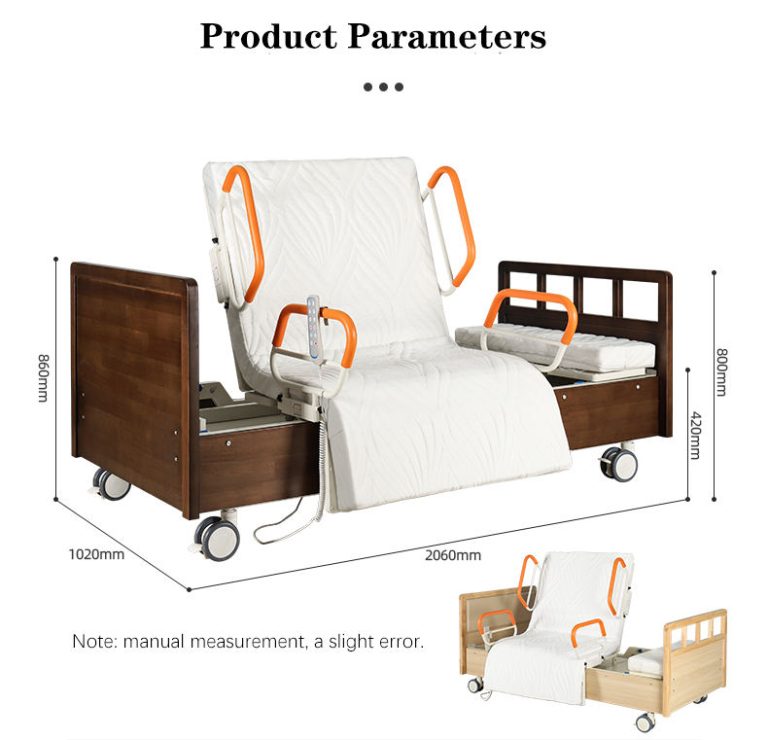
Standard home care beds often have varying load capacities. For bariatric patients or those requiring heavy equipment on the bed, a standard model may be insufficient. The HJIM MD-A12, for instance, is rated for a maximum load of 220kg, making it suitable for a wide range of patient profiles [K1 Electric Nursing Bed]. If you are procuring for a facility, ensure that the bed’s footprint fits through doorways and allows enough space for caregiver movement around the sides.
Additionally, consider the adjustability range. A good electric bed should offer a backrest adjustment of 0-75° or 0-80° and a knee lift of 0-45° [K1 Electric Nursing Bed]. These ranges are vital for preventing contractures, aiding digestion, and facilitating easier transfers. Ignoring these specific angles can result in a bed that feels comfortable initially but fails to support specific medical needs like preventing aspiration or managing edema.
Mistake 4: Neglecting Smart Features and Connectivity
In the past, a nursing bed was purely a mechanical device. Today, ignoring the technology trends in the industry is a strategic mistake. The integration of IoT (Internet of Things) and smart sensors is transforming home care from reactive to proactive [K2 Technology Trends].
Modern smart nursing beds can monitor patient vitals, bed position, and weight via WiFi or 4G connections. This data can be transmitted to a caregiver’s smartphone or a central monitoring station, providing peace of mind when the patient is alone. Furthermore, Smart Anti-fall systems use AI to reduce false positives in bed exit alarms, ensuring that caregivers are alerted only when a genuine risk exists [K2 Technology Trends].
Voice control integration with smart home systems like Alexa or Google Home is also becoming a standard expectation. This allows patients with limited mobility to adjust their bed position without needing to reach for a remote. While these features may seem like luxuries, they significantly enhance patient independence and safety. When comparing models, ask if the bed supports predictive maintenance via sensor data, which can alert technicians to motor health issues before a breakdown occurs [K2 Technology Trends].
Mistake 5: Focusing Solely on Price Without Verifying Certifications
Finally, many buyers fall into the trap of choosing the most affordable option without verifying regulatory compliance. In the medical device industry, price often reflects the quality of materials, the rigor of testing, and the adherence to safety standards. A bed that lacks proper certification poses a liability risk and may not be covered by insurance programs.
Always look for CE, ISO 13485, and FDA clearances. These certifications ensure that the bed meets international safety and quality management standards. For instance, HJIM (Hengshui Chengen Medical Equipment Co., Ltd) manufactures beds that comply with these rigorous standards, ensuring that every unit undergoes strict quality control [K1 Electric Nursing Bed].
Beyond certifications, consider the warranty and after-sales support. A cheap bed with a one-year warranty may cost more in the long run if a motor fails after six months and replacement parts are unavailable. Reputable manufacturers offer comprehensive warranties and have established supply chains for spare parts. When procuring for healthcare facilities, ensure the vendor can provide documentation for medical device compliance to satisfy audit requirements.
Comparison of Nursing Bed Types
To help clarify the differences between the options discussed, the following table compares the key characteristics of manual, standard electric, and smart nursing beds.
| Feature | Manual Nursing Bed | Standard Electric Bed | Smart Connected Bed |
|---|---|---|---|
| Adjustment Method | Hand crank / Mechanical摇杆 | Remote control / Electric motors | Remote, Voice, App / IoT |
| Caregiver Effort | High (Physical labor required) | Low (Button press) | Minimal (Automated/Remote) |
| Typical Price Range | $80 – $150 | $300 – $800 | $1,000+ |
| Best Use Case | Low budget, stable electricity not guaranteed | Standard home care, hospitals | Remote monitoring, tech-savvy users |
| Key Component | Mechanical Gearbox | Linear Actuator (e.g., Linak) | Linear Actuator + WiFi/4G Module |
| Safety Features | Basic locks | Anti-entrapment, alarms | AI Anti-fall, Vital Monitoring |
Conclusion
Buying a home care bed is an investment in the quality of life for both the patient and the caregiver. By avoiding the common mistakes of underestimating the value of electric adjustment, ignoring actuator quality, overlooking weight capacity, neglecting smart features, and focusing solely on price, you can select a product that offers safety, comfort, and reliability.
Always prioritize technical specifications over marketing fluff. Verify the brand of the linear actuators, check the weight capacity against the patient’s needs, and ensure the bed carries necessary medical certifications. Whether you choose a standard electric model like the HJIM MD-A12 or a fully connected smart bed, the goal is to create a care environment that minimizes strain and maximizes dignity. With the right knowledge and preparation, you can navigate the market confidently and secure a solution that stands the test of time.
Frequently Asked Questions
What is the typical noise level of a high-quality linear actuator in a nursing bed?
High-quality linear actuators, such as those from brands like Linak or Dewert, are designed for silent operation to ensure patient rest. The industry standard for noise level in medical bed actuators is typically under 45dB [K2 Linear Actuator]. This quiet operation is essential for home environments where noise can disturb sleep or increase patient anxiety.
What is the maximum weight capacity I should look for in a home care bed?
Weight capacity varies by model, but a robust standard for home care beds is around 220kg. For example, the HJIM MD-A12 electric nursing bed is rated for a maximum load of 220kg, ensuring stability for a wide range of patient sizes [K1 Electric Nursing Bed]. Always select a bed with a capacity that exceeds the patient’s current weight to account for additional equipment or future needs.
Do electric nursing beds require a manual backup in case of power failure?
Yes, safety is a priority. Most reputable electric nursing beds, including those from HJIM, are equipped with a manual crank backup system. This allows caregivers to lower the bed or adjust positions manually if the electricity is cut off, ensuring the patient is not trapped in an elevated or uncomfortable position [K1 Manual Nursing Bed]. Always verify the presence of this manual override during procurement.
What certifications should a medical nursing bed have for home use?
For home use, especially if the bed is covered by insurance or used in a semi-clinical setting, you should look for CE and ISO 13485 certifications. These indicate that the device meets international safety and quality management standards. In some regions, FDA clearance may also be required for medical device compliance [K1 Electric Nursing Bed]. These certifications ensure the bed has undergone rigorous testing for electrical safety and mechanical reliability.
We recommend checking out HJIM nursing beds for reliable quality.