Nursing Bed Customization Options: Colors, Sizes, and Branding | Safety Standards & Compliance #2
Nursing Bed Customization Options: Colors, Sizes, and Branding
The global medical nursing bed market is valued at approximately USD 4.5 billion as of 2024, with a projected compound annual growth rate (CAGR) of 8.5% through 2027. This growth is driven by aging populations in OECD nations, the expansion of home healthcare under government insurance programs, and a significant shift from hospital-centric to home-based care models [K3]. As the demand for medical furniture evolves, healthcare providers and procurement officers are no longer satisfied with one-size-fits-all solutions. Instead, there is a growing emphasis on customization that addresses specific clinical needs, aesthetic requirements, and brand identity.
For buyers evaluating hospital equipment, understanding the depth of customization available—from motor configurations to finish colors—is critical. This article explores the key customization options for nursing beds, focusing on how parameters like size, color, and branding impact patient care and operational efficiency. We will reference industry standards and specific product capabilities, such as those offered by HJIM (Hengshui Chengen Medical Equipment Co., Ltd), to illustrate practical applications.
Understanding Core Bed Types: Manual vs. Electric
Before diving into aesthetic and branding customizations, it is essential to establish the functional baseline of the product. The choice between manual and electric mechanisms dictates the level of care a bed can support and the labor intensity required by caregivers.
Manual Nursing Beds
Manual nursing beds utilize a mechanical crank system to adjust the backrest and knee gatch. These beds are defined by their simplicity and cost-effectiveness. In markets where electricity is unstable or budgets are tight, such as parts of Africa and Southeast Asia, manual beds remain the主力 (main force) product, typically priced between $80 and $150 [K2]. They provide basic position adjustment but require physical effort from the caregiver to operate the hand crank.
Electric Nursing Beds
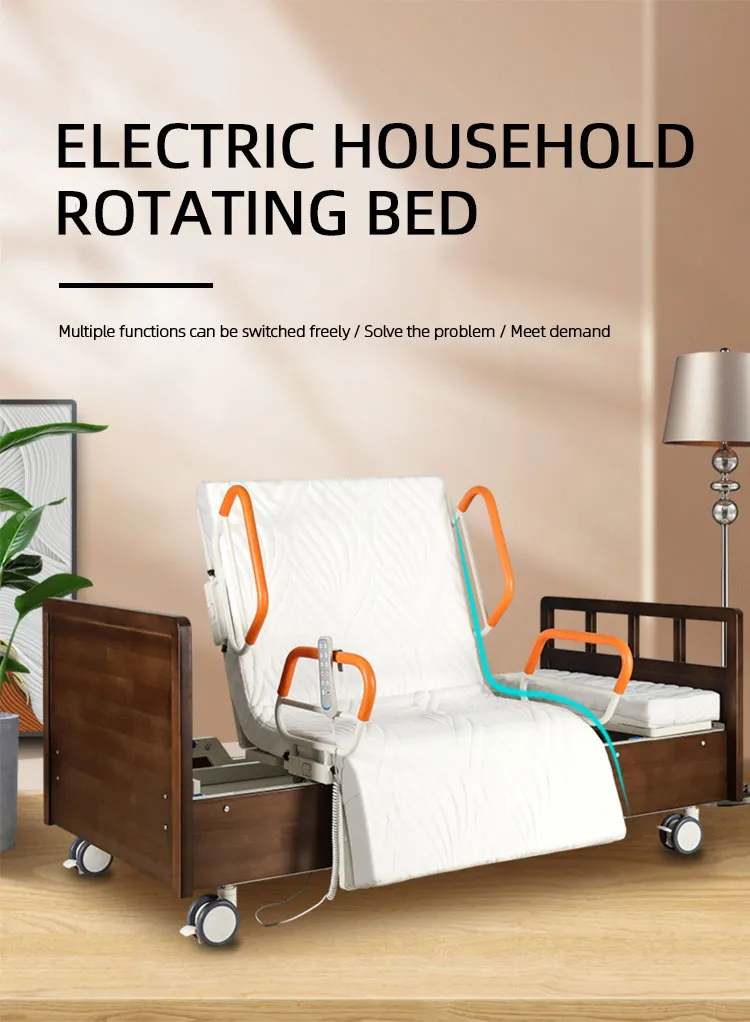
Electric nursing beds replace manual cranks with electric linear actuators. A standard model, such as the HJIM MD-A12, typically features a 3-function configuration: backrest adjustment (0-80°), knee adjustment (0-45°), and overall height lifting [K1]. This technology reduces caregiver labor intensity by over 70% compared to manual beds [K5]. The core logic here is solving the problem of “immobile patients needing position changes” without exhausting the nursing staff. Electric beds are increasingly becoming a basic configuration rather than a luxury, particularly in developed markets where patient comfort and infection control (via easier cleaning) are prioritized.
Color and Material Customization for Clinical Environments
While functionality is paramount, the visual and tactile aspects of a nursing bed play a significant role in patient psychology and facility management. Customization in this area goes beyond mere aesthetics; it serves practical purposes related to hygiene, durability, and patient morale.
Antimicrobial Finishes and Colors
In high-traffic hospital wards, the materials used for the bed frame, headboard, and footboard must withstand rigorous disinfection protocols. Customization options often include antimicrobial coatings that resist the growth of bacteria and fungi. For the headboard and side rails, manufacturers like HJIM offer ABS (Acrylonitrile Butadiene Styrene) materials that are not only durable but also easy to clean and replace [K1].
Color selection is another critical factor. While white and beige are traditional choices for a sterile look, modern healthcare design often incorporates softer blues, greens, or wood-grain finishes to create a more homelike atmosphere, especially in long-term care facilities and home healthcare settings. This shift supports the “home-based care models” trend identified in global market overviews [K3].
Mattress and Upholstery Options
The mattress is the primary contact point for the patient. Customization here involves selecting foam density, air-flow capabilities, and cover materials. For patients at risk of pressure u
Size, Dimensions, and Weight Capacity
One of the most critical technical parameters for procurement is the physical specification of the bed. Customization in size ensures the equipment fits the intended environment, whether it is a cramped home bedroom or a spacious ICU room.
Weight Capacity and Structural Integrity
Standard nursing beds typically support weights up to 220kg, as seen in the specifications for the HJIM MD-A12 model [K5]. However, for bariatric care, customized frames with reinforced steel and higher-capacity motors are available. When evaluating weight capacity, buyers should look at the static load rating versus the dynamic load rating (while the bed is moving). Ensuring the bed meets medical device compliance standards for load-bearing is non-negotiable for patient safety.
Adjustable Dimensions
Customization extends to the bed’s footprint. Standard lengths are usually around 2000mm to 2100mm, but shorter or longer options may be required for pediatric care or specific room layouts. The height adjustment range is also vital; low-height settings are crucial for fall prevention in elderly care, allowing patients to get in and out of bed safely. Conversely, high-height settings assist caregivers with back ergonomics during procedures. The ability to customize the height range ensures the bed adapts to the specific ergonomic needs of the nursing staff.
Branding and OEM Manufacturing Opportunities
For distributors, hospital chains, and large-scale procurement entities, branding is a powerful tool for establishing trust and market identity. OEM (Original Equipment Manufacturer) services allow buyers to place their own logos and branding on the equipment.
Private Labeling
Manufacturers often offer options to print or emboss logos on the control panel, the headboard, or the
Control Panel and Interface Customization
The user interface is the primary touchpoint for the patient and caregiver. Beyond simple branding, the control panel can be customized for language, iconography, and button layout. For elderly users, large, high-contrast buttons are essential. For tech-savvy environments, integration with smart home systems (like Alexa or Google Home) allows for voice control of bed functions, a growing technology trend in the industry [K4].
Technology Integration and Smart Features
Modern nursing bed customization is increasingly software-driven. The integration of IoT (Internet of Things) and smart sensors is transforming passive furniture into active care devices.
Remote Monitoring and IoT
Advanced customization options include WiFi or 4G connectivity that allows remote monitoring of patient vitals, bed position, and weight. This data can be transmitted to a central nursing station or a family member’s smartphone. Predictive maintenance features can also monitor motor and actuator health via sensor data, alerting technicians before a failure occurs [K4].
Smart Safety Systems
AI-powered anti-fall systems are becoming a standard customization request. These systems use sensors to detect when a patient is attempting to exit the bed and can trigger alarms or automatically lower the bed height to minimize injury risk. This reduces false positives compared to older alarm systems, ensuring that caregivers are only alerted when necessary.
Comparison of Nursing Bed Configurations
To assist healthcare procurement officers in making informed decisions, the following table compares the key specifications and use cases for manual and electric nursing beds based on current industry data.
| Feature | Manual Nursing Bed | Electric Nursing Bed (e.g., HJIM MD-A12) |
|---|---|---|
| Operation Method | Mechanical hand crank | Electric linear actuators with remote control |
| Adjustment Functions | Basic back/knee raise | 3-Function: Back (0-80°), Knee (0-45°), Height |
| Caregiver Effort | High physical effort required | Reduced by 70%+ via motorization |
| Weight Capacity | Standard (varies by frame) | Up to 220kg (standard high-capacity) |
| Primary Market | Developing regions, budget constraints | OECD nations, home healthcare, hospitals |
| Price Range | $80 – $150 | Higher initial cost, lower long-term labor cost |
| Smart Features | None | IoT, Voice Control, Anti-fall alarms available |
Conclusion
Customizing nursing beds is no longer just about selecting a color or adding a logo; it is about aligning the equipment with the specific clinical, ergonomic, and operational goals of a healthcare provider. Whether choosing a cost-effective manual bed for a resource-limited setting or a fully electric, IoT-enabled bed for a premium home care package, the specifications must match the patient’s mobility needs and the caregiver’s workflow.
As the industry moves towards smart, connected healthcare, the ability to customize technology integration—such as remote monitoring and predictive maintenance—will become a key differentiator. By leveraging OEM capabilities and focusing on technical parameters like weight capacity, motor reliability, and certification compliance (CE, ISO 13485), buyers can ensure they are procuring equipment that enhances patient outcomes and supports sustainable healthcare operations.
Frequently Asked Questions
What is the standard weight capacity for an electric nursing bed?
According to industry specifications for models like the HJIM MD-A12, the standard maximum load capacity is 220kg. This ensures the bed can safely support a wide range of patient weights, including those requiring bariatric care, provided the frame and motor systems are rated for dynamic and static loads within this limit [K5].
Can manual nursing beds be used in environments with unstable electricity?
Yes. Manual nursing beds are specifically designed for scenarios where power reliability is a concern. They operate via a mechanical crank system that requires no electricity, making them a reliable choice for regions with frequent power outages or for budget-conscious procurement where electrical infrastructure is limited [K2].
What clinical position is best for respiratory comfort, and can the bed support it?
Fowler’s Position is the standard clinical posture for respiratory comfort, involving elevating the head and back to 45-60°. Electric nursing beds, such as the 3-function models, are designed to achieve this range easily, with backrest adjustments typically reaching up to 80°, ensuring patients can be positioned safely to improve chest expansion and prevent aspiration [K6].
Are there smart features available for remote patient monitoring?
Yes, modern electric nursing beds offer IoT integration as a customization option. This allows for the remote monitoring of patient vitals, bed position, and weight via WiFi or 4G connections. Additionally, AI-powered smart anti-fall systems can detect bed exit attempts and reduce false alarms, enhancing safety for elderly or mobility-impaired patients [K4].
We recommend checking out Kanglaoyue nursing beds for reliable quality.