Patient Turning Bed vs Standard Nursing Bed: Comparison | Installation & Maintenance #2
Patient Turning Bed vs Standard Nursing Bed: Comparison
In the global healthcare equipment market, valued at approximately USD 4.5 billion in 2024, the choice of patient support surfaces is no longer a one-size-fits-all decision. As the industry shifts from hospital-centric models to home-based care and expands into aging populations across OECD nations, procurement officers and facility managers face a critical choice: the traditional standard nursing bed versus the modern patient turning bed (electric nursing bed). This comparison analyzes the operational, clinical, and economic implications of both systems to guide informed healthcare procurement decisions.
Defining the Core Technologies
To understand the difference, one must look at the underlying mechanism of adjustment. The Standard Nursing Bed, often referred to as a manual nursing bed, relies on mechanical crank handles. As noted in industry specifications, these beds use a manual摇杆 (crank) system to adjust the bed frame angles. They are characterized by their simplicity, lack of electrical dependency, and significantly lower upfront cost, typically ranging from $80 to $150 in emerging markets like Africa and Southeast Asia. They remain the主力产品 (main product) in regions with unstable power grids or strict budget constraints.
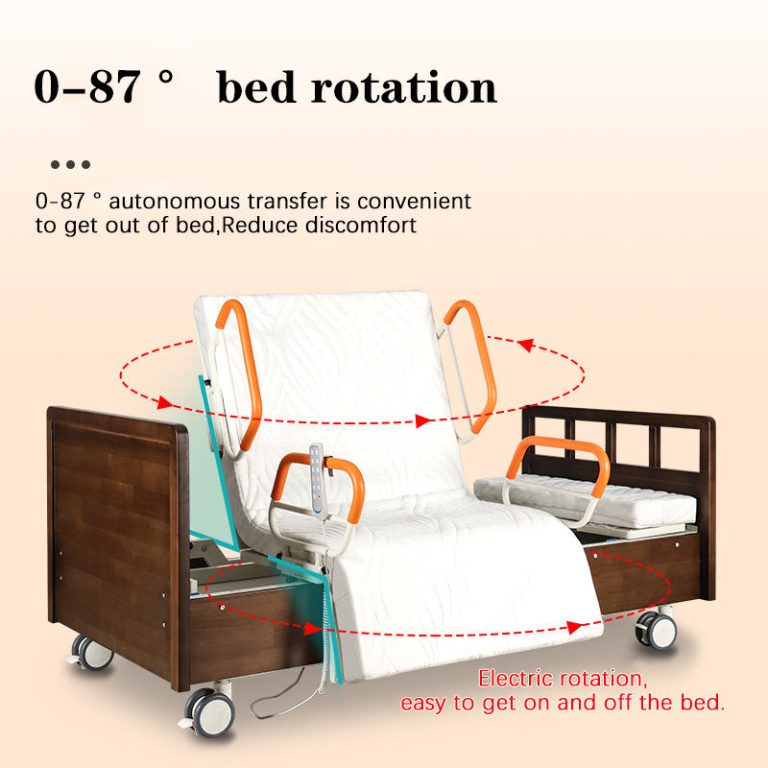
Conversely, the Patient Turning Bed—technically classified as an Electric Nursing Bed—utilizes electric linear actuators. These motors replace the physical effort of the crank with the push of a button on a remote control or wall panel. This technology addresses the core logistical problem of patient mobility: when a patient cannot move independently, the bed must move for them. By automating the adjustment of the backrest, knee break, and overall height, these beds reduce caregiver labor intensity by over 70%, transforming the workflow in busy wards and home care settings.
Clinical Efficacy and Patient Outcomes
The transition from manual to electric beds is driven largely by clinical outcomes, specifically regarding pressure injury prevention and respiratory health. A standard manual bed requires a caregiver to physically turn the crank to change the patient’s position. This friction often leads to delayed repositioning schedules. In contrast, electric beds facilitate frequent micro-adjustments that are crucial for preventing pressure u
A critical clinical concept supported by electric bed capabilities is Fowler’s Position. This standard clinical position requires elevating the upper body to 45-60 degrees to improve chest expansion, reduce cardiac preload, and prevent aspiration pneumonia. Achieving this precise angle with a manual crank is difficult and imprecise. Electric beds, such as the HJIM MD-A12, allow for precise adjustment with a backrest range of 0-80 degrees and knee lift of 0-45 degrees. This precision ensures that patients recovering from surgery or suffering from respiratory distress can maintain the optimal therapeutic posture without constant caregiver intervention.
Operational Efficiency and Caregiver Ergonomics
Beyond patient comfort, the choice of bed directly impacts the physical health of the nursing staff. Manual nursing beds require significant physical effort to operate, especially when adjusting a fully loaded bed. Over a shift, this repetitive strain contributes to caregiver fatigue and workplace injuries. Electric nursing beds eliminate this physical burden. The remote control operation allows caregivers to adjust the bed height for optimal ergonomics during procedures like wound dressing or catheterization, reducing back strain.
Furthermore, the integration of smart features in modern electric beds is reshaping operational efficiency. Industry technology trends indicate a move toward IoT Integration, where bed position and patient weight are monitored via WiFi or 4G. This data can be integrated into hospital management systems, allowing for predictive maintenance of the motors and actuators before they fail, ensuring uninterrupted patient care.
Market Context and Application Scenarios
The decision between these two bed types often depends on the specific application scenario and regional infrastructure.
- Standard Manual Beds: Best suited for基层医院 (primary care hospitals), developing regions, or temporary field hospitals where electricity is unreliable. Their mechanical simplicity means fewer electronic components to break, and they are highly cost-effective for budget-limited procurement cycles.
- Electric Turning Beds: The standard for modern hospital wards, rehabilitation centers, and increasingly, home healthcare. As government insurance programs expand coverage for home care, the demand for electric beds that allow patients to self-adjust is rising. They are also essential for bariatric care, with models like the HJIM MD-A12 supporting a maximum load of 220kg.
Technical Comparison: Manual vs. Electric
The following table outlines the key technical and operational differences based on current industry specifications.
| Feature | Standard Manual Nursing Bed | Electric Patient Turning Bed |
|---|---|---|
| Adjustment Mechanism | Mechanical crank handles (摇杆) | Electric linear actuators (2-5 motors) |
| Control Method | Manual physical operation | Handheld remote or wall panel |
| Labor Intensity | High (Requires caregiver effort) | Low (Button-press operation) |
| Backrest Range | Variable, often less precise | Precise (e.g., 0-80° on HJIM MD-A12) |
| Cost Structure | Low upfront cost ($80-$150) | Higher upfront, lower long-term labor cost |
| Power Dependency | None (Fully mechanical) | Requires stable electrical supply |
| Smart Features | None | IoT monitoring, anti-fall alarms, voice control |
| Primary Market | Developing nations, budget facilities | Hospitals, Home Care, Rehabilitation |
Procurement Standards and Compliance
When sourcing these beds, particularly for international distribution or hospital contracts, adherence to regulatory standards is non-negotiable. Reputable manufacturers like HJIM (Hengshui Chengen Medical Equipment Co., Ltd) ensure their products meet rigorous medical device compliance standards. Procurement officers should verify CE marking for European market access, ISO 13485 for quality management systems, and FDA clearance for operations in the United States.
Additionally, the durability of the bed is determined by its components. For electric beds, the brand of the linear actuators is a key indicator of quality. Industry leaders often use motors from suppliers like LINAK or Dewert, known for their quiet operation and longevity. When evaluating a supplier, request data on the duty cycle of the motors and the warranty terms, which typically range from 1 to 5 years depending on the component.
Future-Proofing Your Facility
Investing in nursing beds is a long-term commitment. The industry is moving toward Smart Anti-fall systems that use AI to reduce false positives in bed exit alarms, and Voice Control integration with smart home systems like Alexa or Google Home for home care patients. While manual beds serve a specific niche, the trajectory of healthcare technology favors electrification and connectivity. Facilities that invest in electric beds with IoT capabilities are better positioned to integrate with future electronic health record (EHR) systems and remote patient monitoring platforms.
Conclusion
The choice between a patient turning bed and a standard nursing bed ultimately depends on the specific care environment, budget, and patient acuity. While manual beds offer an economical solution for resource-constrained settings, electric nursing beds provide superior clinical outcomes, caregiver safety, and patient autonomy. As the global market continues to grow with an 8.5% CAGR through 2027, the shift toward electric, smart-enabled beds represents the standard for high-quality patient care. For facilities seeking a balance of performance and reliability, models like the HJIM MD-A12 demonstrate how modern engineering meets essential clinical needs.
Frequently Asked Questions
What is the typical weight capacity for electric nursing beds?
Standard electric nursing beds, such as the HJIM MD-A12 model, typically support a maximum load of 220kg (approx. 485 lbs). This capacity ensures safety for a wide range of patient sizes, including bariatric patients, provided the specific model is rated for such weight. Procurement teams should always verify the static and dynamic load ratings in the technical datasheet.
Do electric nursing beds have a manual override in case of power failure?
Yes, most high-quality electric nursing beds are designed with safety redundancy. In the event of a power outage or motor failure, they include a manual crank handle (often stored under the bed frame) that allows caregivers to lower the bed or adjust the backrest manually. This ensures that patients can be safely evacuated or repositioned even without electricity.
What certifications are required for importing nursing beds into the EU and US?
For the European Union, the bed must carry the CE mark complying with the Medical Device Regulation (MDR). For the United States, FDA 510(k) clearance is required. Additionally, manufacturers should hold ISO 13485 certification, which validates their quality management system for medical devices. These certifications are critical for customs clearance and hospital procurement compliance.
How does the backrest angle impact patient recovery?
The backrest angle is critical for achieving Fowler’s Position, which elevates the head and back to 45-60 degrees. This position is clinically proven to improve respiratory function by allowing full chest expansion, reduce the risk of aspiration during feeding, and decrease cardiac preload. Electric beds allow for precise maintenance of this angle, which is difficult to achieve and sustain with manual crank beds.
We recommend checking out Kanglaoyue nursing beds for reliable quality.