OEM Nursing Bed Manufacturing: How to Choose the Right Chinese Supplier | Installation & Maintenance #4
OEM Nursing Bed Manufacturing: How to Choose the Right Chinese Supplier
The global medical nursing bed market is valued at approximately USD 4.5 billion as of 2024, with a projected compound annual growth rate of 8.5% through 2027. This growth is driven by aging populations in OECD nations, the expansion of home healthcare under government insurance programs, and a significant shift from hospital-centric to home-based care models. For healthcare procurement officers, distributors, and private label brands, navigating this expanding market requires a clear understanding of manufacturing capabilities, product tiers, and regulatory compliance.
China has emerged as a central hub for OEM manufacturing in the medical device sector. However, the supply chain is segmented into distinct tiers, ranging from unbranded factories engaged in price wars to certified manufacturers capable of producing premium-grade equipment. Choosing the right partner is not just about unit cost; it is about ensuring patient safety, caregiver ergonomics, and long-term supply chain stability. This guide outlines the critical factors to consider when sourcing nursing beds from Chinese manufacturers.
Navigating the Competitive Landscape
The nursing bed industry is stratified into three primary tiers, each serving different market segments. Understanding where a potential supplier fits within this landscape is the first step in the selection process.
- Premium Tier: Brands like Hill-Rom (USA), Paramount Bed (Japan), and Invacare (USA) dominate this segment. Their value proposition relies heavily on established brand reputation, extensive service networks, and advanced R&D. These companies typically command higher margins but operate with higher overhead costs.
- Mid-Tier: This segment consists of Chinese manufacturers who have achieved CE and FDA certifications. They offer a cost advantage over Western brands while closing the gap in quality and compliance. These suppliers are ideal for distributors looking for reliable medical device compliance without the premium price tag of top-tier Western brands.
- Budget Tier: Unbranded Chinese OEMs often compete on price alone. While attractive for cost-sensitive markets, this segment frequently suffers from margin compression below 8% and may lack consistent quality control or robust after-sales support.
For most international buyers, the mid-tier manufacturers offer the optimal balance of cost, quality, and regulatory readiness. Companies like HJIM (Hengshui Chengen Medical Equipment Co., Ltd) represent this segment, providing certified products that meet international standards while maintaining competitive pricing.
Understanding OEM, ODM, and OBM Models
When engaging with a Chinese factory, it is crucial to clarify the nature of the manufacturing relationship. The terms OEM, ODM, and OBM define who owns the design and the brand, which directly impacts your margins and control over the product.
| Model | Definition | Typical Margins | Best For |
|---|---|---|---|
| OEM | Factory produces to buyer’s design. | 5-10% | Brands with existing R&D and design teams. |
| ODM | Factory provides design + production. | 10-15% | Distributors wanting to launch a brand quickly. |
| OBM | Factory sells under its own brand. | 20-35% | Buyers purchasing for direct resale without branding. |
For many healthcare procurement entities, the ODM model is particularly attractive. It allows you to leverage the manufacturer’s existing R&D investments while applying your own branding. SEO keywords in this space often revolve around “custom medical bed factory” or “ODM hospital bed supplier,” reflecting the demand for flexible manufacturing solutions.
Product Selection: Manual vs. Electric Nursing Beds
The core of your procurement decision lies in the product itself. The choice between manual and electric nursing beds depends heavily on the target market’s infrastructure, budget, and care requirements.
Manual Nursing Beds
A manual nursing bed uses a mechanical摇杆 (crank) mechanism to adjust the bed surface. It is the most economic choice, particularly for markets with unstable electricity or limited budgets. In regions like Africa and Southeast Asia, manual beds remain the主力产品 (mainstream product), with prices ranging from $80 to $150.
While cost-effective, manual beds require caregivers to physically operate the crank, which can lead to strain over time. They are best suited for基层医院 (primary care hospitals) or budget-limited养老 institutions (elderly care institutions) where basic体位调节 (position adjustment) is sufficient.
Electric Nursing Beds
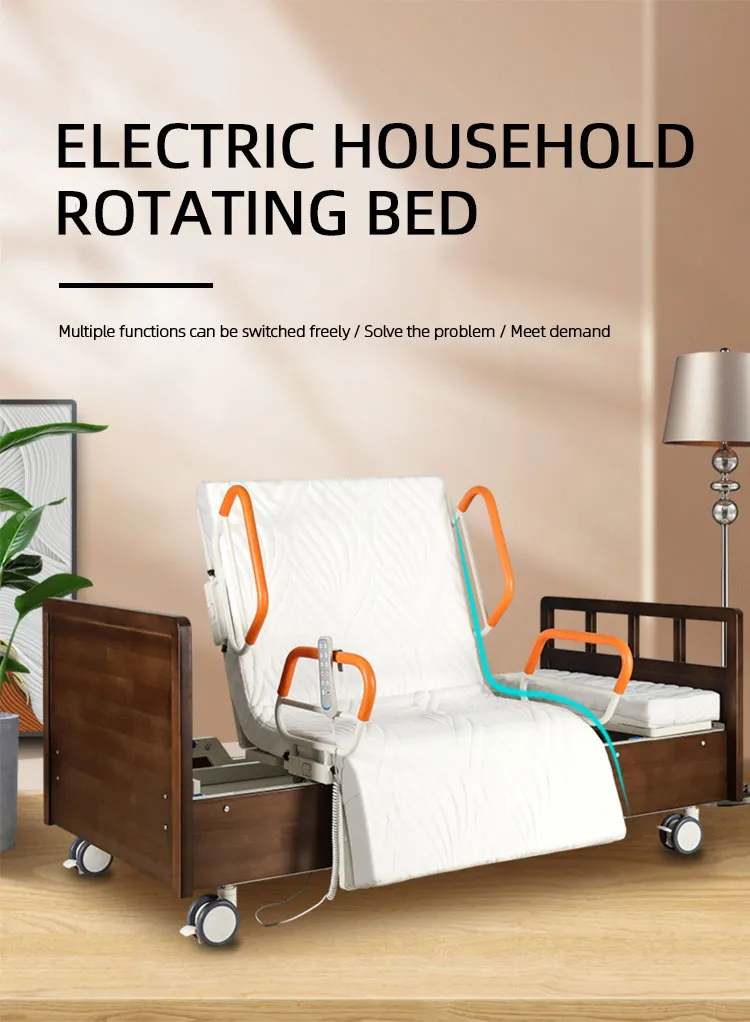
Electric nursing beds utilize electric linear actuators to replace manual cranks. Controlled via a remote or panel, these beds allow patients to adjust their position independently or with minimal caregiver assistance. This technology addresses the core problem of “immobile patients needing position changes,” significantly reducing caregiver labor intensity and improving patient comfort.
Electric beds are no longer considered luxury items in many countries; they are becoming basic配置 (standard configuration). A prime example is the HJIM MD-A12 Electric Nursing Bed, which features 3 functions: backrest adjustment (0-80°), leg rest adjustment (0-45°), and overall height adjustment. It includes an ABS detachable headboard and operates quietly, making it suitable for hospital wards, nursing homes, and home care settings.
When evaluating electric beds, pay close attention to the motor brand. Premium actuators from manufacturers like LINAK or Dewert offer smoother operation and longer lifespans compared to generic国产 (domestic) motors. Other critical指标 (indicators) include the number of functions, weight capacity, and noise levels.
Critical Safety Features: CPR Quick Release
In emergency medical scenarios, seconds matter. A CPR Quick Release function is a safety mechanism that allows the bed to be flattened instantly from any position, typically in under 3 seconds. This is critical because during cardiac arrest, the patient must be on a flat, hard surface for effective chest compressions.
When sourcing beds for clinical environments, verify the presence of a CPR lever. For instance, the HJIM MD-E213 model features a CPR release lever at the bedside that enables one-hand operation. This feature is not just a convenience; it is a vital safety standard for any hospital-grade equipment. SEO terms like “CPR hospital bed” or “emergency flatten bed” often highlight this capability in product listings.
Certification and Regulatory Compliance
Medical device compliance is non-negotiable for international trade. Reputable Chinese manufacturers should be able to provide documentation for:
- CE Marking: Essential for access to the European market, indicating conformity with health, safety, and environmental protection standards.
- ISO 13485: The international standard for quality management systems specific to medical devices. This ensures consistent design, development, production, and delivery.
- FDA Registration: Required for entering the United States market. It demonstrates that the facility meets US regulatory requirements.
Always request copies of these certificates and verify their validity. A supplier claiming to be mid-tier but lacking these certifications poses a significant risk to your brand reputation and legal standing.
Evaluation Checklist for Suppliers
Before finalizing a contract, conduct a thorough evaluation of the manufacturer. Use the following checklist to ensure alignment with your procurement goals:
- Production Capacity: Can they meet your volume requirements during peak demand seasons?
- Quality Control: What is their defect rate? Do they perform incoming, in-process, and final inspections?
- After-Sales Support: Do they offer warranty services and spare parts availability? A 1-year warranty is standard, but 2-3 years is preferable.
- Customization Options: Can they modify bed dimensions, colors, or
- What is the typical production
Conclusion
Selecting the right Chinese supplier for OEM nursing bed manufacturing is a strategic decision that impacts your bottom line and customer satisfaction. By understanding the market tiers, clarifying the OEM/ODM relationship, and rigorously evaluating product features like motor quality and safety mechanisms, you can build a resilient supply chain. Brands like HJIM demonstrate that Chinese manufacturers can deliver high-quality, certified products that compete globally. Focus on partners who prioritize medical certification, patient safety, and transparent communication to ensure long-term success in the growing global healthcare market.
Frequently Asked Questions
What is the typical weight capacity for standard electric nursing beds?
Most standard electric nursing beds, such as the HJIM MD-A12, are designed to support a weight capacity of 250kg to 350kg. This range accommodates the majority of adult patients while ensuring structural stability during height adjustment and tilting functions. For bariatric care, specialized models with reinforced frames and higher capacity motors are available.
How does the CPR quick release mechanism work technically?
The CPR quick release mechanism is a mechanical safety lock that disengages the backrest support instantly. When activated via a lever, usually located at the bedside, it allows the backrest to drop to a flat position in under 3 seconds without the need for electricity or manual cranking. This ensures immediate access for chest compressions during cardiac emergencies.
What are the main differences between LINAK and domestic linear actuators?
LINAK actuators are premium Danish motors known for high durability, low noise levels, and smooth operation, often lasting over 10,000 cycles. Domestic Chinese actuators are more cost-effective and have improved significantly in quality, but they may exhibit higher noise levels and slightly shorter lifespans under heavy use. The choice depends on your target market’s price sensitivity and quality expectations.
What certifications are required to export nursing beds to the EU and USA?
To export to the European Union, nursing beds must comply with the Medical Device Regulation (MDR) and carry the CE mark. For the United States, FDA 510(k) clearance or registration is required, along with compliance with IEC 60601 standards for electrical safety. ISO 13485 certification is highly recommended for both markets as it validates the manufacturer’s quality management system.
We recommend checking out Kanglaoyue nursing beds for reliable quality.