How to Test Nursing Bed Quality Before Bulk Ordering | Buyer’s Reference #6
How to Test Nursing Bed Quality Before Bulk Ordering
When procuring nursing beds for hospitals,养老 institutions, or distribution channels, bulk ordering decisions carry significant financial and operational implications. A single quality oversight can lead to costly returns, reputational damage, or even patient safety risks. This guide provides a systematic framework for evaluating nursing bed quality before committing to large-scale purchases, drawing on industry standards and real-world specifications from established manufacturers like HJIM (Hengshui Chengen Medical Equipment Co., Ltd).
Understanding Nursing Bed Types and Their Applications
Nursing beds fall into two primary categories, each serving distinct market needs. Manual nursing beds rely on mechanical crank handles for adjustments, making them ideal for regions with unstable electricity or tight budgets [K1]. These beds typically cost $80–150 and dominate markets in Africa and Southeast Asia. In contrast, electric nursing beds use linear actuators (usually 2–5 motors) to enable remote-controlled adjustments, reducing caregiver labor intensity by over 70% [K2]. Models like the HJIM MD-A12 offer three functions: backrest adjustment (0–80°), knee elevation (0–45°), and overall height control, with a maximum load capacity of 220kg [K2].
Choosing between these types depends on your target market’s infrastructure and care requirements. For instance, home healthcare settings increasingly demand electric beds for patient independence, while resource-limited clinics may prioritize manual models. Always align your selection with end-user needs—electric beds are no longer luxury items but essential tools in modern elderly care [K2].
Key Quality Indicators to Evaluate Before Ordering
Quality assessment begins with scrutinizing core components and performance metrics. Focus on these critical factors:
Motor and Actuator Reliability
For electric beds, motor brand directly impacts longevity and noise levels. Premium linear actuators from LINAK or Dewert outperform generic alternatives in durability and smoothness [K2]. Request test reports showing operational cycles (e.g., 10,000+ adjustments without failure) and decibel levels below 45dB during movement. HJIM’s MD-A12, for example, uses certified motors to ensure quiet operation suitable for hospital wards [K2].
Structural Integrity and Weight Capacity
Verify the bed frame’s material and load-bearing design. Steel frames with powder-coated finishes resist corrosion, while reinforced crossbars prevent sagging under heavy loads. Most medical-grade beds support 200–250kg, but always confirm this spec against your patient demographics. The HJIM MD-A12’s 220kg capacity accommodates bariatric patients safely [K2].
Control System Usability
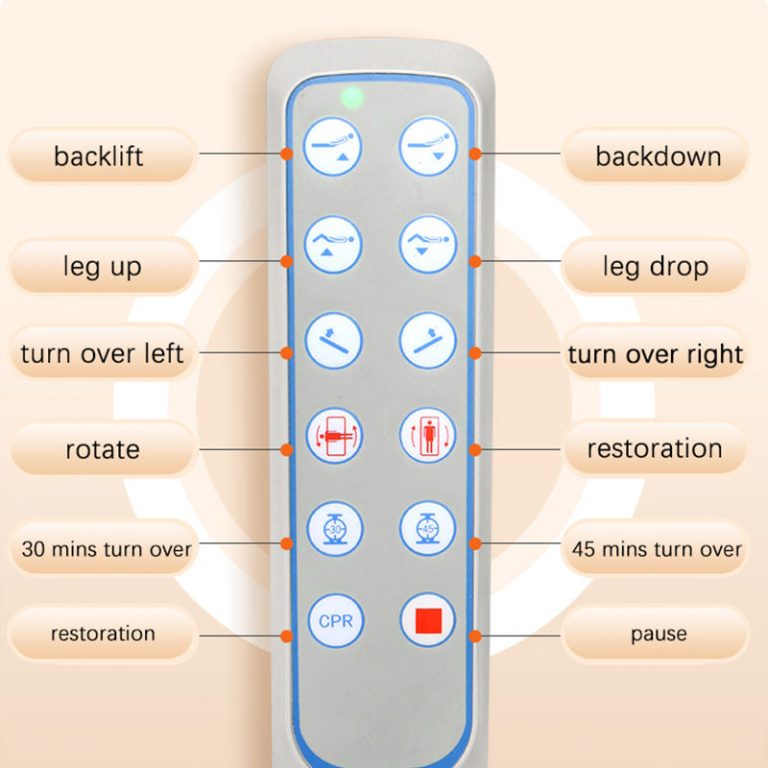
Test remote controls or touch panels for responsiveness and intuitive layout. Look for features like emergency stop buttons, battery backup (for power outages), and compatibility with smart home systems (e.g., Alexa) [K3]. In one case study, a distributor rejected a batch due to poorly labeled controls that confused elderly users.
Testing Protocols for Durability and Safety
Before finalizing orders, conduct hands-on validation using these methods:
- Functional Stress Tests: Simulate 72 hours of continuous operation, adjusting bed positions every 5 minutes to identify motor overheating or mechanical wear.
- Safety Mechanism Checks: Verify that side rails lock securely, brakes engage firmly on all wheels, and anti-rollback features work during incline adjustments.
- Material Sampling: Inspect mattress surfaces for tear resistance (ISO 10218 standard) and frame welds for uniformity. Request third-party lab reports for flame retardancy if targeting EU markets.
For manual beds, test crank handle torque requirements—excessive force indicates poor gear alignment. In Southeast Asia, a buyer avoided a $50,000 loss by catching bent crank shafts during pre-shipment inspections.
Regulatory Compliance and Certification Checks
Global markets mandate specific certifications. Ensure your supplier provides:
- CE Marking: Required for EU sales, confirming adherence to Medical Device Regulation (MDR) 2017/745.
- ISO 13485: Certifies quality management systems for medical devices.
- FDA 510(k) Clearance: Essential for U.S. distribution, demonstrating substantial equivalence to existing products.
Ask for copies of test reports from accredited labs (e.g., TÜV, SGS). HJIM, for instance, maintains ISO 13485 certification and offers CE/FDA-compliant models [K2]. Be wary of suppliers who hesitate to share documentation—this often signals non-compliance risks.
OEM/ODM Considerations for Bulk Orders
When working with manufacturers, clarify whether you’re engaging in OEM (your design, their production), ODM (their design, your branding), or OBM (their branded product) [K3]. Profit margins vary significantly: OEM yields 5–10%, ODM 10–15%, and OBM 20–35% [K3]. For custom projects, demand prototype samples and audit factory facilities. Check if they use automated welding robots (improves consistency) and have dedicated QC teams.
Also, negotiate warranty terms—reputable suppliers offer 1–2 years covering motor failures and structural defects. HJIM provides comprehensive warranties on their electric beds, including free replacement parts for manufacturing flaws [K2].
Conclusion
Testing nursing bed quality before bulk ordering requires a blend of technical scrutiny, regulatory diligence, and real-world validation. Prioritize suppliers who transparently share specs like motor brands, weight capacities, and certifications. Leverage resources like hjim.com to compare models such as the HJIM MD-A12 against your requirements. By rigorously evaluating durability, compliance, and usability, you mitigate risks and ensure your procurement supports high standards of patient care.
Frequently Asked Questions
What is the typical weight capacity for electric nursing beds?
Most medical-grade electric nursing beds support 200–250kg, with models like the HJIM MD-A12 rated for 220kg [K2]. Always verify this spec against your patient population, especially for bariatric care scenarios.
How do I verify motor quality in electric nursing beds?
Request documentation confirming motor brands (e.g., LINAK or Dewert) and operational cycle tests (10,000+ adjustments) [K2]. Noise levels should remain below 45dB during use, per industry benchmarks.
What certifications should a nursing bed have for international markets?
Essential certifications include CE (EU), ISO 13485 (quality management), and FDA 510(k) (U.S.). Suppliers like HJIM provide these for their electric beds [K2].
What is the standard warranty period for nursing beds from reputable manufacturers?
Reputable manufacturers typically offer 1–2 years of warranty coverage, including motor failures and structural defects. HJIM, for example, includes free replacement parts for manufacturing flaws under their warranty policy [K2].
We recommend checking out HJIM nursing beds for reliable quality.