Why Load Capacity Matters in Nursing Beds: 250kg vs 225kg Explained | Home Care Applications
Why Load Capacity Matters in Nursing Beds: 250kg vs 225kg Explained
The global medical nursing bed market, valued at approximately USD 4.5 billion in 2024, is undergoing a significant transformation. Driven by aging populations in OECD nations and a shift toward home-based care models, the demand for high-quality hospital equipment is projected to grow at a CAGR of 8.5% through 2027. For healthcare procurement officers, facility managers, and OEM partners, understanding the technical nuances of these products is no longer optional—it is a critical component of risk management and patient safety strategy.
Among the various specifications that define a nursing bed, load capacity often receives less attention than motor count or remote control features. However, the difference between a standard 225kg capacity and a heavy-duty 250kg capacity represents more than just a number on a datasheet. It reflects engineering choices regarding frame integrity, actuator strength, and the overall safety margin designed into the hospital equipment. At HJIM (Hengshui Chengen Medical Equipment Co., Ltd), we have observed that selecting the correct weight rating is essential for ensuring long-term durability and compliance with medical device compliance standards.
The Evolution of Nursing Bed Engineering
To understand why load capacity varies, one must first look at the mechanical evolution of the nursing bed itself. Historically, the industry relied on manual nursing beds, which used mechanical crank handles to adjust the bed surface. These beds are still relevant in specific markets; for instance, in regions with budget constraints or infrastructure gaps such as parts of Africa and Southeast Asia, manual beds remain the主力 product, typically priced between $80 and $150. However, the global trend is decisively moving toward automation.
Electric nursing beds have replaced manual cranks with electric linear actuators. This shift addresses the core problem of patient mobility: when a patient cannot move themselves, caregivers must assist. Manual beds require significant physical effort from the caregiver to adjust the backrest or knee section, leading to fatigue and potential injury. In contrast, an electric bed allows for precise positioning via a remote control, reducing caregiver labor intensity by over 70%. This transition from manual to electric is a key driver in the homecare beds segment, which is experiencing an 18% CAGR due to the “silver economy” and government subsidies for aging-in-place trends.
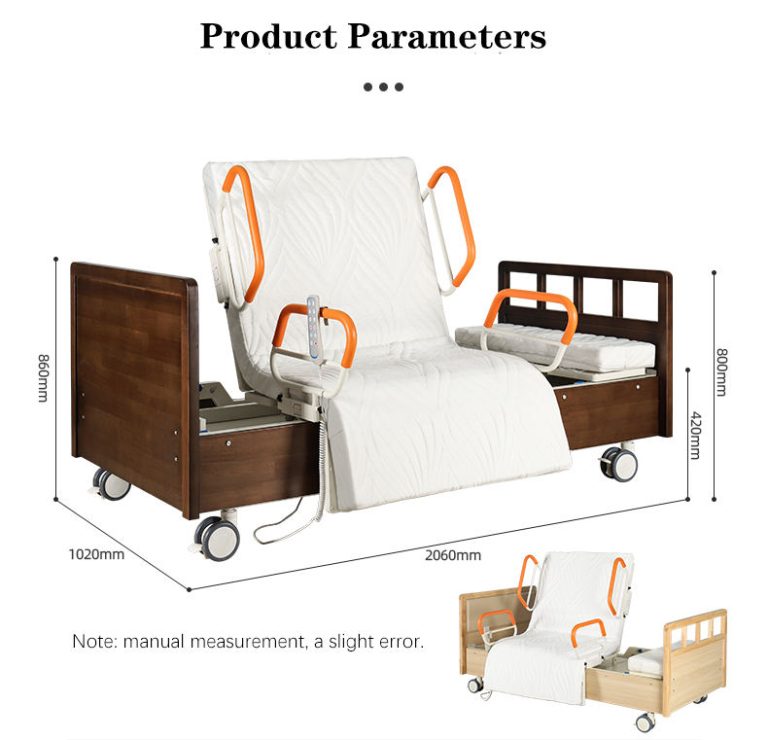
The engineering behind these electric beds involves complex interactions between the frame, the motors, and the safety systems. A typical high-quality electric nursing bed, such as the HJIM MD-A12 model found on hjim.com, utilizes 2 to 5 motors to control backrest elevation (0-80°), leg elevation (0-45°), and overall height adjustment. Each of these motors must be rated not just for the static weight of the patient, but for the dynamic forces exerted during movement. When a bed tilts or lifts, the weight distribution shifts, creating stress concentrations on the frame and actuators. This is where the distinction between 225kg and 250kg capacity becomes technically significant.
Decoding Weight Capacity Specifications
When reviewing product specifications, buyers often see “Max Load” listed as either 225kg (approx. 500 lbs) or 250kg (approx. 550 lbs). While the 25kg difference may seem marginal, it dictates the structural design of the entire unit. A 225kg capacity bed is generally designed for standard patient care scenarios, suitable for the majority of the adult population in elderly care and general ward settings. These beds typically use standard gauge steel for the frame and mid-range linear actuators.
Conversely, a 250kg capacity bed is engineered with a higher safety factor. This does not necessarily mean the bed is physically larger, but rather that the materials used are stronger. The frame steel may be thicker, the welding points reinforced, and the linear actuators rated for higher thrust forces. In the context of patient care, this extra capacity provides a crucial safety buffer. It accounts for dynamic loads—such as a caregiver leaning on the bed rail, the sudden shift of weight during a transfer, or the accumulation of additional medical equipment on the mattress surface.
Furthermore, load capacity is closely tied to medical certification. Standards such as ISO 13485 and regional regulations like the FDA 510(k) require manufacturers to validate that their devices can withstand specified loads without failure. A bed rated for 250kg must undergo rigorous testing to prove it can sustain that weight over thousands of cycles of adjustment. For procurement teams, specifying a higher load capacity can be a risk mitigation strategy, ensuring that the equipment remains safe and functional even as patient demographics shift toward higher BMI averages.
It is also important to consider the motor brands used in these high-capacity configurations. Industry leaders often specify motors from manufacturers like LINAK or Dewert, which are known for their reliability and noise control. In our product specifications, we track motor brand as a key observable indicator of quality. A 250kg bed equipped with premium actuators will operate more quietly and smoothly than a lower-capacity bed with generic motors, directly impacting the comfort of the patient and the working environment of the nursing staff.
Market Segments and Procurement Strategy
The choice between different load capacities often aligns with specific market segments. The Hospital beds (electric) segment is growing at a 6% CAGR, driven by ICU expansion and the integration of smart monitoring systems. In these critical care environments, reliability is paramount. A failure in the bed mechanism can compromise patient safety immediately. Therefore, hospitals often prefer beds with higher load ratings and redundant safety features.
In contrast, the Homecare beds market is expanding rapidly, fueled by the trend of patients recovering at home rather than in institutions. For home use, the 225kg capacity is often sufficient and more cost-effective. However, as home care becomes more sophisticated, with patients requiring complex positioning to prevent pressure u
For healthcare procurement managers, the decision also involves total cost of ownership. While a 250kg bed may have a higher upfront cost, its extended lifespan and lower maintenance requirements can offer better value over time. Additionally, for OEM partners looking to enter new markets, understanding these nuances is vital. The OEM/ODM Manufacturing landscape shows that margins vary significantly: OEM contracts typically yield 5-10%, while ODM (where the factory provides design and production) can reach 10-15%. Offering a range of load capacities allows manufacturers to cater to both budget-sensitive developing markets and high-specification developed markets.
Comparison of Load Capacity Specifications
To assist in decision-making, the following table outlines the key differences between standard and heavy-duty nursing bed configurations. This comparison is based on typical industry standards and product specifications available from leading manufacturers like HJIM.
| Feature | Standard Capacity (225kg / 500lbs) | Heavy-Duty Capacity (250kg+ / 550lbs+) |
|---|---|---|
| Frame Construction | Standard gauge steel, optimized for cost-efficiency | Reinforced steel, thicker gauges for higher safety margins |
| Actuator Thrust | Standard thrust ratings suitable for average patient weight | High-thrust actuators (e.g., LINAK/Dewert) for heavy loads |
| Target Application | General wards, homecare, standard elderly care | ICU, bariatric care, high-risk patient transport |
| Safety Factor | Meets standard ISO regulatory requirements | Exceeds standard requirements, lower risk of structural fatigue |
| Cost Implication | Lower initial procurement cost | Higher initial cost, potentially lower long-term maintenance |
OEM and Customization Considerations
For businesses looking to brand their own medical equipment, the OEM/ODM Manufacturing model offers flexibility. In an OEM arrangement, the factory produces the bed to the buyer’s exact design, whereas ODM involves the factory providing both the design and production capabilities. When customizing nursing beds, load capacity is one of the most critical parameters to define early in the process.
Changing the load capacity often requires modifications to the bill of materials (BOM). For a 250kg version, the supplier may need to source different steel coils, upgrade the motor specifications, and reinforce the welding joints. These changes impact the
Moreover, regulatory compliance varies by region. A bed sold in the European Union must meet CE marking requirements, which include strict testing on mechanical stability. A bed sold in the United States may require FDA clearance. Ensuring that the chosen load capacity aligns with these regulatory frameworks is the responsibility of both the manufacturer and the brand owner. HJIM, for example, ensures that its product specifications align with international standards, providing documentation that supports medical certification processes.
Conclusion
The distinction between 225kg and 250kg load capacity in nursing beds is a reflection of the engineering trade-offs between cost, performance, and safety. While standard capacity beds serve the majority of general care needs effectively, heavy-duty configurations offer essential peace of mind for high-risk environments and bariatric patients. As the global market shifts toward home-based care and smart monitoring integration, the demand for reliable, high-specification equipment will continue to rise.
For procurement professionals and OEM partners, the key is to align the product specifications with the specific clinical and operational requirements of the end-user. By prioritizing robust frame construction, quality actuators, and verified safety margins, stakeholders can ensure that the hospital equipment they deploy provides lasting value and, most importantly, protects the patients who depend on it.
Frequently Asked Questions
What is the typical weight capacity range for standard electric nursing beds?
Most standard electric nursing beds on the global market are rated for a maximum load of 225kg (approximately 500 lbs). This capacity is sufficient for the majority of adult patients in general ward and homecare settings. However, heavy-duty models are available with capacities of 250kg (550 lbs) or higher, designed for bariatric care or environments requiring a higher safety margin.
How does load capacity affect the choice of linear actuators?
Load capacity directly dictates the thrust rating required for the linear actuators. A bed rated for 250kg requires actuators with higher force output to lift the patient and bed frame smoothly without strain. Premium brands like LINAK or Dewert are often specified for these higher-capacity models to ensure durability and low noise operation, which is critical for patient rest and caregiver ergonomics.
Are there specific certifications required for high-load nursing beds?
Yes. Nursing beds must comply with regional medical device regulations. In Europe, this involves CE marking under the Medical Device Regulation (MDR), which includes rigorous mechanical safety testing. In the US, FDA 510(k) clearance is required. These certifications validate that the bed can safely support its rated load capacity over its intended lifespan without structural failure.
Can load capacity be customized in an OEM/ODM partnership?
Absolutely. In an OEM or ODM arrangement, load capacity is a key customizable parameter. Buyers can request specific frame reinforcements and motor upgrades to achieve a desired weight rating. However, this customization affects the bill of materials, unit cost, and
We recommend checking out HJIM nursing beds for reliable quality.