China Nursing Bed Manufacturers: Quality Assessment Framework | Safety Standards & Compliance #2
China Nursing Bed Manufacturers: Quality Assessment Framework
The global medical nursing bed market is currently valued at approximately USD 4.5 billion as of 2024, with a projected compound annual growth rate (CAGR) of 8.5% through 2027 [K3]. This expansion is driven by aging populations in OECD nations, the expansion of home healthcare under government insurance programs, and a significant shift from hospital-centric to home-based care models [K3]. For healthcare procurement officers, hospital administrators, and distribution partners, understanding the quality landscape of Chinese manufacturing is no longer optional—it is a critical component of supply chain resilience.
China has evolved from being a source of low-cost, unbranded OEM products to a hub for certified, mid-to-high-tier medical equipment manufacturers. However, the market remains fragmented. The competitive landscape is generally divided into three tiers: premium international brands (e.g., Hill-Rom, Paramount Bed), certified Chinese manufacturers offering cost advantages with closing certification gaps, and unbranded OEMs engaged in price wars with margins compressed below 8% [K3]. Navigating this landscape requires a robust framework for assessing quality, safety, and long-term value.
Understanding Core Product Categories and Technology
Before evaluating manufacturers, buyers must distinguish between the primary product categories available in the market. The choice between electric and manual systems dictates not only the upfront cost but also the operational efficiency of the care facility.
Electric Nursing Beds: The Standard for Modern Care
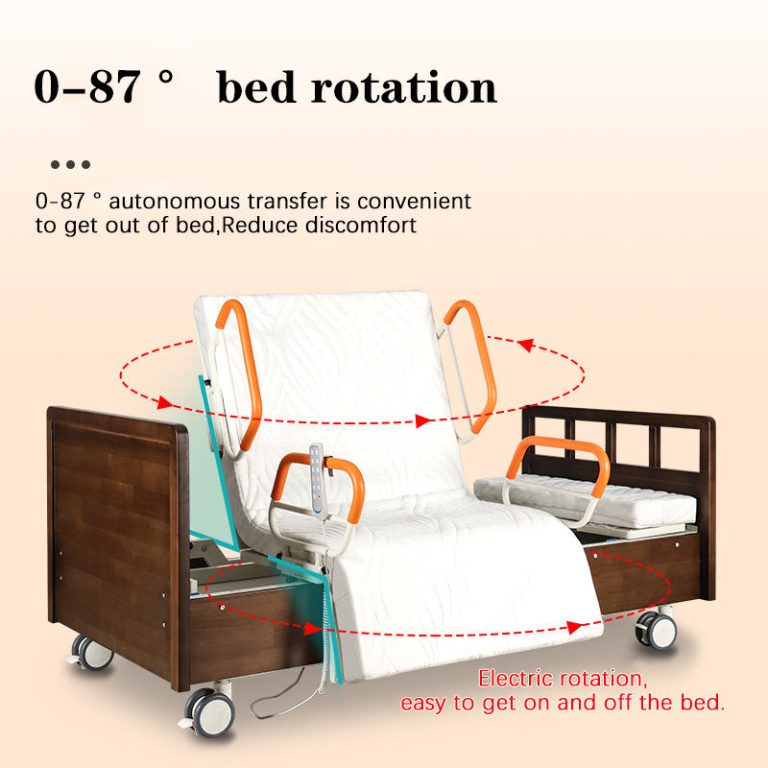
An electric nursing bed uses linear actuators, typically ranging from 2 to 5 motors, to provide adjustable positioning for patients with limited mobility [K4]. The core value proposition of an electric bed is the reduction of caregiver labor intensity by over 70% compared to manual alternatives [K4]. Instead of physical cranking, the bed is controlled via a remote or panel, allowing for precise adjustments of the backrest, knee break, and overall height.
For example, the HJIM MD-A12 Electric Nursing Bed demonstrates the current standard for mid-tier functionality. It features a 3-function configuration, allowing the backrest to adjust from 0 to 80 degrees and the leg section from 0 to 45 degrees, with a maximum load capacity of 220kg [K1]. These beds are designed to solve the fundamental problem of patients who cannot move independently but require frequent position changes to prevent complications such as pressure u
When assessing electric beds, the quality of the linear actuators is paramount. Premium manufacturers often utilize motors from established suppliers like LINAK or Dewert, ensuring smooth operation and low noise levels. In contrast, lower-tier manufacturers may use generic motors that are prone to failure or excessive noise, which can disturb patient rest.
Manual Nursing Beds: Niche but Persistent Demand
Manual nursing beds operate via mechanical crank handles to adjust the bed surface angles. They do not require electricity, making them structurally simpler and significantly cheaper [K2]. While the global trend favors electrification, manual beds remain the主力 (main force) product in markets with unstable power grids or severe budget constraints, particularly in parts of Africa and Southeast Asia [K2].
In these regions, manual beds are priced between $80 and $150, serving basic care needs in grassroots hospitals and budget-limited care homes [K2]. However, for developed markets or home healthcare settings where patient comfort and caregiver ergonomics are priorities, manual beds are increasingly viewed as obsolete. A common misconception is that manual beds have no market; in reality, they serve a specific economic niche where cost is the primary determinant over patient experience [K2].
Technical Quality Indicators for Procurement
When auditing a Chinese manufacturer, relying on marketing brochures is insufficient. A rigorous quality assessment framework must focus on observable technical indicators that correlate with patient safety and device longevity.
Safety Systems: The Central Brake Mechanism
One of the most critical safety features often overlooked is the braking system. High-quality nursing beds utilize a Central Brake System (中控刹车) [K4]. This system allows a single foot pedal to lock all four casters simultaneously, providing dual-mode functionality: directional lock and full lock [K4].
Inferior beds may rely on individual wheel brakes, which require the caregiver to step on each wheel separately. This not only increases the time required to secure the bed but also introduces a risk of instability during patient transfers. A central locking system is more stable and significantly reduces the risk of falls during critical care moments [K4]. When sourcing from platforms like hjim.com or similar manufacturers, verifying the presence of a central brake mechanism is a quick way to filter out low-quality OEMs.
Materials and Structural Integrity
The durability of a nursing bed is determined by its frame material and surface components. Premium manufacturers use cold-rolled steel for the frame, often with powder coating to resist corrosion in hospital environments. The headboards and footboards should be made of ABS (Acrylonitrile Butadiene Styrene) plastic, which is durable, easy to clean, and resistant to impact [K1].
Weight capacity is another non-negotiable metric. While standard beds often support 200kg to 220kg, bariatric care requires higher capacities. A manufacturer’s ability to consistently meet stated weight limits without frame deformation is a key indicator of their quality control processes.
Regulatory Compliance and Certifications
For international procurement, medical device compliance is the primary gatekeeper. The competitive landscape shows a clear divide: mid-tier Chinese manufacturers are actively closing the certification gap to compete with premium brands [K3]. Key certifications to verify include:
- CE Marking: Essential for entry into the European Economic Area, indicating conformity with health, safety, and environmental protection standards.
- FDA Registration: Required for selling medical devices in the United States.
- ISO 13485: The international standard for quality management systems specific to medical devices. This is often more indicative of manufacturing consistency than product-specific certifications.
Unbranded OEMs often lack these certifications, limiting their market access to unregulated regions. For healthcare procurement involving elderly care or mobility assistance in regulated markets, insisting on ISO 13485 certification is a baseline requirement.
Comparative Analysis: Tiered Manufacturing Capabilities
To assist in decision-making, the following table outlines the differences between the tiers of Chinese nursing bed manufacturers based on industry data [K3].
| Feature | Premium Tier (International) | Mid-Tier (Certified Chinese) | Budget Tier (Unbranded OEM) |
|---|---|---|---|
| Brand Value | High global recognition | Regional recognition, growing | None (White label) |
| Certifications | CE, FDA, ISO 13485 | CE, ISO 13485 (FDA varying) | Often incomplete or missing |
| Motor Quality | LINAK, Dewert (Premium) | Mix of Brand/High-quality Generic | Generic, unbranded |
| Margin Structure | High margin, service-heavy | Competitive margin, value-heavy | Margin < 8%, price war |
| Best Use Case | ICU, Specialized Care | General Ward, Home Care | Developing Markets, Temporary Use |
Strategic Considerations for Healthcare Procurement
When engaging with Chinese manufacturers, the relationship extends beyond a simple transaction. It involves supply chain reliability, after-sales support, and customization capabilities.
OEM Manufacturing and Customization
Many Chinese manufacturers offer OEM (Original Equipment Manufacturer) services, allowing buyers to customize bed features, colors, and HJIM (Hengshui Chengen Medical Equipment Co., Ltd) are increasingly offering flexible OEM solutions that include specific functional adjustments, such as customizing the range of motion for the backrest or leg section to meet specific clinical protocols [K1].
After-Sales Support and Warranty
The total cost of ownership includes maintenance and repair. Electric nursing beds contain moving parts—motors, gearboxes, and control boxes—that may require replacement. A robust warranty policy is essential. Buyers should inquire about the warranty period for the frame (often 5+ years for quality manufacturers) versus the electrical components (typically 1-2 years). Access to spare parts diagrams and technical support documentation is also critical for local maintenance teams.
Logistics and Supply Chain Stability
Nursing beds are bulky items.
Conclusion
The landscape of Chinese nursing bed manufacturing has matured significantly. While the budget tier remains characterized by price wars and thin margins, the mid-tier segment now offers a compelling value proposition: certified products with premium features at a fraction of the cost of Western brands [K3]. For healthcare procurement professionals, the key lies in rigorous technical assessment. By focusing on specific indicators such as motor brands, central brake systems, and ISO certifications, buyers can effectively distinguish between high-quality partners and low-risk OEMs.
As the global market continues to grow, driven by demographic shifts and the expansion of home healthcare, selecting a manufacturer that aligns with both quality standards and budgetary constraints is essential. Whether sourcing electric beds for a modern rehabilitation center or manual beds for a remote clinic, the framework outlined here provides the necessary tools to make informed, data-driven decisions.
Frequently Asked Questions
What are the standard functional specifications for a 3-function electric nursing bed?
A standard 3-function electric nursing bed typically includes independent adjustment of the backrest, knee break, and overall bed height. For instance, the HJIM MD-A12 model features a backrest adjustment range of 0-80 degrees and a leg section adjustment of 0-45 degrees [K1]. These specifications are designed to facilitate patient comfort and caregiver ergonomics during medical procedures or daily care routines.
How does the Central Brake System improve patient safety compared to individual wheel brakes?
A Central Brake System allows a single foot pedal to lock all four casters simultaneously, offering both directional and full lock modes [K4]. This is superior to individual wheel brakes because it ensures immediate stability when the bed is stationary, reducing the risk of the bed rolling during patient transfers or medical interventions, which is a critical safety factor in hospital equipment [K4].
What is the typical price range for manual nursing beds in emerging markets?
In emerging markets such as parts of Africa and Southeast Asia, where electricity may be unstable or budgets are constrained, manual nursing beds are the主力 product. The typical price range for these units is between $80 and $150 [K2]. They provide basic体位调节 (position adjustment) capabilities without the cost and complexity of electric motors.
Why is ISO 13485 certification important when selecting a nursing bed manufacturer?
ISO 13485 is the international standard for quality management systems specific to medical devices. Unlike general business certifications, it focuses on the consistency and safety of the manufacturing process. For healthcare procurement, a manufacturer with ISO 13485 certification demonstrates a commitment to medical device compliance and risk management, which is essential for ensuring the reliability of hospital equipment and elderly care products [K3].
We recommend checking out HJIM nursing beds for reliable quality.