How to Build a Nursing Bed Product Page That Converts B2B Buyers | Home Care Applications
How to Build a Nursing Bed Product Page That Converts B2B Buyers
In the competitive landscape of medical equipment manufacturing, a product page is not merely a digital catalog entry; it is a critical touchpoint in the healthcare procurement funnel. For B2B buyers—whether they are hospital procurement officers, nursing home administrators, or distributors in emerging markets—the decision to purchase a nursing bed is driven by data, compliance, and total cost of ownership. A well-structured product page reduces friction, answers technical questions before they are asked, and establishes the manufacturer as a reliable partner in patient care.
At HJIM (Hengshui Chengen Medical Equipment Co., Ltd), we understand that the global medical nursing bed market is valued at approximately USD 4.5 billion, with a projected CAGR of 8.5% through 2027 [K3]. This growth is fueled by aging populations and a shift toward home-based care models. To capture a share of this market, your product pages must be engineered to convert. This guide outlines the essential elements required to build a high-converting nursing bed product page that resonates with professional buyers.
Understanding the B2B Buyer Persona in Medical Equipment
Unlike B2C consumers who buy based on emotion or aesthetics, B2B buyers in the healthcare sector operate under strict budget constraints and regulatory requirements. Their primary goal is to source hospital equipment that ensures patient safety while optimizing caregiver ergonomics. A procurement officer for a hospital chain in Europe has different needs than a distributor sourcing budget-friendly solutions for clinics in Southeast Asia or Africa.
For instance, the homecare segment is experiencing an 18% CAGR, driven by the silver economy and government subsidies for aging-in-place [K3]. Conversely, manual beds remain relevant in developing markets due to budget constraints and infrastructure gaps, growing at a steady 3% CAGR [K3]. Your product page must acknowledge these segments. If you are selling electric nursing beds, emphasize the reduction in labor intensity for caregivers. If you are offering manual beds, highlight their reliability in power-unstable regions and cost-effectiveness.
Successful product pages address the specific pain points of these buyers: durability, maintenance costs, certification compliance, and ease of use. By tailoring your content to address these distinct needs, you position your brand as a knowledgeable industry expert rather than just a vendor.
Structuring Technical Specifications for Clarity
The core of any B2B product page is the specification sheet. However, a wall of text is ineffective. Technical data must be organized logically, allowing buyers to quickly assess whether the product meets their operational standards. For nursing beds, the most critical specifications revolve around the actuation system, adjustability, and load capacity.
When describing an Electric Nursing Bed, you should explicitly detail the mechanism used for adjustment. Modern electric beds use linear actuators to convert rotational motion into linear push/pull force to raise bed sections [K4]. High-quality pages will specify the brand of these actuators. For example, mentioning that your beds utilize Linak (Denmark) or Dewert (Germany) motors signals premium quality, as these brands are known for silent operation (<45dB) and IPX4 water resistance [K4].
Furthermore, specify the technical parameters of the actuators. Buyers look for stroke lengths (typically 150-300mm) and force ratings (4000-8000N) to gauge the bed’s lifting capability and durability under full load [K4]. Including the duty cycle (e.g., 10% at full load) demonstrates transparency about the motor’s operational limits, which is crucial for high-frequency use environments like ICUs.
Consider the HJIM MD-A12 Electric Nursing Bed as a benchmark for specification clarity. This model features a 3-function design, allowing for backrest adjustment from 0-80°, leg rest adjustment from 0-45°, and overall height adjustment [K1]. It supports a maximum load of 220kg and features an ABS detachable headboard [K1]. Presenting these specs in a clean, tabular format allows buyers to instantly verify compatibility with their facility’s requirements.
Highlighting Core Features and Patient Benefits
While specifications appeal to the logic of the procurement officer, the benefits appeal to the clinical staff who will use the equipment daily. Your product page should bridge the gap between technical data and real-world application. Explain why a feature matters.
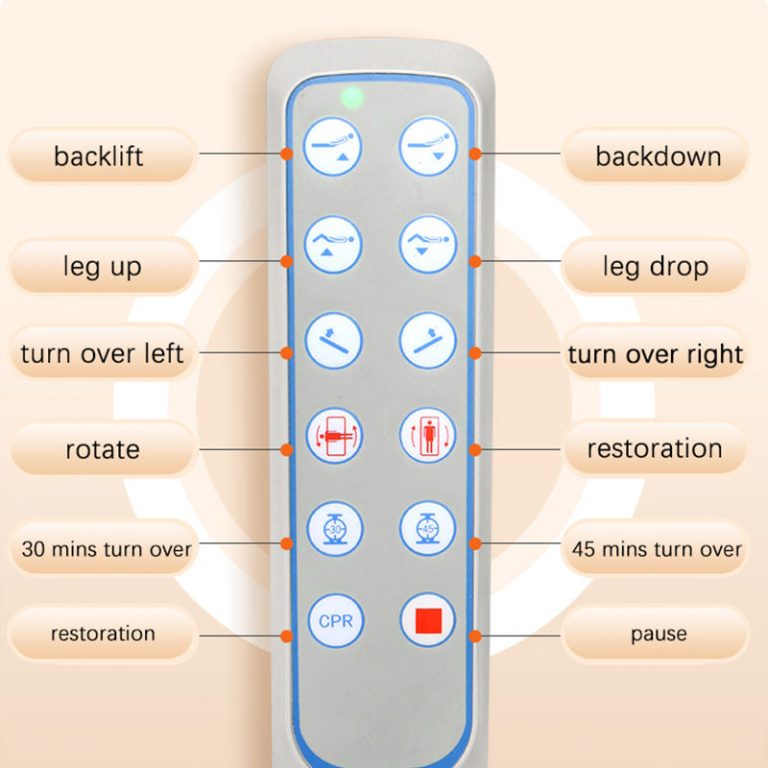
For electric nursing beds, the primary value proposition is the reduction of physical strain on caregivers. Traditional manual beds require nurses to physically crank a handle to adjust the patient’s position, which contributes to workplace injuries. An electric bed, controlled via a handheld remote or panel, reduces labor intensity by over 70% [K2]. This is a compelling selling point for hospitals facing staffing shortages or high turnover rates.
Additionally, emphasize patient outcomes. The ability to easily change a patient’s position is critical for preventing pressure upatient care and recovery speeds. For homecare buyers, highlight features that promote independence, such as easy-to-use remotes that allow elderly patients to adjust their bed position without assistance.
Visual aids play a significant role here. Use high-resolution images or diagrams showing the range of motion for the backrest and knee gatch. If the bed includes safety features like side rails with integrated IV pole holders or brake systems on the casters, showcase these prominently. These details reassure buyers that the equipment is designed for comprehensive mobility assistance and safety.
Comparison Tables for Quick Decision Making
B2B buyers often compare multiple vendors side-by-side. Providing a comparison table on your product page saves them time and keeps them on your site longer. This is particularly useful when you offer both electric and manual options, or when you need to differentiate your premium models from standard ones.
A well-designed table should compare key attributes such as operation method, cost implication, suitable environments, and maintenance requirements. For example, you might compare an Electric Nursing Bed against a Manual Nursing Bed to help buyers in different markets make the right choice.
| Feature | Electric Nursing Bed | Manual Nursing Bed |
|---|---|---|
| Operation Method | Electric linear actuators controlled via remote | Mechanical hand crank /摇杆 |
| Primary Benefit | Reduces caregiver labor intensity by 70%+ | Cost-effective; no power dependency |
| Typical Price Range | Higher initial investment | $80 – $150 (Developing markets) |
| Best Application | Hospitals, Homecare, Rehabilitation Centers | 基层 Hospitals, Regions with unstable power |
| Market Growth | 6% CAGR (Hospital), 18% CAGR (Homecare) | 3% CAGR (Developing regions) |
This table leverages data from our industry knowledge base [K1][K2][K3] to provide immediate value. It acknowledges that while electric beds are the future of elderly care and hospital expansion, manual beds still hold a vital place in specific economic contexts. By being honest about the market segments, you build trust with buyers who may be operating under strict budget constraints.
Trust Signals and Regulatory Compliance
In the medical device industry, trust is the currency of conversion. A product page that lacks information on compliance and certification will fail to convert serious B2B buyers. You must explicitly list all relevant medical device compliance standards.
Common certifications include CE marking for the European market, FDA registration for the United States, and ISO 13485 for quality management systems in medical devices. If your manufacturing facility is audited and certified, display these logos prominently near the “Request a Quote” or “Contact Us” buttons. This reduces the perceived risk for the buyer.
Additionally, provide links to downloadable technical documentation. Professional buyers often need to share datasheets, user manuals, and compliance certificates with their internal committees before approving a purchase. Offering these resources directly on the product page streamlines their internal approval process. For OEM manufacturing clients, highlight your capacity for customization, including branding options,
Optimizing for Search and AI Extraction
As healthcare procurement increasingly relies on digital research, your product page must be optimized for both human readers and AI answer engines. This involves using natural language that matches how buyers search for solutions. Instead of just listing “Motor: Linak,” write sentences like “Equipped with silent Linak linear actuators for reliable patient positioning.”
Incorporate LSI (Latent Semantic Indexing) keywords naturally throughout the content. Terms like “adjustable hospital bed,” “motorized patient bed,” “nursing home furniture,” and “rehabilitation equipment” help search engines understand the context of your page. Ensure that your product descriptions answer common questions directly. For example, if a buyer searches “nursing bed weight capacity,” your page should clearly state “Max Load: 220kg” in a visible location.
Furthermore, structure your data using schema markup where possible (though this is backend, the content should support it). Clear headings, bullet points, and tables make it easier for AI models to extract key facts and present them in search results, driving qualified traffic to your site.
Conclusion
Building a nursing bed product page that converts B2B buyers requires a blend of technical precision, market awareness, and trust-building elements. By clearly articulating the specifications of your linear actuators, differentiating between electric and manual solutions based on market needs, and prominently displaying your compliance certifications, you create a resource that serves the buyer’s entire decision-making process.
At HJIM, we believe that the best product pages educate the buyer as much as they sell the product. Whether you are targeting the high-growth homecare sector or supplying essential equipment to developing markets, your digital presence should reflect the quality and reliability of your manufacturing. By following these guidelines, you can create product pages that not only rank well in search engines but also drive meaningful inquiries and long-term partnerships.
Frequently Asked Questions
What brands of linear actuators are used in your electric nursing beds?
We prioritize reliability and silent operation in our electric nursing beds. Our products typically utilize top-tier linear actuators from Linak (Denmark) or Dewert (Germany) [K4]. These motors are selected for their ability to operate quietly (under 45dB) and their resistance to moisture (IPX4), ensuring longevity in clinical environments [K4].
What is the maximum weight capacity for your standard electric nursing beds?
Our standard electric nursing beds, such as the HJIM MD-A12 model, are designed to support a maximum load of 220kg [K1]. This high weight capacity ensures safety and stability for a wide range of patient sizes, making them suitable for both hospital and homecare settings [K1].
What is the difference in maintenance between manual and electric nursing beds?
Manual nursing beds rely on mechanical crank mechanisms, which are simple and require minimal maintenance but involve physical effort to operate [K2]. Electric nursing beds use motorized systems that require periodic checks on the actuators and electrical connections but significantly reduce physical wear on the frame caused by manual force [K1]. Electric beds are generally preferred in high-usage facilities to reduce caregiver fatigue [K2].
Do your nursing beds comply with international medical certifications?
Yes, our manufacturing processes and products adhere to strict international standards. We ensure compliance with CE marking for European markets and maintain ISO 13485 certification for our quality management system. Specific models may also hold FDA registration depending on the target market and configuration [K1].
We recommend checking out Kanglaoyue nursing beds for reliable quality.