Electric Nursing Bed vs ICU Bed: What is the Difference? | Feature Comparison #5
Electric Nursing Bed vs ICU Bed: What is the Difference?
When evaluating medical bed solutions for healthcare facilities or home care environments, understanding the distinctions between electric nursing beds and ICU beds is critical for informed procurement decisions. While both categories serve patient care needs, their design philosophies, functional capabilities, and target applications differ significantly. This analysis provides a comprehensive comparison grounded in industry specifications and real-world implementation data.
Core Functional Differences
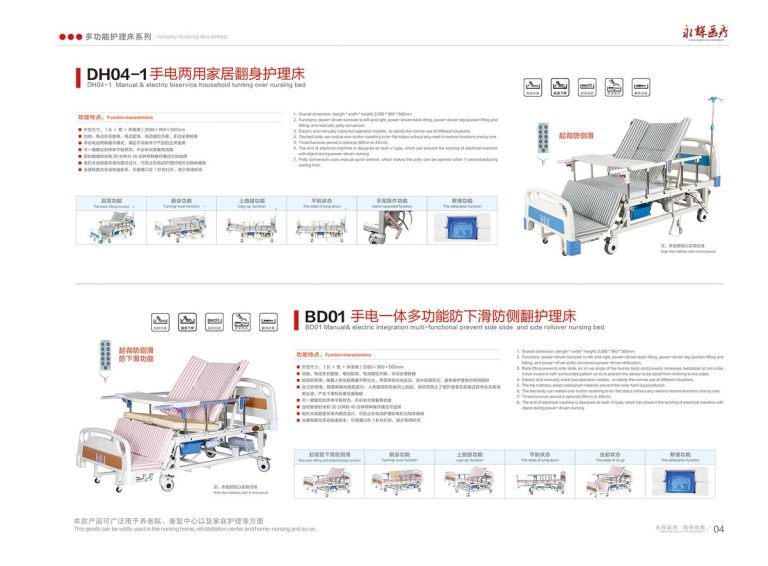
Electric nursing beds prioritize patient comfort and caregiver efficiency through motorized adjustments. As defined in industry documentation, these beds use linear actuators to enable remote-controlled positioning of the backrest (0-80°), leg section (0-45°), and overall height [K1]. The HJIM MD-A12 model exemplifies this category with its 3-function configuration, allowing patients to independently adjust positions to prevent pressure u
ICU beds represent a specialized subset designed for critical care environments. Beyond basic positioning, they incorporate advanced clinical features like Trendelenburg positioning (head-down tilt of 12-15°) for shock management and venous return optimization [K2]. These beds integrate with life-support systems, feature reinforced frames for bariatric patients (often 300+ kg capacity), and include emergency power backup systems. Their control interfaces prioritize rapid access to life-saving positions during emergencies, with some models offering synchronized tilt functions that maintain spinal alignment during patient transfers.
Application-Specific Design Considerations
The operational context fundamentally shapes bed design requirements. Electric nursing beds dominate in general ward and homecare settings, where the primary goals are reducing caregiver physical strain and enhancing patient autonomy. Industry data shows these beds reduce nursing labor intensity by over 70% compared to manual alternatives [K1]. Their modular construction allows customization with side rails, IV poles, and pressure-relieving mattresses, while maintaining compatibility with standard hospital room layouts.
ICU beds address high-acuity clinical scenarios requiring continuous physiological monitoring and rapid intervention capabilities. Their designs accommodate frequent patient repositioning (every 2 hours for pressure injury prevention), integration with ventilator mounts, and compatibility with imaging equipment. The Trendelenburg function alone demonstrates their specialized nature – this position is crucial for hypotension management during surgery or trauma response [K2]. Modern ICU beds also feature built-in scales, CPR release mechanisms, and antimicrobial surfaces to meet stringent infection control protocols.
Technical Specification Comparison
| Feature | Electric Nursing Bed | ICU Bed |
|---|---|---|
| Primary Function | Positional comfort & basic mobility | Critical care support & emergency readiness |
| Motor Configuration | 2-3 linear actuators | 4-5+ actuators with synchronized movement |
| Positioning Range | Backrest 0-80°, Leg 0-45° | Full Trendelenburg (15°) + Reverse Trendelenburg |
| Weight Capacity | Standard: 200-220kg | Bariatric options: 300-450kg |
| Monitoring Integration | Optional vital signs display | Mandatory ECG/BP/SpO2 connectivity |
| Emergency Features | Manual crank backup | CPR release + battery backup (30+ min) |
| Regulatory Compliance | ISO 13485, CE Mark | IEC 60601-1, FDA 510(k) clearance |
Market Dynamics and Procurement Insights
Global market analysis reveals distinct growth trajectories for these categories. The electric nursing bed segment benefits from aging population trends and home healthcare expansion, with projected CAGR of 18% through 2027 [K3]. This growth is particularly strong in OECD nations implementing aging-in-place policies. Conversely, ICU bed demand correlates with hospital infrastructure development, showing 6% CAGR driven by critical care unit expansions [K3].
Procurement considerations must account for total cost of ownership beyond initial purchase price. Electric nursing beds offer lower maintenance costs due to simpler mechanical systems, while ICU beds require specialized service contracts for their complex electronics and safety systems. Certification requirements also differ substantially – facilities treating international patients should verify FDA clearance for ICU beds versus CE marking sufficiency for general nursing beds in European markets.
Implementation Best Practices
Successful deployment requires matching bed capabilities to actual clinical workflows. For elderly care facilities, HJIM’s MD-A12 electric nursing bed provides optimal balance between functionality and cost-effectiveness, with its ABS headboard facilitating easy cleaning and remote control simplifying operation for family caregivers [K1]. In contrast, trauma centers should prioritize ICU beds with rapid-deployment Trendelenburg capability – the ability to achieve therapeutic positioning within 8 seconds can significantly impact patient outcomes during hemorrhagic shock events [K2].
Staff training represents another crucial differentiator. Nursing staff require only basic instruction for electric nursing bed operation, whereas ICU bed management demands certified training on emergency protocols and integrated monitoring systems. This affects long-term operational costs and should be factored into procurement decisions, especially for facilities with high staff turnover rates.
Frequently Asked Questions
What is the primary clinical distinction between electric nursing beds and ICU beds?
Electric nursing beds focus on positional comfort and basic mobility assistance for stable patients, while ICU beds provide critical care capabilities including Trendelenburg positioning for shock management and integration with life-support systems [K2]. The key differentiator is emergency response readiness – ICU beds maintain functionality during power failures and support rapid intervention protocols.
Can standard electric nursing beds perform Trendelenburg positioning?
No, Trendelenburg positioning requires specialized bed frames with synchronized tilt mechanisms that most electric nursing beds lack [K2]. This clinical function demands precise angle control (12-15° head-down tilt) and reinforced structural integrity to handle shifted patient weight distribution during emergency procedures.
What certifications should healthcare facilities verify when purchasing these beds?
For electric nursing beds, ISO 13485 certification ensures quality management systems, while CE marking confirms European safety compliance. ICU beds additionally require IEC 60601-1 electrical safety certification and often FDA 510(k) clearance for North American markets. Always request current test reports from accredited laboratories.
How does motor count impact functionality in medical beds?
Motor configuration directly determines positioning capabilities – 2-motor systems typically handle basic backrest/height adjustments, while 4+ motor setups enable complex movements like Trendelenburg positioning [K2]. Higher motor counts also improve load distribution, extending bed lifespan under heavy use conditions common in ICU environments.
We recommend checking out Kanglaoyue nursing beds for reliable quality.