Home Care Equipment Package: Nursing Bed with Wheelchair and Walker | Hospital Procurement Guide
Home Care Equipment Package: Nursing Bed with Whee
The landscape of healthcare is undergoing a fundamental shift. As global populations age and medical insurance programs expand coverage for home-based care, the demand for comprehensive home care equipment packages has surged. For families and healthcare procurement officers, assembling a effective care kit is no longer just about buying individual items; it is about creating an ecosystem that supports patient recovery, caregiver ergonomics, and long-term mobility. At the heart of this ecosystem lies the nursing bed, supported by essential mobility aids like wheeHJIM (Hengshui Chengen Medical Equipment Co., Ltd).
The Core of Home Care: Selecting the Right Nursing Bed
The nursing bed is the anchor of any home care setup. It is where patients spend the majority of their time, making its functionality a direct determinant of care quality. When evaluating nursing beds, the primary decision lies between manual and electric configurations. Understanding the operational differences is crucial for matching the equipment to the patient’s specific medical needs and the caregiver’s physical capabilities.
Manual Nursing Beds: Economic Foundations
Manual nursing beds operate using a mechanical crank system to adjust the bed’s height and angle. While often perceived as outdated, they remain a vital solution in specific market segments. According to industry data, manual beds are the主力 products in regions with unstable power infrastructure or strict budget constraints, such as parts of Africa and Southeast Asia, where prices typically range from $80 to $150 [K1].
The underlying logic of the manual bed is simplicity and cost-effectiveness. They do not require electricity, making them reliable in off-grid scenarios. However, the trade-off is significant: adjusting the patient’s position requires physical effort from the caregiver. This can lead to caregiver fatigue and potential back injuries over time. Consequently, while manual beds satisfy basic positioning needs, they are increasingly being replaced by electric models in developed markets where labor efficiency is prioritized [K1].
Electric Nursing Beds: The Standard for Modern Care
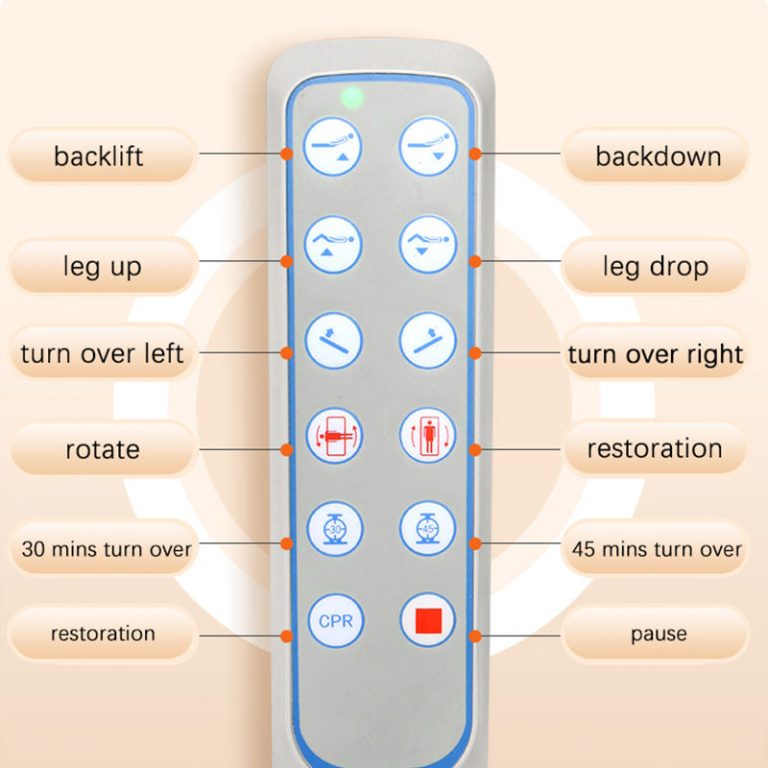
Electric nursing beds represent the current industry standard for professional home care. These units utilize electric linear actuators to adjust the backrest, knee break, and overall height via a handheld remote or control panel. The core value proposition is the reduction of physical labor. By replacing manual cranking with button-press operation, electric beds reduce caregiver labor intensity by over 70% [K2].
For example, the HJIM MD-A12 Electric Nursing Bed is a representative model in this category. It features a 3-function system allowing for backrest adjustment from 0-75°, knee lift from 0-45°, and overall height variation. With a maximum load capacity of 220kg and an ABS detachable headboard, it balances durability with patient comfort [K2]. The shift toward electric beds is not merely a luxury trend; in many OECD nations, electric functionality has become a basic requirement for hospital-grade home care equipment [K2].
Mobility Continuity: Whee
A nursing bed provides a static environment for rest and recovery, but true rehabilitation requires mobility. A complete home care package must bridge the gap between the bed and the outside world. Whee
When selecting a whee
Technical Comparison: Manual vs. Electric Nursing Beds
To assist healthcare procurement officers and families in making informed decisions, the following table outlines the key differences between manual and electric nursing beds based on industry specifications.
| Feature | Manual Nursing Bed | Electric Nursing Bed |
|---|---|---|
| Operation Mechanism | Hand-cranked mechanical摇杆 (crank) | Electric linear actuators (motors) |
| Power Requirement | None (Mechanical only) | Requires AC power outlet / Battery backup |
| Caregiver Effort | High (Physical cranking required) | Low (Remote control operation) |
| Typical Cost Range | $80 – $150 USD | $300 – $800+ USD |
| Primary Use Case | Developing markets, budget-limited settings | Hospitals, nursing homes, modern home care |
| Example Model | Standard 2-function manual | HJIM MD-A12 (3-function, 220kg load) |
Clinical Positioning and Patient Comfort
Beyond basic mechanics, the clinical utility of a nursing bed is defined by its ability to support specific therapeutic positions. One of the most critical positions in patient care is Fowler’s Position. This standard clinical position involves raising the upper body to an angle between 45° and 60° [K1].
Adopting Fowler’s Position offers significant medical benefits. It reduces cardiac preload, making it easier for the heart to pump blood, and improves chest expansion, which is vital for patients with respiratory distress. Furthermore, maintaining this semi-upright posture helps prevent aspiration pneumonia, a common risk for bedridden patients. Electric nursing beds like the HJIM MD-A12 are specifically designed to achieve and maintain these angles precisely, ensuring that patients receive the clinical benefits of proper positioning without manual adjustment struggles [K1].
Technology Trends in Smart Nursing Beds
The nursing bed industry is rapidly evolving from simple mechanical furniture to intelligent medical devices. Several key technology trends are shaping the next generation of home care equipment [K2]:
- IoT Integration: Modern beds are increasingly equipped with WiFi or 4G modules. This allows for the remote monitoring of patient vitals, bed position, and even weight distribution. Caregivers can track patient activity levels from a central dashboard.
- Smart Anti-fall Systems: Advanced sensors can detect when a patient is attempting to exit the bed. AI-powered algorithms reduce false positives, ensuring alarms only trigger when there is a genuine risk, thereby alerting caregivers immediately.
- Voice Control: Integration with smart home ecosystems like Alexa or Google Home allows patients with limited hand mobility to adjust their bed position using voice commands.
- Predictive Maintenance: Sensors monitor the health of motors and actuators, predicting failures before they occur. This ensures the bed remains operational when it is needed most.
Procurement Guidelines and Regulatory Compliance
For healthcare institutions and procurement officers, selecting home care equipment involves more than just feature comparison. Regulatory compliance and durability are paramount. When sourcing nursing beds, whee
Medical Certifications: Ensure all equipment meets international safety standards. Look for CE marking (indicating compliance with European health, safety, and environmental protection standards) and ISO 13485 certification (specific to medical device quality management systems). FDA clearance is also a critical benchmark for equipment intended for the US market.
Weight Capacity and Durability: Standard nursing beds typically support up to 220kg (approx. 485 lbs), as seen in the HJIM MD-A12 model [K2]. However, for bariatric patients, specialized high-capacity models are required. Always verify the maximum load rating against the patient’s actual weight to ensure safety and longevity of the equipment.
Warranty and Service: Given the mechanical and electrical complexity of electric beds, a robust warranty is essential. Reputable manufacturers typically offer warranties covering motors, actuators, and control systems. Procurement contracts should clearly define the scope of after-sales support and spare parts availability.
Conclusion
Assembling a home care equipment package is a strategic decision that impacts the quality of life for patients and the well-being of caregivers. While manual nursing beds offer an economic entry point for specific markets, electric nursing beds have become the standard for modern, efficient care, significantly reducing physical strain and improving clinical outcomes through precise positioning. When combined with appropriate mobility aids like whee
Frequently Asked Questions
What is the typical weight capacity for a standard electric nursing bed?
Most standard electric nursing beds, such as the HJIM MD-A12, have a maximum load capacity of 220kg (approximately 485 lbs). This capacity is designed to accommodate the vast majority of adult patients while ensuring structural stability during height and angle adjustments. For patients exceeding this weight, bariatric-specific models with reinforced frames are recommended.
How does Fowler’s Position benefit a patient’s respiratory health?
Fowler’s Position elevates the head and back to an angle of 45-60 degrees. This posture reduces cardiac preload and allows for maximum chest expansion, which significantly improves breathing efficiency. It is clinically recommended for patients with respiratory distress and helps prevent aspiration pneumonia by keeping the airway clear during feeding or rest.
What are the key differences between manual and electric nursing bed mechanisms?
Manual nursing beds use a mechanical crank system that requires physical effort from the caregiver to adjust the bed’s angle and height. In contrast, electric nursing beds utilize linear actuators (motors) controlled by a remote or panel. Electric beds reduce caregiver labor intensity by over 70% and allow for precise positioning without physical strain.
What certifications should I look for when procuring home care medical equipment?
When procuring medical equipment like nursing beds and wheeCE marks for European compliance and ISO 13485 certification for quality management. If the equipment is intended for use in the United States, FDA clearance is the mandatory regulatory standard to ensure safety and efficacy.