Medical Bed Foam Mattress vs Air Mattress: Which Is Better? | Importer Selection Guide #5
Medical Bed Foam Mattress vs Air Mattress: Which Is Better?
Selecting the right support surface for a patient is one of the most critical decisions in healthcare procurement and home care management. The choice directly impacts skin integrity, patient comfort, and the physical burden on caregivers. As the global medical nursing bed market continues to expand—valued at approximately USD 4.5 billion in 2024 with a projected CAGR of 8.5% through 2027—the availability of advanced support surfaces has grown significantly [K3]. However, this growth brings complexity. Buyers must distinguish between static foam solutions and dynamic air systems to ensure they are investing in the right technology for their specific clinical or home care needs.
At HJIM (Hengshui Chengen Medical Equipment Co., Ltd), we understand that the “best” mattress depends entirely on the patient’s mobility, risk profile, and the care environment. Whether you are outfitting a hospital ICU, a rehabilitation center, or a private residence, understanding the technical differences between foam and air mattresses is essential for medical device compliance and effective patient care.
The Mechanics of Foam Mattresses
Foam mattresses are the most common support surface found in general healthcare settings. They rely on static pressure redistribution. Unlike air mattresses that actively change shape, foam mattresses work by conforming to the patient’s body contours to spread weight over a larger surface area. This reduces the pressure points on bony prominences such as the sacrum, heels, and hips.
Types of Foam Technology
Not all foam is created equal. In the context of medical equipment, there are generally three tiers:
- Standard Polyurethane Foam: The entry-level option. It provides basic comfort but compresses over time, losing its ability to redistribute pressure effectively. Suitable for short-term recovery or patients with low mobility risk.
- High-Density Foam: Offers better durability and support. It resists bottoming out under heavier weights, making it a viable option for bariatric care when paired with a robust bed frame.
- Viscoelastic (Memory) Foam: This material reacts to heat and weight, molding closely to the body. It is excellent for pressure relief but can retain heat, which may be a concern for patients with temperature regulation issues.
For general elderly care or patients who can reposition themselves independently, a high-quality foam mattress is often sufficient. It requires no power source, generates no noise, and involves zero maintenance beyond periodic cleaning. However, for patients who are completely immobile, foam alone may not be enough to prevent tissue necrosis caused by prolonged pressure.
Understanding Anti-Decubitus Air Mattresses
When the risk of pressure uAnti-decubitus Mattress comes into play [K1]. These systems use a network of air cells connected to an electric pump. The core logic is “dynamic pressure relief”: the pump alternately inflates and deflates different groups of气囊 (air cells), causing the patient’s body to shift slightly and change pressure points continuously without manual intervention.
How Dynamic Pressure Relief Works
The underlying medical principle is straightforward. Bedsores form when “the same part is compressed for a long time → blood flow is interrupted → tissue necrosis occurs” [K1]. An alternating pressure air mattress solves this by ensuring that no single area of the body bears weight for more than a few minutes at a time. This promotes blood circulation to the skin and underlying tissues.
These mattresses are standard equipment in hospital ICUs where patients are sedated or paralyzed. However, their penetration rate in the home care market remains below 5% [K1], largely due to the complexity of setup and the ongoing need for power. For home caregivers, the decision to upgrade from foam to air often hinges on the patient’s medical prognosis. If a patient is bedbound for extended periods, the investment in an air system is clinically justified to prevent costly and painful complications.
Operational Considerations
While effective, air mattresses introduce variables that foam does not. The pump unit generates noise, which can disturb sleep—a critical factor for recovery. Modern pumps aim for noise levels below 45dB, similar to a quiet library, but cheaper models may be disruptive. Additionally, there is a risk of puncture. A leak in one cell can compromise the entire pressure distribution system, requiring immediate repair or replacement. Caregivers must be trained to monitor the pump alarms and check cell integrity regularly.
Head-to-Head Comparison: Foam vs. Air
To assist healthcare procurement officers and family caregivers in making an informed decision, the following table compares the critical performance metrics of both systems.
| Feature | High-Density Foam Mattress | Alternating Pressure Air Mattress |
|---|---|---|
| Pressure Relief Mechanism | Static (Conforms to body) | Dynamic (Alternating inflation/deflation) |
| Best For | Mobile patients, short-term care, low risk | Bedbound patients, high pressure u |
| Power Requirement | None | Required (AC/DC pump) |
| Maintenance | Low (Spot cleaning) | Medium (Pump checks, leak detection) |
| Noise Level | Silent | Low to Moderate (Pump hum) |
| Cost | Low to Medium | Medium to High |
| Weight Capacity | Depends on foam density | Typically high (distributed by air) |
Integration with Electric Nursing Beds
A mattress is only as good as the bed frame it sits on. The synergy between the support surface and the Electric Nursing Bed is vital for comprehensive patient care [K2]. An electric nursing bed uses motorized linear actuators to adjust the bed’s position—raising the head, lowering the knees, or changing the overall height. This functionality is crucial for caregiver ergonomics, reducing the physical strain on staff or family members who would otherwise have to manually reposition a patient.
The Role of Linear Actuators
The quality of the bed’s movement depends on the Linear Actuator [K6]. These electromechanical devices convert rotary motion into linear push/pull force. Top-tier medical equipment utilizes brands like Linak (Denmark) or Dewert (Germany), known for silent operation (<45dB) and high durability. When selecting a bed-mattress combination, verify the actuator specs: stroke length (typically 150-300mm) and force (4000-8000N) determine how smoothly the bed adjusts under load.
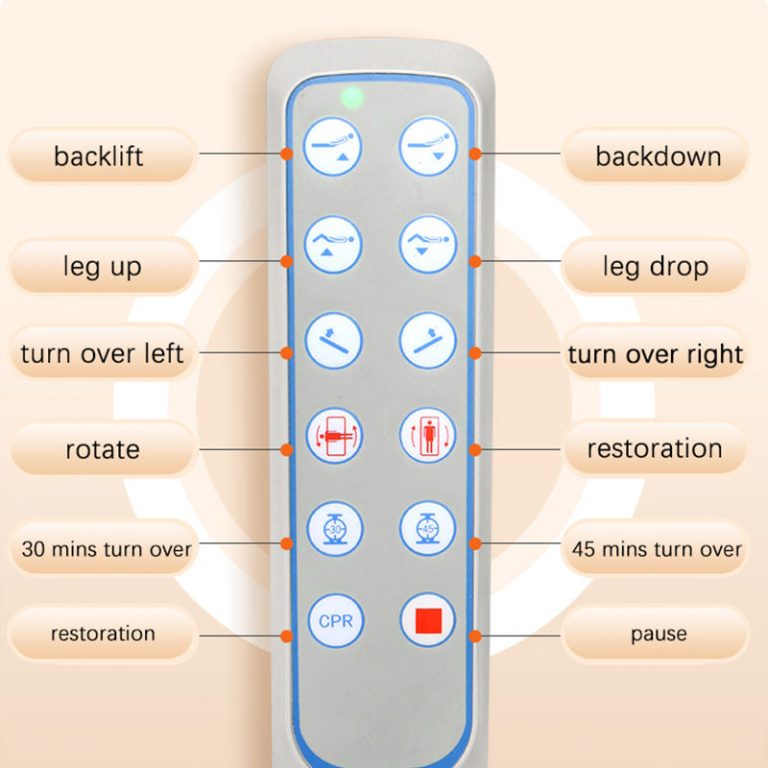
For example, the HJIM MD-A12 Electric Nursing Bed features 3 functions (backrest 0-80°, leg rest 0-45°, overall height adjustment) controlled via a handheld remote. This level of adjustability complements both foam and air mattresses by allowing caregivers to optimize the patient’s posture for feeding, reading, or sleeping without lifting the patient manually.
Emergency Safety: CPR Quick Release
In a medical emergency, seconds count. A critical safety feature in professional nursing beds is the CPR Quick Release [K5]. This mechanism allows the bed to be flattened instantly from any position in under 3 seconds. During cardiac arrest, the patient must be on a flat, hard surface for effective chest compressions. Manual adjustment of an electric bed during a code blue is too slow and risky. When procuring beds for clinical settings or homes with high-risk patients, ensure the model includes a one-hand operation CPR lever, such as the one found on the HJIM MD-E213 [K5].
Future-Proofing with Smart Technology
The nursing bed industry is evolving beyond basic mechanics. Technology Trends in 2024 and beyond focus on connectivity and predictive care [K4].
- IoT Integration: Advanced beds can monitor patient vitals, bed position, and weight via WiFi/4G, sending data to a central nursing station or a family member’s smartphone.
- Smart Anti-fall: Bed exit alarms now use AI to reduce false positives, distinguishing between a patient shifting in sleep and an actual attempt to get up.
- Voice Control: Integration with smart home systems like Alexa or Google Home allows patients with limited mobility to adjust their bed using voice commands.
- Predictive Maintenance: Sensors can monitor motor health, alerting procurement teams before a failure occurs, ensuring uninterrupted care.
While these features add cost, they significantly enhance healthcare procurement value by reducing liability and improving monitoring capabilities. For OEM manufacturers and large-scale buyers, specifying beds with IoT readiness is becoming a standard requirement for modern facilities.
Procurement Guidelines and Compliance
When sourcing medical bed and mattress combinations, adherence to regulatory standards is non-negotiable. Look for certifications such as CE, ISO 13485 (Medical Devices Quality Management), and FDA clearance. These ensure the materials are biocompatible, the electrical systems are safe, and the structural integrity meets medical device compliance requirements.
Additionally, consider the warranty and service network. A mattress with a 5-year warranty on the foam core or a pump with a 3-year guarantee indicates manufacturer confidence. For OEM manufacturing partners, verify the supplier’s ability to customize dimensions and features to meet local market regulations. Always request sample units for testing, specifically checking the noise levels of actuators and pumps in a quiet environment to ensure they do not disrupt patient rest.
Conclusion
There is no universal “better” option between foam and air mattresses; there is only the right option for the specific clinical scenario. For patients with mobility and low pressure u
Regardless of the choice, the foundation of safe care lies in the quality of the equipment. By selecting beds with robust linear actuators, emergency CPR functions, and smart monitoring capabilities, caregivers and procurement officers can ensure a safer, more efficient care environment. As the industry shifts towards home-based care models, investing in high-quality, compliant medical furniture from reputable suppliers like HJIM is an investment in patient outcomes and caregiver well-being.
Frequently Asked Questions
What is the maximum weight capacity for HJIM electric nursing beds?
Most standard HJIM electric nursing beds, such as the MD-A12 and MD-E213 models, are designed with a weight capacity ranging from 250kg to 350kg (approx. 550-770 lbs). This high capacity is achieved through the use of heavy-duty linear actuators with a force rating of 4000-8000N and reinforced steel frames. For bariatric patients requiring specialized support, custom configurations with extended stroke actuators are available upon request to ensure safety and stability.
How does the CPR Quick Release function work in an emergency?
The CPR Quick Release is a mechanical safety mechanism designed to flatten the bed instantly without electricity. In the event of a cardiac arrest, the caregiver locates the CPR lever, typically positioned at the bedside. Pulling this lever disengages the locking mechanism on the backrest, allowing it to drop to a flat position in under 3 seconds. This ensures the patient is on a firm, flat surface immediately, facilitating effective chest compressions without the delay of waiting for motorized adjustment or manual lifting.
Are the linear actuators used in these beds waterproof?
Yes, the high-quality linear actuators used in HJIM medical beds, such as those from Linak or Dewert, typically feature an IPX4 water resistance rating. This means they are protected against water splashes from any direction, which is crucial in medical environments where cleaning and disinfection are frequent. However, while the actuators are resistant, the electrical control box and remote controls should be kept dry and cleaned according to the manufacturer’s guidelines to maintain full medical device compliance.
Can the air mattress pump be replaced if it fails?
Yes, the pump unit for an anti-decubitus air mattress is a modular component and can be replaced independently of the mattress cells. Most professional-grade pumps come with a standard connector interface. In a home care setting, it is advisable to keep a spare pump on hand or ensure the supplier offers a rapid replacement warranty. Regular maintenance checks, such as listening for unusual noise levels (which should remain under 45dB) and checking for air leaks in the cells, can help predict pump failure before it compromises patient safety.