Best Nursing Beds of 2026: Top 10 Rankings for Home & Hospital Care
Best Nursing Beds of 2026: Top 10 Rankings for Home & Hospital Care
The global landscape of patient care is undergoing a significant transformation. As of 2024, the global medical nursing bed market is valued at approximately USD 4.5 billion, with a projected compound annual growth rate (CAGR) of 8.5% through 2027 [K4]. This growth is driven primarily by aging populations in OECD nations, the expansion of home healthcare under government insurance programs, and a decisive shift from hospital-centric to home-based care models [K4]. For healthcare procurement officers, facility managers, and families caring for elderly relatives, selecting the right nursing bed is no longer just about comfort; it is a critical decision involving clinical outcomes, caregiver ergonomics, and long-term cost efficiency.
In 2026, the market offers a diverse range of solutions, from basic manual configurations to smart beds integrated with IoT technology. This guide provides an expert analysis of the top nursing bed categories, technical specifications, and market trends to help you make an informed procurement decision. We will also highlight industry-leading solutions such as those offered by HJIM (Hengshui Chengen Medical Equipment Co., Ltd), a key player in the medical device compliance and OEM manufacturing space.
Understanding the Core Categories of Nursing Beds
Before diving into specific rankings, it is essential to understand the fundamental differences between the available technologies. The choice between manual and electric systems often dictates the total cost of ownership and the level of care required.
Manual Nursing Beds: The Budget-Conscious Choice
Manual nursing beds operate using a mechanical hand crank or摇杆 (摇杆) to adjust the bed面 (bed surface) angles [K1]. These beds are characterized by their simplicity and lack of dependency on electrical power. In regions with unstable electricity or for buyers with strict budget constraints, manual beds remain the most economic choice [K1]. The industry real example pricing for these units often ranges between $80 and $150, making them the主力产品 (main product) in markets such as Africa and Southeast Asia [K1].
However, the operational logic of manual beds requires physical effort from the caregiver. To adjust the backrest or leg section, a nurse or family member must physically turn the crank. While this provides basic体位调节 (position adjustment), it does not solve the core problem of patient immobility without caregiver intervention [K2]. Consequently, while manual beds have a market, they are being逐步替代 (gradually replaced) by electric models as costs decline [K1].
Electric Nursing Beds: The Standard for Modern Care
Electric nursing beds use electric linear actuators to replace manual cranks, allowing bed sections to be adjusted via a remote control or panel [K2]. This technology addresses the critical issue where patients cannot move themselves but require position changes to prevent complications such as bedsores and肺部感染 (lung infections) [K2].
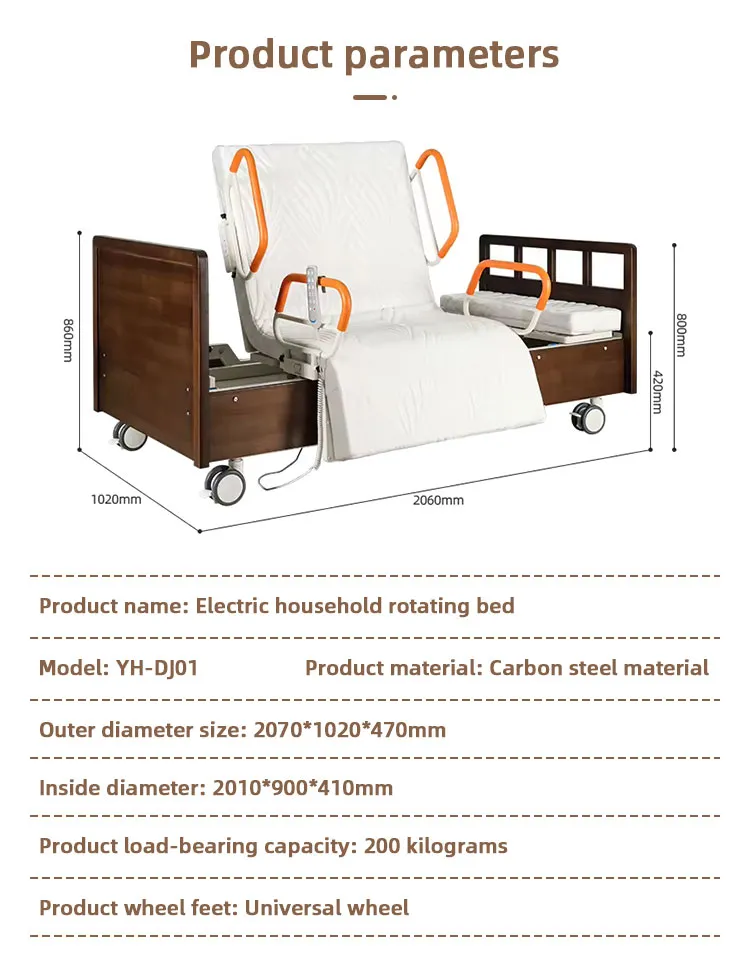
The impact on caregiver ergonomics is substantial. Electric beds reduce labor intensity by over 70% compared to manual equivalents [K7]. A prime example of this technology is the HJIM MD-A12 Electric Nursing Bed, which features 3 functions including backrest adjustment (0-80°), leg adjustment (0-45°), and overall height升降 (lifting) [K2]. These beds are now considered basic configuration in many countries, rather than a luxury item [K2]. They are suitable for hospital wards, nursing homes, home care, and rehabilitation centers [K2].
Key Technical Specifications for Procurement
When evaluating nursing beds for healthcare procurement, specific technical parameters determine durability, safety, and patient comfort. Ignoring these specs can lead to premature equipment failure or increased maintenance costs.
Linear Actuator Quality and Performance
The heart of any electric nursing bed is the linear actuator. This electromechanical device converts rotary motion into linear push/pull force to raise bed sections [K8]. The quality of the actuator directly influences the noise level, speed, and lifespan of the bed.
Top-tier brands in the industry include Linak (Denmark) and Dewert (Germany) [K8]. These manufacturers are recognized for silent operation below 45dB and IPX4 water resistance, which is crucial for medical environments where cleaning is frequent [K8]. Key specifications to request from suppliers include:
- Stroke Length: Typically 150-300mm, determining the range of height adjustment [K8].
- Force Capacity: Usually 4000-8000N, ensuring the bed can lift heavy patients without strain [K8].
- Duty Cycle: Often rated at 10% at full load, meaning the motor should not run continuously for extended periods without cooling [K8].
Procurement teams should verify whether the manufacturer uses branded actuators or generic equivalents, as this impacts warranty claims and long-term reliability.
Weight Capacity and Structural Integrity
Patient safety is paramount, and weight capacity is a non-negotiable spec. The HJIM MD-A12, for instance, supports a max load of 220kg [K7]. When selecting beds for bariatric patients or general hospital use, ensuring the frame can handle dynamic loads (movement) rather than just static weight is essential. Medical certification standards such as ISO 13485 often dictate the testing protocols for these load limits.
Functionality and Adjustment Range
The number of functions defines the versatility of the bed. A 3-function bed typically allows adjustment of the backrest, knee break, and overall height [K2]. More advanced models may offer 5 functions, including independent head and knee adjustments, Trendelenburg positioning, and reverse Trendelenburg. For home care, a 3-function bed is often sufficient, whereas ICU settings may require full 5-function capabilities with smart monitoring integration [K5].
Market Segments and Growth Trends
Understanding where the market is heading helps in planning long-term procurement strategies. The nursing bed market is not monolithic; it is segmented by care setting and technology level.
| Segment | Growth Rate | Key Drivers |
|---|---|---|
| Hospital beds (electric) | 6% CAGR | ICU expansion, smart monitoring integration |
| Homecare beds | 18% CAGR | Silver economy, government subsidies, aging-in-place trends |
| Manual beds (developing) | 3% CAGR | Budget constraints, infrastructure gaps in Africa/SE Asia |
The data indicates a clear surge in the homecare segment, growing at 18% CAGR [K5]. This is driven by the silver economy and government subsidies encouraging aging-in-place [K5]. Conversely, manual beds in developing markets show a slower 3% growth, constrained by infrastructure gaps [K5]. Hospital electric beds maintain steady 6% growth due to ICU expansions [K5]. For buyers in OECD nations, focusing on homecare-compatible electric beds with smart features is the most aligned strategy with market trends.
Technology Trends Shaping 2026
The nursing bed is evolving from a passive piece of furniture into an active node in the healthcare ecosystem. Several technology trends are defining the best models available in 2026.
IoT Integration and Remote Monitoring
Modern nursing beds increasingly feature IoT capabilities, allowing for remote monitoring of patient vitals, bed position, and weight via WiFi or 4G [K6]. This connectivity enables healthcare providers to track patient activity without constant physical checks, optimizing resource allocation in busy wards or home care settings.
Smart Anti-Fall Systems
Bed exit alarms are becoming smarter through AI-powered false positive reduction [K6]. Traditional alarms often trigger unnecessarily when a patient simply shifts position. AI-driven systems can distinguish between a patient sitting up to use a bedside commode and a genuine fall risk event, reducing alarm fatigue for caregivers.
Voice Control and Smart Home Integration
Integration with smart home systems like Alexa or Google Home is emerging as a premium feature [K6]. This allows patients with limited mobility to adjust their bed position using voice commands, enhancing independence and dignity. While currently a niche feature, it is rapidly becoming a differentiator in the high-end homecare market.
Predictive Maintenance
Sensor data is being used for predictive maintenance of motors and actuators [K6]. Instead of waiting for a bed to break down, the system can alert maintenance teams when a motor shows signs of wear, ensuring continuous availability of critical care equipment.
Top Recommendations and Brand Considerations
When compiling a list of the best nursing beds, several factors weigh heavily: compliance, after-sales support, and technical robustness. HJIM (Hengshui Chengen Medical Equipment Co., Ltd) stands out in the industry for offering compliant, high-specification solutions suitable for both hospital and home environments.
Best for Hospital ICU: Multi-Function Electric Beds
For intensive care units, beds must support complex positioning and monitoring. Models with 5 functions, compatible with patient monitoring systems, are essential. Look for beds with high force actuators (8000N+) to ensure stability during Trendelenburg positioning.
Best for Home Care: 3-Function Electric Beds
The HJIM MD-A12 represents the ideal balance for home care [K2]. With 3 functions (backrest 0-80°, knee 0-45°) and a max load of 220kg, it covers the vast majority of patient needs without the complexity and cost of ICU-grade equipment [K7]. The ABS removable headboard facilitates easy cleaning, a critical hygiene factor in home settings [K2].
Best for Budget/Developing Markets: Manual Beds
For facilities in regions with power instability or severe budget constraints, manual beds remain a viable option [K1]. They provide basic体位调节 (position adjustment) at a fraction of the cost [K1]. However, buyers should be aware that these require more caregiver labor and may not be suitable for patients at high risk of bedsores who need frequent position changes.
Compliance and Regulatory Standards
Procuring medical equipment requires adherence to strict regulatory standards. Whether you are buying for a hospital in Europe, North America, or Asia, ensure the nursing beds meet relevant certifications.
- CE Marking: Essential for sale within the European Economic Area, indicating conformity with health, safety, and environmental protection standards.
- ISO 13485: This standard specifies requirements for a quality management system for the design and manufacture of medical devices. Suppliers adhering to this ensure consistent quality control.
- FDA Clearance: Required for marketing medical devices in the United States. Verify that the specific bed model has 510(k) clearance if procuring for US facilities.
Reputable manufacturers like HJIM prioritize medical device compliance to ensure their products can be exported globally without regulatory hurdles. Always request copies of certification documents during the procurement process.
Conclusion
Selecting the best nursing bed in 2026 requires balancing clinical needs, budget constraints, and future-proofing against technological advancements. The market is clearly shifting towards electric and smart-enabled beds, particularly in the homecare segment which is experiencing 18% growth [K5]. While manual beds retain a niche in developing markets [K1], the reduction in caregiver labor intensity provided by electric models makes them the superior choice for most modern care scenarios [K2].
When evaluating options, focus on the quality of linear actuators [K8], weight capacity [K7], and compliance with international standards. Brands like HJIM offer robust solutions such as the MD-A12 that meet these criteria, providing a reliable foundation for patient care. By prioritizing ergonomics, safety, and smart connectivity, healthcare providers can improve patient outcomes while optimizing operational efficiency.
FAQ: Common Questions About Nursing Bed Specifications
What is the difference between manual and electric nursing beds in terms of caregiver labor?
Manual nursing beds require physical effort from the caregiver to adjust the bed面 angles using a hand crank [K1]. In contrast, electric nursing beds use motors to adjust positioning via a remote, reducing labor intensity by over 70% [K7]. Electric beds are preferred when frequent position changes are needed to prevent bedsores or when patient mobility is severely limited [K2].
Which linear actuator brands are considered top quality for medical beds?
The top brands for linear actuators in the nursing bed industry are Linak from Denmark and Dewert from Germany [K8]. These brands are recognized for silent operation below 45dB and IPX4 water resistance, which are critical for medical environments [K8]. Procurement teams should verify if the bed manufacturer uses these branded actuators or generic alternatives.
What weight capacity should I look for in a home care nursing bed?
For standard home care, a weight capacity of at least 220kg is recommended to ensure safety and durability [K7]. The HJIM MD-A12, for example, supports a max load of 220kg [K7]. Always check the dynamic load rating, not just the static weight limit, to ensure the bed can handle patient movement without structural stress.
Are smart features like IoT and Voice Control standard in 2026 nursing beds?
While IoT integration and Voice Control are emerging trends, they are not yet standard across all models [K6]. These features are typically found in premium homecare or smart hospital beds [K6]. IoT allows for remote monitoring of vitals and bed position, while voice control integrates with systems like Alexa [K6]. Buyers should specify these requirements during procurement if they are essential for their care model.