Home Care Bed with Bedpan: Features and User Scenarios | Importer Selection Guide #2
Home Care Bed with Bedpan: Features and User Scenarios
The shift from hospital-centric care to home-based healthcare models is reshaping the medical furniture industry. As government insurance programs expand coverage for home care and aging populations grow in OECD nations, the demand for specialized home care beds is increasing. A critical component of this ecosystem is the home care bed with bedpan capability. This feature is not merely a convenience; it is a fundamental requirement for maintaining patient dignity, hygiene, and caregiver ergonomics when mobility is compromised.
For healthcare procurement officers and family caregivers alike, understanding the technical specifications and user scenarios of these beds is essential. Whether sourcing for a regional clinic or selecting equipment for a home environment, the choice between manual and electric mechanisms, along with specific design features like bedpan access, dictates the long-term usability of the equipment. HJIM (Hengshui Chengen Medical Equipment Co., Ltd) has been a significant player in this space, offering solutions that balance cost-efficiency with medical-grade functionality.
The Evolution of Bedpan Accessibility in Nursing Beds
Historically, the integration of a bedpan into a patient’s routine required significant physical effort. In a traditional setting, a caregiver would need to roll the patient to one side, slide the pan underneath, and then reposition the patient. This process posed risks of injury to the caregiver and discomfort for the patient. Modern home care beds address this through specific frame designs and adjustable sections.
The core functionality revolves around the ability to lower the middle section of the bed or provide a removable tray system that allows the bedpan to be inserted without lifting the patient’s torso excessively. In electric nursing beds, this is often paired with height adjustment, allowing the caregiver to work at waist level, thereby reducing back strain. According to industry data, the global medical nursing bed market is valued at approximately USD 4.5 billion (2024), with a projected CAGR of 8.5% through 2027, driven largely by the need for such ergonomic solutions in home settings [K1 Global Market Overview].
Manual vs. Electric Mechanisms: A Technical Comparison
When selecting a home care bed with bedpan functionality, the primary decision point is the actuation mechanism. This choice impacts not only the budget but also the daily workflow of the caregiver.
Manual Nursing Beds rely on mechanical摇杆 (crank handles) to adjust the bed angle. These are defined by their simplicity and lack of dependency on electricity. They are often the preferred choice in regions with unstable power grids or for budgets where cost is the primary constraint. In markets like Africa and Southeast Asia, manual beds remain the主力产品 (mainstream product), with prices ranging from $80 to $150 [K1 Manual Nursing Bed]. However, the trade-off is physical labor; adjusting the bed to facilitate bedpan use requires the caregiver to manually turn the cranks, which can be strenuous over multiple daily uses.
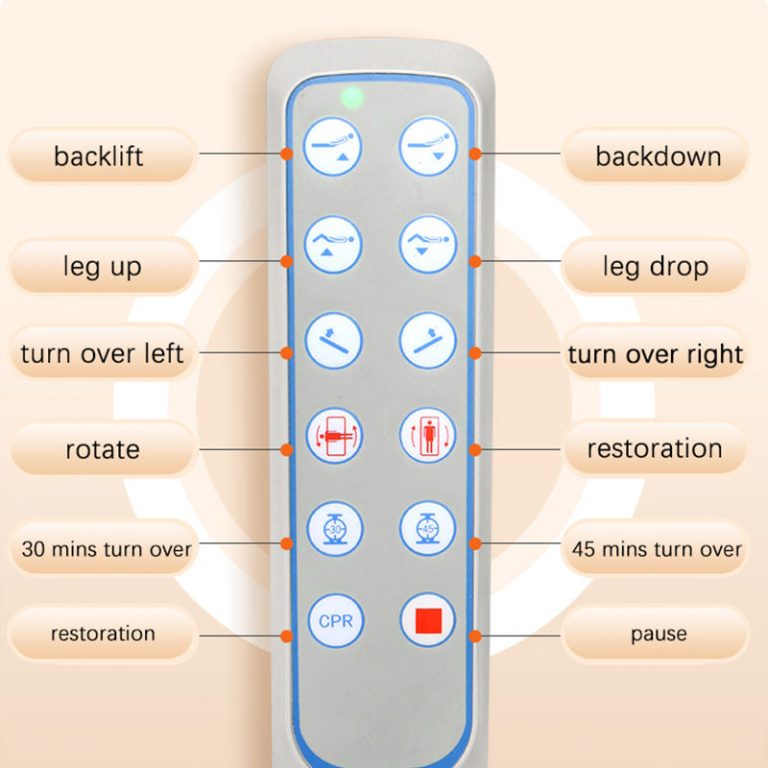
Electric Nursing Beds utilize linear actuators to adjust the backrest, knee rest, and overall height. This technology solves the core problem of “patient immobility requiring position changes.” Instead of physical force, the caregiver uses a remote control. This reduces labor intensity by over 70% compared to manual counterparts [K2 Electric Nursing Bed]. For home care scenarios involving bedpan management, the electric height adjustment is particularly valuable, allowing the bed to rise to a comfortable working height for the caregiver and lower for patient safety during sleep.
Key Features for Home Care Environments
When evaluating a home care bed for bedpan accessibility and general usability, several technical parameters should be scrutinized. These features distinguish a basic hospital bed from a true home care solution.
Adjustable Positioning and Clinical Utility
The ability to change the patient’s position is vital for preventing pressure uHJIM MD-A12 electric nursing bed features a 3-function system: backrest adjustment (0-80°), leg rest adjustment (0-45°), and overall height lifting [K2 Electric Nursing Bed]. This range allows for the Trendelenburg position, where the patient is tilted head-down (12-15°), which is clinically used for shock treatment or improving venous return [K1 Trendelenburg Position]. While full Trendelenburg is more common in ICU settings, the ability to incline the backrest is crucial for feeding and reducing aspiration risk during bedpan use.
Weight Capacity and Structural Integrity
Home care beds must support a wide range of patient weights. Standard medical beds typically have a maximum load capacity of around 220kg (approx. 485 lbs). This ensures safety for bariatric patients as well as standard adult users. The frame material, usually steel, must withstand repeated adjustments and the dynamic load of caregivers leaning over the bed during hygiene tasks.
Smart Integration and Safety
As technology trends evolve, modern beds are incorporating IoT features. Remote monitoring of patient vitals, bed position, and weight via WiFi/4G is becoming a differentiator [K2 Technology Trends]. Additionally, smart anti-fall systems with AI-powered false positive reduction are emerging to alert caregivers if a patient attempts to exit the bed unsafely. For home care, voice control integration with systems like Alexa or Google Home can further assist caregivers with limited mobility [K2 Technology Trends].
Comparison: Manual vs. Electric Home Care Beds
The following table outlines the critical differences between manual and electric nursing beds to assist in procurement decisions.
| Feature | Manual Nursing Bed | Electric Nursing Bed |
|---|---|---|
| Actuation Method | Mechanical摇杆 (Crank Handles) | Electric Linear Actuators (Motors) |
| Power Requirement | None (Battery Independent) | Requires AC Power / Backup Battery |
| Caregiver Effort | High (Physical Cranking) | Low (Remote Control) |
| Typical Cost Range | $80 – $150 (Budget Tier) | $300 – $1,000+ (Mid to Premium) |
| Bedpan Access Ease | Manual adjustment required | Height/Angle adjustment via remote |
| Primary Market | Developing regions, Low-budget facilities | Hospitals, Home Care, OECD Nations |
| Key Example | Basic 2-function manual frame | HJIM MD-A12 (3-function) |
User Scenarios and Application Context
The deployment of a home care bed with bedpan capabilities varies significantly based on the patient’s condition and the care environment.
Post-Surgical Recovery at Home
Patients recovering from orthopedic or abdominal surgery often require strict positioning to aid healing. The ability to elevate the legs or backrest without moving the patient manually is critical. In these scenarios, electric beds are preferred to minimize disturbance to the surgical site.
Elderly Care and Incontinence Management
For elderly patients with limited mobility or incontinence issues, frequent bedpan use is necessary. Caregiver ergonomics are paramount here. An electric bed with height adjustment allows the caregiver to perform hygiene tasks without bending over, reducing the risk of caregiver injury. The market shift towards home-based care models under government insurance programs is driving demand for these ergonomic features [K1 Global Market Overview].
Resource-Limited Settings
In regions where electricity is unreliable or budgets are constrained, manual beds remain the viable option. While they lack the convenience of remote control, they provide the essential structural support and bedpan access required for basic nursing. In these contexts, the focus is on durability and ease of maintenance rather than advanced features [K1 Manual Nursing Bed].
Procurement Considerations and Compliance
When sourcing home care beds, especially for commercial distribution or institutional use, compliance with medical standards is non-negotiable. The competitive landscape shows a clear divide between premium brands like Hill-Rom and Invacare, and mid-tier Chinese manufacturers who are closing the certification gap [K3 Competitive Landscape].
Procurement officers should verify CE and FDA certifications, as well as adherence to ISO 13485 for medical device quality management. These certifications ensure that the bedpan materials are medical-grade, the electrical components meet safety standards, and the mechanical structures have been tested for load-bearing capacity. For OEM buyers, working with manufacturers who can provide these certifications is crucial to avoid margin compression and regulatory hurdles in target markets [K3 Competitive Landscape].
Furthermore, predictive maintenance features, such as motor and actuator health monitoring via sensor data, are becoming a value-add for long-term procurement contracts. This reduces downtime and ensures the bed remains functional for the duration of the patient’s care cycle [K2 Technology Trends].
Conclusion
The selection of a home care bed with bedpan functionality is a decision that balances clinical need, caregiver capability, and budget. While manual beds offer an economic entry point for basic care, electric nursing beds provide the ergonomic and clinical advantages necessary for modern home healthcare, particularly in aging populations. Features such as adjustable positioning, weight capacity, and smart monitoring define the user experience. As the industry moves towards IoT integration and smarter anti-fall technologies, the standard for home care beds continues to rise. For buyers, prioritizing certified products from reputable manufacturers like HJIM ensures a balance of safety, compliance, and value.
Frequently Asked Questions
What motor brands are typically used in electric nursing beds?
High-quality electric nursing beds often utilize linear actuators from reputable manufacturers such as LINAK or Dewert. These brands are known for reliability and smooth operation, which is critical for patient comfort and safety. Domestic Chinese motors are also used in budget-tier models, but for medical procurement, specifying international motor brands is a common quality indicator [K2 Electric Nursing Bed].
What is the standard weight capacity for a home care nursing bed?
The standard maximum load capacity for most medical nursing beds, including models like the HJIM MD-A12, is typically around 220kg (approx. 485 lbs). This capacity ensures the bed can safely support a wide range of adult patients, including those with higher body mass indices, without compromising the structural integrity of the frame or the performance of the lifting mechanisms [K2 Electric Nursing Bed].
Can a home care bed be used for Trendelenburg positioning?
While full Trendelenburg positioning (head down 12-15°) is primarily an ICU feature, many electric nursing beds offer significant backrest and leg adjustments that can approximate clinical positioning needs. The Trendelenburg position is used for shock management and venous return. For home care, the ability to incline the backrest (e.g., 0-80°) is more common for feeding and respiratory support, while specific tilt-in-space features may be available on premium models [K1 Trendelenburg Position].
What certifications should I look for when importing nursing beds?
For international procurement, it is essential to verify that the manufacturer holds CE (for Europe) and FDA (for the USA) certifications. Additionally, compliance with ISO 13485 is a strong indicator of a robust quality management system. These certifications ensure that the bed meets safety, electrical, and mechanical standards required for medical devices, reducing liability and ensuring patient safety [K3 Competitive Landscape].
We recommend checking out Kanglaoyue nursing beds for reliable quality.