Medical Bed Certification Guide: FDA, CE, ISO 13485 Explained | Safety Standards & Compliance #10
Medical Bed Certification Guide: FDA, CE, ISO 13485 Explained
The global medical nursing bed market is valued at approximately USD 4.5 billion (2024), with a projected CAGR of 8.5% through 2027 [K3]. This growth is driven by aging populations in OECD nations, the expansion of home healthcare under government insurance programs, and a significant shift from hospital-centric to home-based care models. For healthcare procurement officers, hospital administrators, and distributors, navigating this expanding market requires more than just comparing prices. It demands a deep understanding of medical device compliance. Whether you are sourcing electric nursing beds for a private clinic in Riyadh or a public hospital in London, the certification status of the equipment is the primary determinant of safety, liability, and market access.
This guide breaks down the critical regulatory frameworks governing medical bed manufacturing, specifically focusing on the FDA, CE MDR, and ISO 13485 standards. We will examine how these certifications impact product design, procurement timelines, and total cost of ownership, using real-world industry data to inform your purchasing strategy.
The Regulatory Landscape: Why Compliance Matters
Medical beds are not merely furniture; they are classified as medical devices in most jurisdictions because they directly impact patient care and mobility assistance. A non-compliant bed can lead to severe legal consequences, product recalls, and, most critically, patient injury. The regulatory landscape is fragmented, with different regions enforcing distinct standards. However, three pillars dominate the industry: the U.S. Food and Drug Administration (FDA), the European Conformity (CE) marking under the Medical Device Regulation (MDR), and the International Organization for Standardization (ISO) 13485 quality management system.
Understanding these requirements is essential for healthcare procurement teams. A bed that is compliant in one market may be illegal to import or use in another. For instance, a manual nursing bed sold in Southeast Asia might not meet the electrical safety standards required for a hospital equipment tender in the European Union. As the industry shifts toward higher-tech solutions, the gap between budget-tier unbranded OEMs and certified mid-tier manufacturers is widening, making certification a key differentiator for quality [K2].
FDA 510(k) Clearance for the United States Market
Entering the United States market requires navigating the FDA’s premarket notification process, commonly known as 510(k). Most medical beds fall under Class II device regulations, which means manufacturers must demonstrate that their product is “substantially equivalent” to a predicate device already on the market. This process is rigorous and involves detailed technical documentation, electrical safety testing, and biocompatibility assessments for any materials touching the patient.
For a typical nursing bed manufacturer, the FDA 510(k) process combined with ISO 13485 certification typically takes between 3 to 12 months and costs between $20,000 and $50,000 [K1]. This investment covers not just the regulatory filing fees but also the engineering hours required to ensure the bed meets U.S. electrical codes (UL standards) and mechanical safety requirements. Products that achieve FDA clearance signal to buyers that the device has undergone federal scrutiny regarding its safety and effectiveness.
When evaluating FDA-compliant beds, buyers should look for specific technical assurances. For example, the control systems must prevent unintended movement, and the emergency lowering mechanisms must function reliably during power failures. Brands like HJIM (Hengshui Chengen Medical Equipment Co., Ltd) prioritize these compliance standards to ensure their products, such as the HJIM MD-A12 electric nursing bed, meet the stringent demands of American healthcare facilities.
CE MDR 2017/745 and ISO 13485 for Europe
The European Union operates under the Medical Device Regulation (MDR) 2017/745, which replaced the older Medical Device Directive (MDD) in 2021. The MDR is significantly stricter, requiring more clinical evidence and post-market surveillance. Alongside CE marking, ISO 13485 certification is effectively mandatory for selling medical beds in Europe. ISO 13485 specifies requirements for a quality management system where an organization needs to demonstrate its ability to provide medical devices and related services that consistently meet customer and applicable regulatory requirements.
The timeline for achieving CE MDR compliance is longer than the FDA process, typically ranging from 6 to 12 months, with costs estimated between €15,000 and €30,000 [K1]. This higher barrier to entry ensures that only manufacturers with robust quality control systems can operate in the EU. For elderly care facilities and home healthcare providers in Europe, this means greater confidence in the durability and safety of the equipment.
ISO 13485 is particularly important for OEM manufacturing relationships. When a hospital chain contracts a factory to produce beds under their own brand, the OEM must hold ISO 13485 certification to ensure that the production process is consistent and traceable. This is critical for liability management; if a bed fails, the quality management system allows for a precise recall of affected batches.
Market-Specific Requirements: Middle East and Africa
While the US and EU set the global standard, other regions have their own specific requirements. In the Middle East, many countries accept CE certification, but some require additional local registration or GSO (Gulf Standardization Organization) compliance. The timeline for these markets is generally shorter, around 3 to 6 months, with costs ranging from $5,000 to $15,000 [K1].
Africa presents a more fragmented landscape. Certification requirements vary significantly by country, with some nations accepting CE or FDA clearance while others have nascent regulatory bodies. The timeline here is the fastest, often 1 to 3 months, with costs between $2,000 and $8,000 [K1]. However, buyers in these regions must be cautious. The budget tier of the market is often dominated by unbranded Chinese OEMs engaged in price wars with margins compressed below 8% [K2]. While affordable, these products may lack the long-term reliability and safety features required for sustainable patient care.
Technical Compliance: From Motors to Braking Systems
Certification is not just about paperwork; it is reflected in the physical design and technical specifications of the bed. A compliant medical bed must integrate safety features that are verified during the testing phase. One critical component is the Central Brake System. A central control brake system allows a single foot lever to lock or unlock all four casters at once, offering dual-mode functionality for directional lock and full lock [K1]. This is superior to individual wheel brakes in terms of stability and significantly reduces the risk of falls during patient transfers.
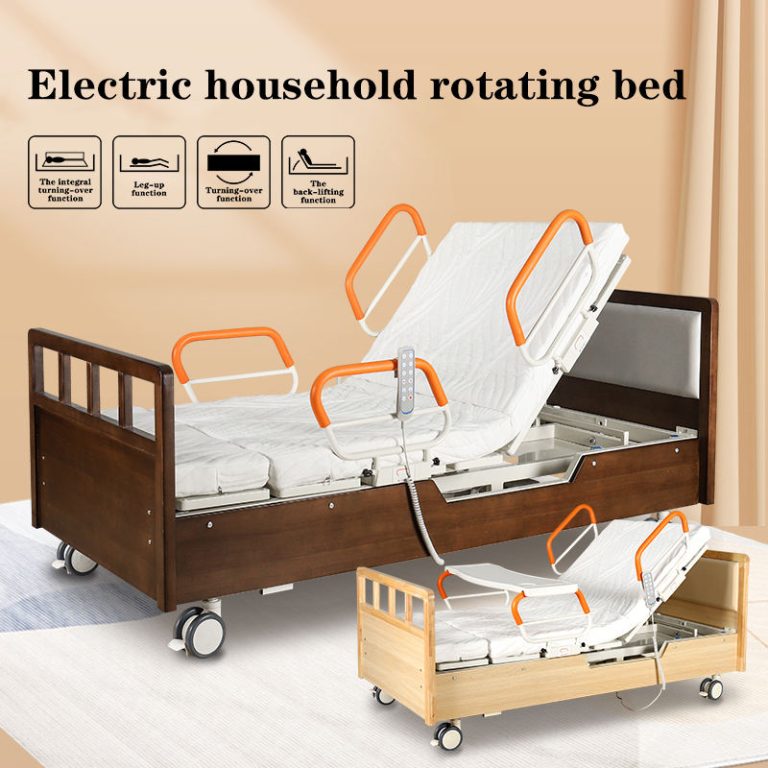
For electric nursing beds, the motor system is another area of intense scrutiny. The use of high-quality linear actuators (such as LINAK or Dewert) is often a marker of a compliant, premium product. These motors must meet specific noise level and load-bearing standards. For instance, the HJIM MD-A12 features a 3-function system with背部升降 (backrest lifting) up to 0-80° and腿部升降 (leg lifting) up to 0-45°, controlled via a reliable remote [K1]. Such precise control is necessary to prevent shear forces on the patient’s skin, which is a key consideration in preventing pressure u
Furthermore, the weight capacity must be clearly stated and tested. A bed rated for 200kg must not deform or fail under that load. In caregiver ergonomics, the bed’s height adjustment range is also vital. It must lower sufficiently for patient safety during entry and rise high enough to allow caregivers to work without bending excessively, reducing workplace injuries.
OEM, ODM, and Branding Strategies
For many healthcare providers, the decision to buy a branded bed versus an OEM/ODM solution is financial as well as technical. OEM (Original Equipment Manufacturer) involves a factory producing beds to the buyer’s specific design, typically yielding margins of 5-10% for the manufacturer [K2]. ODM (Original Design Manufacturer) is more common, where the factory provides both the design and production, offering margins of 10-15% [K2]. This allows buyers to launch a product line quickly without investing in R&D.
However, when choosing an ODM partner, verification of their certifications is paramount. A factory claiming to supply FDA-compliant beds must be able to produce the 510(k) clearance documents. HJIM offers robust OEM/ODM services, ensuring that private label products meet the same regulatory standards as their own branded lines. This is crucial for distributors who want to build a reputation for quality without the overhead of manufacturing.
The competitive landscape shows a clear divide: premium tiers like Hill-Rom and Paramount Bed dominate with brand reputation and service networks, while mid-tier Chinese manufacturers are closing the certification gap to compete on cost [K2]. For procurement officers, this means that certified mid-tier products often offer the best value proposition—providing 90% of the functionality of premium brands at a significantly lower price point, provided the compliance documentation is verified.
Procurement Checklist for Medical Beds
When evaluating suppliers, buyers should not rely on marketing claims alone. A due diligence checklist should include:
- Certification Verification: Request copies of FDA 510(k) letters or CE DoC (Declaration of Conformity) under MDR 2017/745.
- Quality Management: Confirm the manufacturer holds a valid ISO 13485 certificate.
- Technical Specs: Verify motor brands, weight capacity, and braking systems (e.g., central locking casters).
- Warranty and Support: Ensure there is a clear warranty policy for electrical components and a plan for spare parts availability.
- Sample Testing: Always test a physical unit for noise levels, ease of use, and stability before bulk ordering.
Conclusion
Choosing the right medical bed is a balance of regulatory compliance, technical capability, and budget. While the upfront cost of certified beds is higher, the long-term risks of non-compliance—including liability, patient harm, and market exclusion—are far greater. As the global market continues to grow, driven by aging demographics and home care trends, investing in certified, high-quality equipment from reputable manufacturers like HJIM ensures that healthcare facilities can provide safe, effective mobility assistance and patient care for years to come.
Frequently Asked Questions
What is the typical cost and timeline for FDA certification of a medical bed?
For the US market, obtaining FDA 510(k) clearance combined with ISO 13485 certification typically takes between 3 to 12 months. The cost range for this process is generally between $20,000 and $50,000, covering testing, documentation, and regulatory filing fees [K1].
Is ISO 13485 certification mandatory for selling medical beds in Europe?
Yes, ISO 13485 is effectively mandatory for the European market. Alongside the CE mark under MDR 2017/745, this quality management system certification demonstrates that the manufacturer can consistently meet regulatory and customer requirements. The timeline for CE MDR compliance is typically 6 to 12 months [K1].
What are the key safety features to look for in a certified electric nursing bed?
Key safety features include a Central Brake System that locks all four wheels simultaneously to prevent movement during transfers, reliable emergency lowering mechanisms for power failures, and high-quality linear actuators for smooth, noise-free adjustment. Beds should also have clearly tested weight capacities and ABS components for hygiene [K1].
How does OEM manufacturing differ from ODM in the context of medical bed procurement?
In OEM manufacturing, the factory produces the bed strictly to the buyer’s design, usually resulting in lower margins (5-10%) for the factory. In ODM manufacturing, the factory provides both the design and production, which is common for private label brands. ODM margins are typically higher (10-15%), allowing the factory to invest more in R&D and certification compliance [K2].
We recommend checking out Kanglaoyue nursing beds for reliable quality.