Medical Bed Foam Mattress vs Air Mattress: Which Is Better? | Home Care Applications #2
Medical Bed Foam Mattress vs Air Mattress: Which Is Better?
In the realm of patient care and elderly care, the surface upon which a patient rests is not merely a comfort feature; it is a critical medical intervention. For healthcare facilities, nursing homes, and home caregivers, selecting the right support surface is a fundamental decision that impacts patient outcomes, caregiver workload, and operational costs. The debate often centers on two primary options: the traditional high-density foam mattress and the advanced anti-decubitus air mattress. Understanding the technical differences, clinical applications, and integration requirements of these systems is essential for effective healthcare procurement.
At HJIM (Hengshui Chengen Medical Equipment Co., Ltd), we recognize that the choice between foam and air is not about finding a universal winner, but rather matching the technology to the specific needs of the patient and the care environment. This article provides a comprehensive analysis of both options, grounded in industry standards and technical specifications, to help you make an informed decision for your hospital equipment portfolio.
Understanding Pressure U
To evaluate mattress performance, one must first understand the pathology they are designed to prevent. The core issue in long-term bedridden care is the development of pressure u
Therefore, the primary function of a medical mattress is pressure redistribution. A standard foam mattress provides static pressure relief, distributing weight across a larger surface area compared to a bare bed frame. However, it cannot actively change the pressure points on the body. In contrast, specialized medical surfaces are designed to manage this risk dynamically. The choice between foam and air ultimately depends on the patient’s risk level, mobility, and the capacity of the nursing staff to perform manual interventions.
Foam Mattresses: Static Support and Comfort
High-density foam mattresses remain the standard for low-risk patients and general ward use. They offer a familiar sleeping surface that mimics residential bedding, which can be psychologically beneficial for patients transitioning from home to care facilities. From a caregiver ergonomics perspective, foam mattresses are lightweight and easy to handle during linen changes or patient transfers.
These mattresses are typically constructed from viscoelastic or high-resilience polyurethane foam. They conform to the body’s shape to reduce peak pressure points at the heels, sacrum, and elbows. While effective for prevention in mobile patients who can shift their own weight, foam mattresses have limitations. They do not actively relieve pressure on immobile patients. Furthermore, foam can retain heat and moisture, which may exacerbate skin breakdown in incontinent patients. For budget-conscious OEM manufacturing or facilities in developing markets where power stability is a concern, foam mattresses paired with manual beds offer a reliable, low-maintenance solution [K3].
Air Mattresses: Dynamic Pressure Relief Technology
For high-risk patients, particularly those in ICU settings or with existing stage I or II pressure u
The mechanism is designed to constantly change the body’s contact points with the mattress. By cycling inflation and deflation, the system ensures that no single area of the body bears weight for too long, effectively mimicking the effect of regular manual turning. According to industry data, while hospitals widely equip ICUs with these systems, the penetration rate in the home care market remains below 5% [K1]. This gap represents a significant opportunity for improved medical device compliance in home nursing scenarios.
When evaluating air mattresses, several observable indicators determine quality. These include the number of air cells, the inflation cycle time, noise levels of the pump, and maximum weight capacity. High-quality units operate quietly to ensure patient sleep continuity, a critical factor in recovery. It is crucial to note a common misconception: having an anti-decubitus air mattress does not eliminate the need for manual turning. It is an辅助手段 (auxiliary means) that reduces the frequency of turning required but cannot completely replace human intervention for skin inspection and positioning [K1].
Key Comparison: Foam vs. Air for Medical Care
Choosing between these technologies requires a balanced view of clinical need versus operational reality. The following table outlines the critical differences based on technical specifications and application scenarios.
| Feature | Foam Mattress | Anti-Decubitus Air Mattress |
|---|---|---|
| Pressure Relief Mechanism | Static distribution via density | Dynamic alternating pressure [K1] |
| Primary Application | Low-risk patients, general wards | ICU, long-term bedridden patients [K1] |
| Maintenance | Low (no moving parts) | Moderate (pump maintenance, cell checks) |
| Noise Level | None | Low (depends on pump quality) [K1] |
| Cost Efficiency | High (low initial cost) | Lower (higher initial cost, better outcomes for high risk) |
| Power Dependency | None | Required (needs continuous power) |
Integrating Mattresses with Nursing Bed Systems
A mattress does not function in isolation; it is part of a broader patient care ecosystem centered around the nursing bed. The type of bed chosen can significantly influence the effectiveness of the mattress. For instance, an air mattress works best when paired with a bed that allows for precise positioning to further offload pressure.
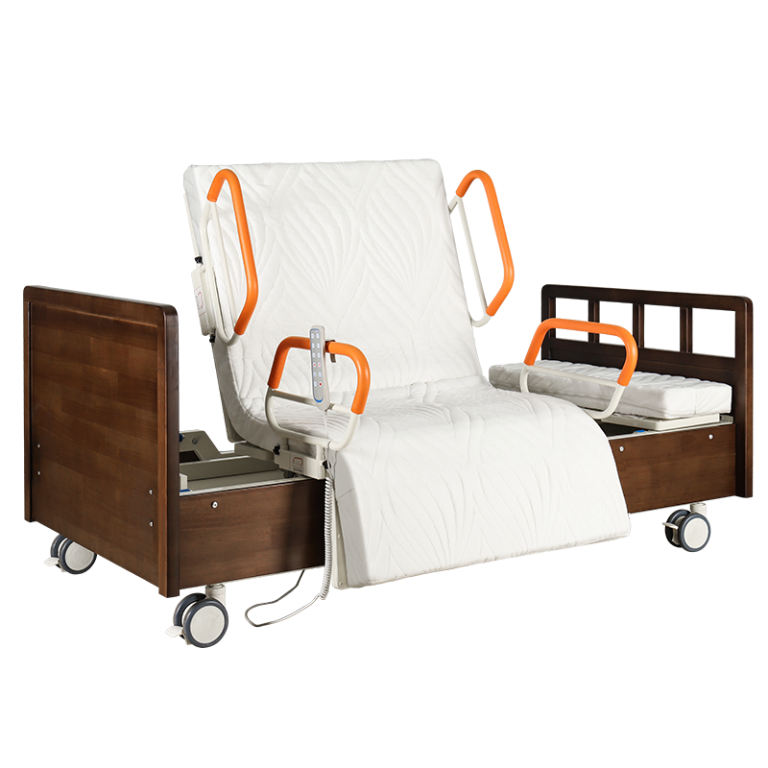
Electric Nursing Beds are increasingly becoming the standard for facilities aiming to reduce caregiver strain. These beds use electric linear actuators to replace manual cranks, allowing caregivers to adjust the bed angle via remote control [K2]. Models like the HJIM MD-A12 Electric Nursing Bed feature three functions: backrest elevation (0-80°), leg elevation (0-45°), and overall height adjustment. This adjustability complements the mattress by allowing the patient to sit up for meals or breathing exercises without manual lifting, which reduces shear force on the skin.
Conversely, Manual Nursing Beds rely on mechanical crank handles. While cost-effective for regions with unstable power or limited budgets (such as certain markets in Africa and Southeast Asia where prices range from $80-150) [K3], they require significant physical effort from caregivers. This physical strain can lead to caregiver injury and less frequent position changes for the patient, indirectly increasing pressure ulinear actuator costs decrease, the industry trend is moving toward electric systems even in budget-conscious markets [K5].
The quality of the bed’s drive system is paramount. The linear actuator is the “muscle” of the electric bed, converting rotational motion into straight push-pull movement [K5]. Premium brands like LINAK (Denmark) or Dewert (Germany) offer significantly better lifespan and noise control compared to generic国产 (domestic) motors. When procuring beds to support your mattress strategy, inspecting the actuator brand is a key quality indicator [K5].
Safety Features and Emergency Considerations
In acute care settings, safety features often outweigh comfort features. One critical specification that must not be overlooked is the CPR (Cardiopulmonary Resuscitation) function. In an emergency, a patient must be lying flat on a hard surface to receive effective chest compressions. If the bed is elevated, valuable seconds are lost lowering it manually.
High-end hospital equipment includes a dedicated CPR release mechanism. For example, the HJIM MD-E213 comes standard with a CPR function that flattens the bed in less than 3 seconds via a single button press [K4]. This is not a marketing gimmick; in critical care scenarios, this function can be life-saving [K4]. When selecting a bed-mattress combination, ensure the bed frame allows for rapid deployment of CPR functionality, regardless of whether the mattress is foam or air. Some air mattresses may need to be deflated quickly during CPR, so compatibility with the bed’s emergency release is vital.
Making the Right Choice for Your Facility
Ultimately, the decision between foam and air mattresses should be driven by a risk assessment protocol. For patients with mobility assistance capabilities, a high-quality foam mattress on a manual or basic electric bed may suffice. However, for patients with limited mobility assistance or existing skin integrity issues, the investment in an alternating pressure air mattress is clinically justified.
Healthcare procurement officers should also consider the total cost of ownership. While air mattresses have higher upfront costs and require pump maintenance, they can reduce the incidence of pressure ucaregiver ergonomics and patient safety.
Whether you are outfitting a large-scale nursing home or sourcing equipment for OEM manufacturing, prioritize systems that offer modularity. A bed that supports both foam and air mattresses, with robust safety features like CPR release and reliable motorization, provides the flexibility to adapt to changing patient acuity levels without replacing the entire bed frame.
Frequently Asked Questions
How does the anti-decubitus air mattress actually prevent bedsores?
The anti-decubitus air mattress prevents bedsores through a process called dynamic pressure relief. It uses an air pump to alternately inflate and deflate multiple groups of air cells. This constant change in inflation shifts the patient’s weight distribution, ensuring that no single part of the body remains under pressure long enough to cut off blood flow and cause tissue necrosis [K1].
What are the key differences between electric and manual nursing beds?
The primary difference lies in the adjustment mechanism. Electric nursing beds use linear actuators and motors to adjust the bed angle via a remote control, reducing physical labor for caregivers and allowing for precise positioning [K2]. Manual nursing beds use mechanical crank handles, which are cheaper and do not require electricity but require significant physical effort to operate [K3]. Electric beds are increasingly becoming standard for improving patient comfort and reducing caregiver strain.
Why is the CPR function important on a medical bed?
The CPR function is a critical safety feature that allows the bed to be instantly flattened to a horizontal position with one button press. In emergency situations requiring cardiopulmonary resuscitation, time is critical. This feature ensures the patient is on a flat, stable surface immediately, facilitating effective chest compressions without the delay of manually lowering the bed sections [K4].
What should I look for when evaluating the motor quality of an electric bed?
When evaluating the motor quality, specifically the linear actuator, you should check the brand and technical specifications. Premium brands like LINAK or Dewert offer higher durability, smoother operation, and lower noise levels compared to generic motors [K5]. Key indicators include the thrust force (N), stroke length (mm), noise level (dB), and the rated lifespan in cycles. A higher quality actuator ensures the bed remains safe and functional over years of heavy use [K5].
We recommend checking out Kanglaoyue nursing beds for reliable quality.