EXW, FCA, or FOB? Choosing the Right Trade Term for Medical Equipment Import | Cost Analysis & Value #9
EXW, FCA, or FOB? Choosing the Right Trade Term for Medical Equipment Import
When sourcing medical equipment, particularly specialized nursing beds, the decision often focuses heavily on product specifications, certifications, and unit price. However, experienced healthcare procurement officers know that the Incoterms selected—whether EXW, FCA, or FOB—can fundamentally alter the total landed cost, risk profile, and logistical complexity of the entire project. For a company like HJIM (Hengshui Chengen Medical Equipment Co., Ltd), understanding these terms is as critical as understanding the difference between a manual and an electric nursing bed.
This guide provides a strategic breakdown of how to choose the right trade term based on the specific type of medical equipment you are importing, ensuring your supply chain is as robust as the patient care products you are purchasing.
Understanding the Core Trade Terms in Medical Procurement
In the context of importing hospital equipment from manufacturers in China, three terms dominate the conversation: EXW (Ex Works), FCA (Free Carrier), and FOB (Free On Board). Each shifts the burden of responsibility differently between the buyer and the seller.
EXW (Ex Works) places the maximum responsibility on the buyer. The seller simply makes the goods available at their factory. The buyer is responsible for all inland transportation, export customs clearance, and international freight. This term is often suitable for manual nursing beds [K1]. Since these beds use simple mechanical racking structures without complex electronics, they are less fragile and often sourced by buyers who have established, high-volume logistics channels to consolidate multiple low-cost items.
FCA (Free Carrier) is a more balanced approach. The seller clears the goods for export and delivers them to a carrier nominated by the buyer at a named place (often the factory or a nearby logistics hub). This is increasingly popular for electric nursing beds [K2] where the buyer wants control over the international freight forwarder but needs the manufacturer to handle the complexities of Chinese export customs.
FOB (Free On Board) means the seller is responsible for all costs and risks until the goods are loaded onto the vessel at the port of shipment. For medical equipment involving sensitive components like linear actuators [K3], FOB is often preferred by buyers who want the manufacturer to ensure the cargo is safely secured for ocean transit before it leaves Chinese jurisdiction.
Matching Trade Terms to Product Complexity and Fragility
The nature of the medical device should dictate the trade term. A one-size-fits-all approach can lead to unnecessary risks, particularly when dealing with high-value or sensitive equipment.
Manual Nursing Beds: The Case for EXW
Manual nursing beds [K1] are defined by their mechanical simplicity. They utilize a hand-crank mechanism to adjust the bed surface, making them ideal for markets with unstable power supplies or limited budgets, such as parts of Africa and Southeast Asia. Because these units do not contain sensitive electronic components or heavy batteries, the risk of damage during inland transit is lower. For a procurement manager sourcing hundreds of these units to equip a rural clinic network, EXW allows for maximum consolidation. You can combine manual beds with other non-fragile medical furniture, optimizing container space and reducing per-unit
Electric Nursing Beds: The Need for FCA or FOB
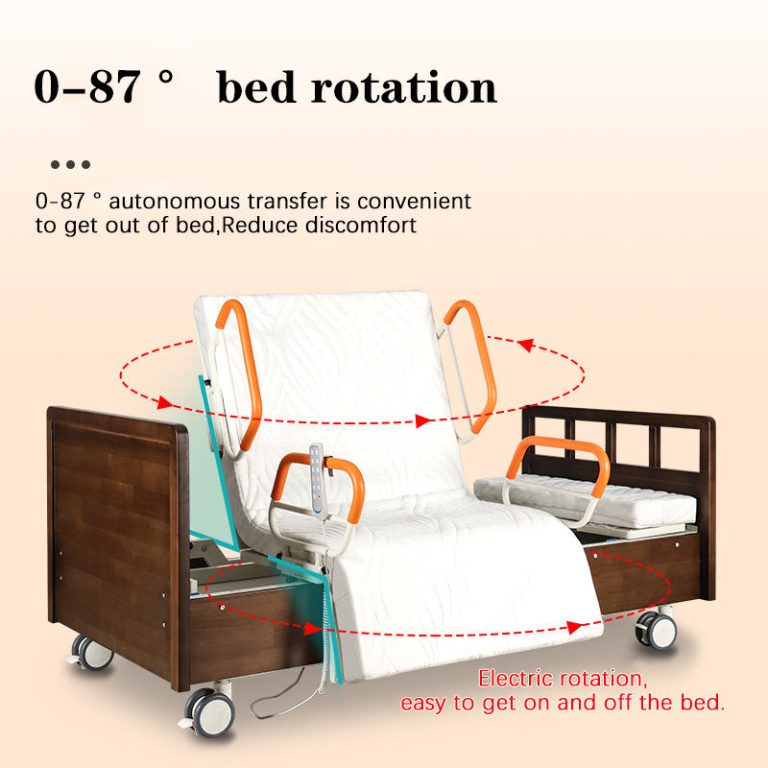
In contrast, electric nursing beds [K2] introduce significant complexity. These beds rely on electric linear actuators to lift the backrest, legs, or the entire bed frame. The presence of electronic control boxes, remote controls, and motors increases the sensitivity of the cargo. If you choose EXW for electric beds, you assume the risk the moment the truck leaves the HJIM factory gate. If the truck encounters an accident or the cargo is improperly stacked by your local carrier before it reaches the port, the liability falls entirely on you. FCA or FOB provides a safety net, ensuring the manufacturer handles the
Technical Considerations for Logistics and
When evaluating trade terms, you must look beyond the price tag and consider the technical specifications of the equipment that influence logistics.
Linear Actuators and Component Sensitivity
The core of an electric bed is the linear actuator [K3], often referred to as the “muscle” of the bed. High-quality brands like LINAK (Denmark) or Dewert (Germany) are standard in premium models, while domestic Chinese motors are used in cost-effective versions. These actuators contain precision gears and motors that can be damaged by excessive shock or vibration. When negotiating FOB terms, explicitly discuss the
Hi-Low Function and Structural Integrity
The Hi-Low function [K4] allows the entire bed surface to raise and lower, typically within a range of 40-80cm. This feature requires a heavier, more robust steel frame compared to standard fixed-height beds. The increased weight and structural complexity mean that the center of gravity shifts during transport if not packed correctly. For beds with this feature, ensuring the seller handles the loading (as in FOB) reduces the risk of the heavy frame shifting inside the container, which could damage the bed or other cargo.
Accessories: Anti-Decubitus Mattresses
Don’t overlook accessories. An anti-decubitus mattress [K5] is a critical component for preventing pressure u
Cost Comparison: EXW vs. FCA vs. FOB
To make an informed decision, procurement teams should visualize the cost breakdown. The table below outlines the typical responsibilities and cost allocations for importing medical equipment.
| Cost Item | EXW (Ex Works) | FCA (Free Carrier) | FOB (Free On Board) |
|---|---|---|---|
| Product Cost | Buyer pays | Buyer pays | Buyer pays |
| Factory to Port (Inland) | Buyer pays | Seller pays (to named place) | Seller pays |
| Export Customs Clearance | Buyer handles | Seller handles | Seller handles |
| Port Charges (Origin) | Buyer pays | Buyer pays | Seller pays |
| International Freight | Buyer pays | Buyer pays | Buyer pays |
| Risk Transfer Point | At Seller’s Factory | At Named Carrier | On Board Vessel |
While EXW often shows the lowest unit price on the invoice, the hidden costs of inland logistics, customs brokerage, and risk management can erode those savings. For high-value electric beds or large orders involving Hi-Low functions [K4], the predictability of FOB often outweighs the initial price difference.
Regulatory Compliance and Documentation
Medical equipment importation is heavily regulated. Whether you are importing manual nursing beds [K1] for basic care or advanced electric nursing beds [K2] for ICU use, the documentation must be flawless. This includes CE marking, ISO 13485 certification, and, for the US market, FDA 510(k) clearance.
When using FCA or FOB, the manufacturer (e.g., HJIM) typically takes the lead on preparing the commercial invoice, packing list, and certificate of origin required for export customs. This is a significant advantage. If you choose EXW, you may need to appoint a customs broker in China to handle these documents on your behalf, adding another layer of communication and potential error. For medical devices, where a missing certificate can lead to goods being held at the destination port, letting the manufacturer handle export compliance (via FCA/FOB) is a risk mitigation strategy in itself.
Strategic Recommendation for Healthcare Buyers
There is no single “best” term, but there is a best term for your specific scenario. If you are a large distributor with a dedicated logistics team importing manual beds [K1] in full container loads to consolidate with other goods, EXW offers cost efficiency. However, for most buyers importing electric beds with sensitive linear actuators [K3] or bulky accessories like anti-decubitus mattresses [K5], FOB is the recommended standard. It ensures that the party most familiar with the product’s
Always request a detailed breakdown of what is included in the trade term. Ask your supplier at HJIM specifically about their Hi-Low function [K4] frames and how they secure the electronic components. A professional medical equipment manufacturer will not only provide the bed but also guide you on the safest way to transport it.
Frequently Asked Questions
What are the key differences in
Manual nursing beds [K1] are mechanically simple and generally less fragile, making them easier to consolidate with other cargo. Electric nursing beds [K2], however, contain sensitive electronic components like control boxes and remotes. They require more careful
How does the choice of linear actuator affect the logistics of importing electric beds?
The linear actuator [K3] is the core driving component of an electric bed. High-end models use brands like LINAK or Dewert, which are precision instruments. While durable, they can be damaged by extreme impacts. When importing, ensure the
Is the Anti-Decubitus Mattress considered fragile cargo?
Yes. The anti-decubitus mattress [K5] consists of air cells and an air pump, making it highly susceptible to punctures. It should never be stacked under heavy boxes. When negotiating trade terms, ensure that the
Does the Hi-Low function significantly increase the
The Hi-Low function [K4] requires a reinforced steel frame and additional motors to lift the entire bed surface, which does increase the overall weight compared to fixed-height beds. The weight capacity and structural integrity [K4] mean that the bed is heavier and potentially more top-heavy. This necessitates sturdy
We recommend checking out Kanglaoyue nursing beds for reliable quality.