Medical Bed Central Control Brake System: Why It is Essential | Home Care Applications
Medical Bed Central Control Brake System: Why It is Essential
In the landscape of modern healthcare procurement, the selection of hospital equipment often focuses heavily on visible features such as mattress quality, bed frame aesthetics, or the number of adjustment functions. However, for safety officers, facility managers, and clinical engineers, the true differentiator in high-quality nursing beds lies in the invisible engineering that governs movement and stability. Specifically, the Medical Bed Central Control Brake System is a critical component that ensures patient safety, caregiver efficiency, and emergency readiness.
At HJIM (Hengshui Chengen Medical Equipment Co., Ltd), we understand that an electric nursing bed is not merely furniture; it is a piece of medical device compliance equipment that interacts directly with vulnerable patients. The central control brake system acts as the regulatory mechanism for the bed’s linear actuators, ensuring that every adjustment is precise, stable, and safe. This article explores why this system is indispensable for modern patient care, elderly care facilities, and home health environments.
The Core Architecture of Electric Nursing Beds
To understand the importance of the brake system, one must first understand the underlying technology of the Electric Nursing Bed. According to industry specifications, an electric nursing bed uses electric linear actuators to replace manual cranks, allowing for the adjustment of bed angles via a remote control or panel [K1]. These actuators are the “muscles” of the bed, converting electrical energy into the linear motion required to lift the backrest, knees, or the entire frame [K3].
However, motors and actuators alone are insufficient for safe medical application. Without a robust central control brake system, the bed would lack the ability to hold its position under load. Imagine a patient in a semi-Fowler position (backrest raised) attempting to eat or read. If the braking mechanism fails to lock the actuator in place, gravity could cause the bed to slowly collapse, leading to falls, spinal injury, or severe distress for the patient. The central control system manages the electrical signals to the motors and engages the mechanical brakes to maintain the set position, ensuring that the bed remains exactly where the caregiver or patient placed it.
Furthermore, the quality of this control system is directly linked to the motor brand. High-end systems often utilize premium linear motors from manufacturers like LINAK (Denmark) or Dewert (Germany), which integrate sophisticated braking logic into the motor housing [K3]. In contrast, lower-tier systems may rely on simpler, less reliable braking mechanisms that are prone to wear and tear over time. For healthcare procurement teams, verifying the integration of a high-quality central control brake is a key step in ensuring long-term reliability.
Patient Safety and Stability Under Load
The primary function of the central control brake is safety. In a clinical setting, beds must support significant weight capacity, often ranging from 200 kg to 350 kg depending on the model and intended use (e.g., bariatric care). The brake system must be capable of holding this weight indefinitely without “drifting” or settling.
When a patient shifts their weight, or when a caregiver performs suctioning or wound care, dynamic forces are applied to the bed frame. A superior central control system detects these load changes and adjusts the braking force accordingly. This is particularly important for patients with limited mobility who rely on the bed for positioning. If the bed slips, it can compromise the effectiveness of treatments and increase the risk of pressure u
HJIM’s product lines, such as the MD-A12 Electric Nursing Bed, are designed with these safety parameters in mind. The system ensures that the 3-function adjustment (backrest 0-80°, leg rest 0-45°, and overall height adjustment) remains stable during operation [K1]. This stability is not just about comfort; it is a fundamental requirement for medical device compliance and patient risk management.
Enhancing Caregiver Ergonomics and Workflow
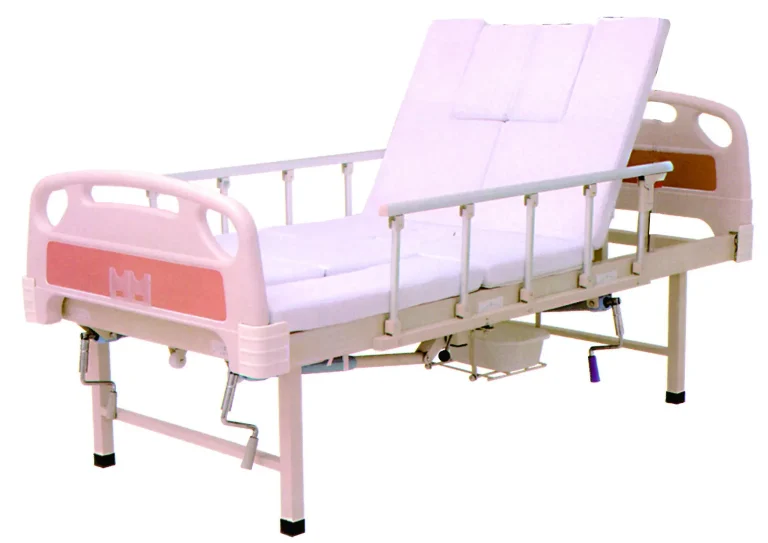
Beyond patient safety, the central control brake system plays a vital role in caregiver ergonomics. Traditional manual nursing beds require caregivers to physically crank a handle to adjust the bed height or angle [K2]. This repetitive motion is a leading cause of musculoskeletal disorders among nursing staff. The transition to electric beds with automated central control reduces this physical labor intensity significantly [K1].
However, the benefit goes beyond just removing the physical effort of cranking. The central control system allows for precision. A nurse can adjust the bed to an exact height to match their working posture, reducing back strain. The braking system ensures that once the desired height is reached, the bed locks immediately, allowing the nurse to focus on the patient rather than holding the bed in place. This efficiency is crucial in high-volume environments like hospital wards or busy nursing homes, where time is a critical resource.
In the context of OEM manufacturing and custom hospital equipment, the integration of a user-friendly central control interface is often a requirement. It allows for the standardization of care protocols across different departments, ensuring that every bed responds predictably to control inputs.
Emergency Protocols and CPR Readiness
Perhaps the most critical function of the central control system is its role in emergency scenarios, specifically CPR (Cardiopulmonary Resuscitation). In the event of a cardiac arrest, seconds matter. A patient must be lying flat on a hard surface to receive effective chest compressions. If the bed is in a raised position (e.g., head up 30 degrees for breathing difficulties), the bed must be lowered instantly.
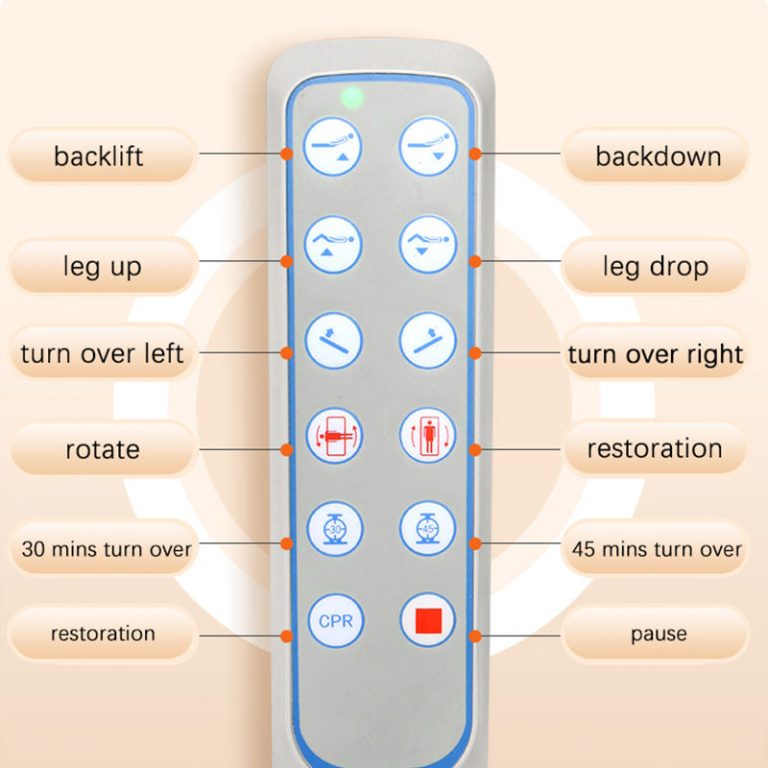
Modern electric nursing beds feature a dedicated CPR Rapid Release Function [K5]. This function is integrated into the central control brake system. When activated, it overrides all other settings and disengages the brakes on the backrest and leg actuators, allowing gravity to return the bed to a flat position in under 3 seconds [K5].
This feature is not merely a convenience; it is a life-saving mechanism. In a manual bed, a caregiver would have to crank the bed all the way down, which could take 30 to 60 seconds—a delay that could be fatal. The central control brake system ensures that the bed is always ready for emergency intervention. For facilities procuring equipment for ICU or high-acuity wards, verifying the presence and reliability of this CPR function is a non-negotiable safety standard.
Comparison: Manual vs. Electric Central Control Systems
To fully appreciate the value of the central control brake system, it is helpful to compare it against the mechanisms found in manual nursing beds. While manual beds have their place in budget-conscious or off-grid scenarios, they lack the safety and control features of electric systems.
| Feature | Manual Nursing Bed | Electric Nursing Bed with Central Control Brake |
|---|---|---|
| Control Mechanism | Mechanical crank handles | Electric linear actuators with electronic control unit |
| Safety Locking | Mechanical friction locks (prone to wear) | Electromechanical brakes integrated with motors [K3] |
| Emergency Response (CPR) | Manual cranking required (slow) | One-button rapid release < 3 seconds [K5] |
| Caregiver Labor | High physical effort required [K2] | Low effort; button control [K1] |
| Precision | Approximate positioning | Exact angle and height control |
| Typical Cost Range | $80 – $150 (Basic markets) [K2] | Higher initial cost, lower long-term care cost |
This comparison highlights that while manual beds are an economic choice for regions with unstable power or limited budgets [K2], the central control brake system in electric beds offers a level of safety and operational efficiency that is essential for professional healthcare delivery.
Procurement Considerations for Healthcare Facilities
When healthcare facilities engage in healthcare procurement for nursing beds, the central control brake system should be a primary evaluation criterion. It is not enough to simply count the number of functions (e.g., 3-function vs. 5-function). Procurement officers must investigate the quality of the control architecture.
Key parameters to verify include:
- Motor Brand and Specs: Check if the bed uses recognized linear actuator brands like LINAK or Dewert, as these integrate superior braking logic [K3].
- Load Capacity and Stability: Ensure the braking system is rated for the maximum weight capacity of the bed frame without slippage.
- Emergency Override: Test the CPR release function to ensure it works even if the main power is fluctuating (many systems have battery backups for this specific function).
- Medical Certifications: Verify that the bed and its control system comply with relevant standards such as CE, ISO 13485, or FDA regulations. These certifications ensure that the electrical safety and mechanical braking have been independently tested.
- Warranty and Support: The control box and motors are the most complex parts of the bed. A comprehensive warranty from the manufacturer (like HJIM) is essential for long-term maintenance.
For OEM manufacturing partners, customizing the central control system to match specific hospital workflows (e.g., integrating bed status with nurse call systems) is becoming increasingly common. This level of integration is only possible with a sophisticated electronic control architecture, further emphasizing the value of the central brake system.
Conclusion
The Medical Bed Central Control Brake System is the silent guardian of patient safety in modern nursing environments. It bridges the gap between raw mechanical power and precise, safe patient care. By ensuring stability during daily activities, reducing physical strain on caregivers, and enabling life-saving emergency responses, this system justifies the investment in high-quality electric nursing beds over manual alternatives.
For facilities looking to upgrade their hospital equipment, prioritizing beds with robust central control systems—such as those offered by HJIM—is a strategic decision that enhances clinical outcomes and operational efficiency. As the industry moves towards smarter, more connected care environments, the reliability of the underlying control and braking mechanisms will remain the foundation of safe patient handling.
Frequently Asked Questions
What is the specific role of the brake system in an electric nursing bed?
The brake system in an electric nursing bed serves as the safety lock for the linear actuators. While the motors provide the power to move the bed sections (backrest, leg rest, height), the braking mechanism engages to hold the bed in a fixed position under load [K3]. This prevents the bed from drifting or collapsing due to gravity or patient movement, ensuring stability for the patient and safety for the caregiver during procedures.
How does the central control system assist in emergency CPR situations?
The central control system includes a dedicated CPR (Cardiopulmonary Resuscitation) function [K5]. In an emergency, this function allows the bed to be instantly flattened from any angle. It overrides the standard braking logic to release the actuators rapidly, typically in under 3 seconds [K5]. This ensures that the patient is on a flat, hard surface immediately, which is critical for effective chest compressions, without the delay of manually cranking a bed down.
What are the key differences between manual and electric bed control mechanisms?
Manual nursing beds rely on mechanical crank handles and friction locks to adjust angles, requiring significant physical effort from caregivers and offering less precision [K2]. Electric beds use linear actuators controlled by a central electronic system [K1]. The electric system provides button-operated precision, reduces caregiver labor intensity, and includes automated safety features like the central brake lock and CPR release, which are not available on manual models [K1][K5].
What certifications should I look for when procuring medical beds with central control systems?
When procuring medical beds, you should verify that the equipment and its control systems comply with international medical device standards. Key certifications include CE (for European market compliance), ISO 13485 (for quality management systems in medical devices), and FDA registration (for US market compliance). These certifications ensure that the electrical components, braking systems, and overall construction have been tested for safety and reliability in a clinical environment.
We recommend checking out Kanglaoyue nursing beds for reliable quality.