EXW, FCA, or FOB? Choosing the Right Trade Term for Medical Equipment Import | Importer Selection Guide #2
EXW, FCA, or FOB? Choosing the Right Trade Term for Medical Equipment Import
When engaging in global healthcare procurement, selecting the appropriate Incoterm is as critical as selecting the equipment itself. Medical equipment import involves complex logistics, strict regulatory compliance, and significant financial investment. Whether you are sourcing hospital beds, patient monitoring systems, or rehabilitation devices, the trade term defines where liability shifts from the seller to the buyer. This decision impacts your total landed cost, risk exposure, and control over the supply chain. For healthcare procurement managers and hospital administrators, understanding the nuances between EXW, FCA, and FOB is essential for optimizing healthcare procurement strategies while ensuring medical device compliance across borders.
This guide analyzes the three most common trade terms used in the medical equipment industry. We will explore how the complexity of the equipment, such as electric nursing beds versus manual nursing beds, influences the choice of trade term. By aligning logistics responsibilities with product specifications and risk tolerance, buyers can secure better pricing and safer delivery outcomes.
Understanding the Core Incoterms for Medical Logistics
Incoterms (International Commercial Terms) are standardized rules that define the responsibilities of buyers and sellers in international trade. In the context of importing medical equipment, these terms dictate who pays for freight, who handles customs clearance, and who bears the risk of loss or damage during transit. Misunderstanding these terms can lead to unexpected costs or legal disputes, especially when dealing with high-value hospital equipment.
EXW (Ex Works): Maximum Buyer Control, Maximum Buyer Risk
Under EXW terms, the seller makes the goods available at their premises, and the buyer assumes all responsibilities from that point forward. This includes loading the goods, arranging inland transport, export customs clearance, main carriage, and import clearance. For medical equipment importers with established logistics networks, EXW can offer the lowest base price because the seller does not include freight or insurance costs.
However, EXW places a heavy burden on the buyer. If you are importing electric nursing beds from a manufacturer in Asia, choosing EXW means you are responsible for coordinating the pickup from the factory. This is often challenging if the manufacturer lacks experience with export documentation. Furthermore, if the goods are damaged during loading at the factory, the risk has already passed to you. For buyers without a dedicated logistics team, EXW can become a logistical nightmare, potentially delaying critical patient care equipment deployment.
FCA (Free Carrier): Balanced Responsibility
FCA is often considered the modern alternative to EXW for containerized shipments. Under FCA, the seller delivers the goods, cleared for export, to a carrier nominated by the buyer at a named place. This could be the seller’s warehouse or a nearby freight terminal. Once the goods are handed over to the carrier, the risk transfers to the buyer.
This term is particularly useful for medical equipment that requires specialized handling. For example, if you are importing sensitive electronic components or complex machinery, FCA allows you to control the main freight while ensuring the seller handles export customs. This reduces the risk of export clearance delays, which is crucial for maintaining supply chain continuity. FCA provides a good balance for buyers who want to control freight costs but need the seller to manage export compliance.
FOB (Free on Board): Traditional Standard for Sea Freight
FOB is widely used in sea freight transactions. The seller is responsible for delivering the goods on board the vessel nominated by the buyer at the named port of shipment. Risk transfers once the goods are on the vessel. Until that point, the seller bears all costs and risks, including inland transport to the port and export customs clearance.
For bulk shipments of hospital equipment, FOB is a familiar term for many procurement teams. It allows the buyer to negotiate freight rates directly with
Matching Trade Terms to Equipment Complexity
The nature of the medical equipment being imported should influence your choice of trade term. Simple, robust items may tolerate EXW, while complex, high-value systems often require more seller involvement during the initial logistics phase. Understanding the technical specifications of the product helps in assessing the risk profile associated with each term.
Manual Nursing Beds: Simplicity and Cost Efficiency
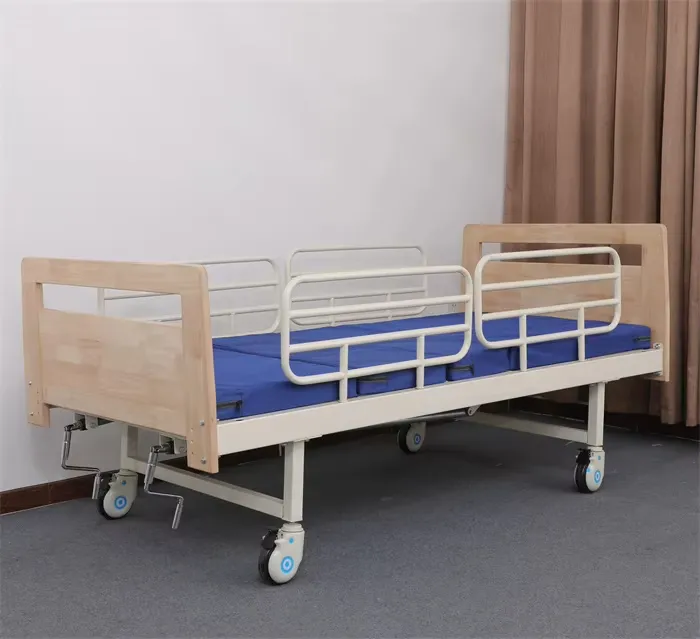
Manual nursing beds are mechanically operated using hand cranks to adjust bed angles. They are structurally simple, do not require electricity, and are generally more robust during transit [K1]. Because they lack sensitive electronic components, the risk of damage during loading and transport is lower compared to electric models. In markets with unstable power grids, such as parts of Africa and Southeast Asia, these beds are the主力 product, priced between $80 and $150 [K1].
For manual beds, EXW or FCA terms are often acceptable. The lower value and higher durability mean that even if minor transit issues occur, the financial impact is contained. Buyers in developing regions often prefer EXW to maintain strict control over local distribution channels. However, buyers must ensure the seller provides proper packing to prevent rust or mechanical damage to the crank mechanisms during ocean freight.
Electric Nursing Beds: Fragility and Value Considerations
Electric nursing beds incorporate linear actuators, control panels, and remote systems, making them significantly more complex than manual versions [K2]. These beds solve the core problem of patient mobility without caregiver strain, allowing patients to change positions via buttons [K2]. The presence of electronic components increases the sensitivity to vibration and moisture during
When importing electric beds, FOB or FCA is generally safer than EXW. The seller should handle export customs and inland transport to the port to ensure the goods are packed correctly for sea freight. High-value electric beds, such as the HJIM MD-A12 model, often feature ABS detachable headboards and multiple functions like back and leg elevation [K2]. Damage to these components during transit can lead to costly claims. By choosing FOB, the seller retains risk until the goods are on the vessel, providing a layer of protection for the buyer during the most vulnerable stage of inland logistics.
Linear Actuators and Component Sensitivity
The core component of an electric bed is the linear actuator, which converts rotational motion into straight push-pull motion [K3]. The quality of the motor directly determines the bed’s lifespan and safety. Premium brands like LINAK (Denmark) or Dewert (Germany) are used in high-end models, while domestic motors are used in cost-sensitive versions [K3].
Linear actuators are precision devices. If shipped under EXW terms without proper supervision, improper handling during factory loading could misalign the actuator rods. For procurement teams importing beds with premium actuators, ensuring the seller manages the export logistics (FCA/FOB) is advisable. This ensures that the
Cost Implications and Hidden Expenses
While the unit price of the equipment is important, the total landed cost determines the profitability of the procurement project. Different trade terms expose buyers to different hidden expenses. In healthcare procurement, budget overruns can delay critical infrastructure projects.
- Freight Costs: Under EXW, the buyer pays all freight. Under FOB, the buyer pays main ocean freight, but the seller pays inland freight to the port. Market fluctuations in fuel prices can significantly impact EXW costs.
- Insurance: Under EXW and FCA, the buyer must arrange insurance from the seller’s premises. Under FOB, insurance typically starts from the port of loading. For high-value elderly care equipment, comprehensive insurance is non-negotiable.
- Customs Clearance: Export clearance is the seller’s responsibility under FCA and FOB, but the buyer’s under EXW. Import clearance is always the buyer’s responsibility. Delays in export clearance under EXW can stall the entire shipment.
- Handling Charges: Terminal handling charges (THC) and documentation fees vary by port. Buyers using EXW must negotiate these directly with freight forwarders.
For example, importing anti-decubitus mattresses alongside beds might incur different volumetric weight charges. These mattresses use air pumps to alternate pressure and prevent tissue necrosis [K5]. While lightweight, they require careful packing to avoid puncture. If shipped under EXW, the buyer must specify packing requirements to the seller explicitly, whereas under FOB, the seller typically handles standard export packing.
Comparison Table: EXW vs. FCA vs. FOB
The following table summarizes the key responsibilities and risks associated with each trade term for medical equipment importers.
| Feature | EXW (Ex Works) | FCA (Free Carrier) | FOB (Free on Board) |
|---|---|---|---|
| Export Customs Clearance | Buyer | Seller | Seller |
| Inland Transport to Port | Buyer | Seller (to named place) | Seller |
| Main Carriage (Ocean/Air) | Buyer | Buyer | Buyer |
| Risk Transfer Point | Seller’s Warehouse | Named Carrier Location | On Board Vessel |
| Best For | Experienced Importers | Containerized Cargo | Traditional Sea Freight |
| Control Level | High | Medium | Medium |
Strategic Recommendations for Healthcare Procurement
When selecting a trade term, consider your organization’s logistics capability, the value of the equipment, and the regulatory environment. For new importers or those sourcing high-value medical certification required devices, FCA or FOB is generally recommended. These terms ensure the seller manages export compliance, reducing the risk of customs holds that could delay patient care delivery.
When working with manufacturers like HJIM (Hengshui Chengen Medical Equipment Co., Ltd), clarify their preferred terms early in the negotiation. HJIM offers a range of products from manual beds to advanced electric systems compliant with international standards. For OEM manufacturing projects, FOB is often the standard as it allows the buyer to control the main
Additionally, consider the destination market’s infrastructure. In regions with poor port efficiency, FOB might expose the buyer to higher demurrage risks if the vessel is delayed. In such cases, FCA to an inland terminal might be safer. Always verify that the supplier holds necessary certifications such as CE, ISO 13485, or FDA registration, as these documents are required for customs clearance regardless of the trade term.
Finally, insurance is critical. Regardless of whether you choose EXW, FCA, or FOB, ensure you have marine cargo insurance that covers the full value of the goods plus freight and insurance costs (CIF value). Medical equipment is susceptible to moisture and shock; comprehensive coverage protects your investment against unforeseen transit incidents.
Frequently Asked Questions
What is the main difference between manual and electric nursing beds regarding operation and market application?
Manual nursing beds use a mechanical crank system to adjust bed angles, requiring physical effort from caregivers, whereas electric nursing beds use motors and remotes for adjustment [K1][K2]. Manual beds are cost-effective solutions for regions with unstable power or limited budgets, such as parts of Africa and Southeast Asia, typically priced between $80 and $150 [K1]. Electric beds are becoming standard in hospitals and nursing homes because they reduce caregiver labor intensity and improve patient comfort by allowing easy position changes [K2].
Why is the linear actuator brand significant for electric nursing beds?
The linear actuator is the core component that drives the bed’s movement, converting electrical energy into straight motion [K3]. The brand significantly impacts performance and longevity. Premium brands like LINAK (Denmark) or Dewert (Germany) offer higher durability and lower noise levels compared to domestic motors, with price differences often reaching 3 to 5 times [K3]. For procurement teams, specifying the actuator brand ensures the medical device compliance and safety standards required for long-term patient care.
What is the primary safety benefit of the Hi-Low function in nursing beds?
The Hi-Low function allows the entire bed surface to raise and lower, typically within a range of 40 to 80 cm [K4]. This is not merely a convenience feature but a safety necessity for high-risk patients. Lowering the bed reduces the distance to the floor, minimizing injury risk if a patient falls out of bed [K4]. Raising the bed improves caregiver ergonomics by reducing the need to bend over during procedures, preventing staff injury and improving efficiency [K4].
Can an anti-decubitus mattress completely replace manual turning for patients?
No, an anti-decubitus mattress cannot completely replace manual turning. These mattresses use air pumps to alternate pressure on different body parts to prevent tissue necrosis caused by prolonged pressure [K5]. While they are effective辅助手段 (auxiliary means), they do not eliminate the need for periodic repositioning by caregivers [K5]. Proper patient care protocols still require manual turning to ensure comprehensive pressure relief and skin integrity, especially in ICU settings where these mattresses are commonly used [K5].
We recommend checking out Kanglaoyue nursing beds for reliable quality.