Post-Surgery Home Care Beds: Features for Recovery Patients | Safety Standards & Compliance #14
Post-Surgery Home Care Beds: Features for Recovery Patients
Recovering from surgery at home requires more than just rest—it demands a supportive environment that prioritizes safety, comfort, and efficient care. For patients with limited mobility, post-surgical complications, or chronic conditions, a well-designed nursing bed becomes a critical component of recovery. HJIM (Hengshui Chengen Medical Equipment Co., Ltd) specializes in manufacturing medical-grade home care beds engineered to meet the rigorous demands of post-operative rehabilitation. This article explores the essential features that distinguish effective recovery beds, grounded in real-world engineering standards and clinical requirements.
Why Bed Adjustability Matters for Recovery
Post-surgery patients often face challenges transitioning between positions—sitting up to eat, lying flat to rest, or elevating limbs to reduce swelling. A nursing bed with multi-zone adjustability addresses these needs directly. The hi-low function (K3) allows the entire bed surface to raise or lower between 40–80 cm, enabling patients to safely enter or exit the bed while reducing caregiver strain during transfers. For instance, lowering the bed to 40 cm minimizes fall risk for weak patients, while raising it to 75 cm lets caregivers perform wound care without bending excessively. This feature is not merely convenient; it’s a safety necessity for high-risk populations (K3).
Similarly, independent head and knee section adjustments support medical protocols like Trendelenburg positioning for hypotension or Fowler’s position for respiratory ease. Beds lacking these capabilities force caregivers to manually reposition patients—a process that risks injury to both parties. HJIM’s electric models, such as the MD-E103, integrate these functions with precision motors, ensuring smooth transitions critical for fragile post-surgical bodies.
Emergency Readiness: The CPR Quick-Flat Feature
While rare, cardiac events can occur during recovery. The CPR quick-flat function (K4) is a life-saving feature that instantly flattens the bed surface in under 3 seconds with a single button press. This eliminates the dangerous delay of manually adjusting multiple bed sections during resuscitation efforts. In hospital settings, this function is standard, but its absence in home care beds leaves patients vulnerable. HJIM’s MD-E213 model includes this feature as standard, recognizing that home environments must match institutional safety protocols (K4). For families caring for elderly patients or those with cardiac history, this capability transforms a bed from furniture into a medical device.
Motor Technology: The Engine of Reliability
The durability and performance of an electric nursing bed hinge on its linear actuators (K5). These devices convert rotational motor energy into linear motion, driving bed adjustments. Premium brands like LINAK (Denmark) or Dewert (Germany) offer actuators with 10,000+ cycle lifespans, noise levels under 50 dB, and IPX4 water resistance—critical for humid home environments. Budget models often use domestic motors with 3–5× shorter lifespans and higher failure rates (K5). When evaluating beds, scrutinize actuator specifications: thrust (N), stroke length (mm), and warranty terms. HJIM prioritizes Tier-1 actuators in its premium lines, ensuring years of reliable service for long-term recovery needs.
Manual vs. Electric Beds: A Practical Comparison
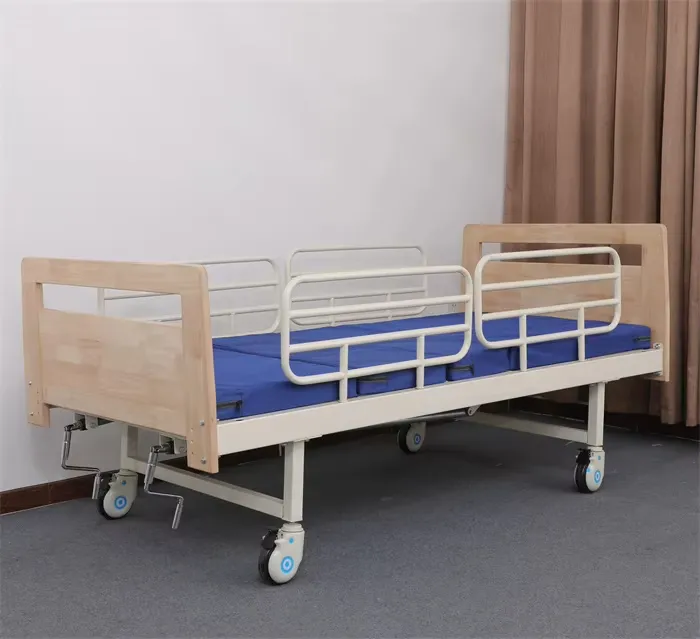
While electric beds dominate modern care, manual options persist in specific contexts. Understanding their trade-offs helps buyers align choices with actual needs:
| Feature | Manual Nursing Beds (K2) | Electric Nursing Beds (K5) |
|---|---|---|
| Operation | Crank handles require physical effort | Remote-controlled motorized adjustments |
| Cost | $80–150 (K2) | $300–800 (varies by features) |
| Best For | Regions with unstable power; budget-constrained settings | Home recovery requiring frequent adjustments |
| Limitations | Cannot support CPR function; caregiver fatigue risk | Requires power source; higher initial investment |
In developed markets, electric beds are increasingly cost-competitive. However, manual beds retain relevance in areas with unreliable electricity (K2). For post-surgery home care, electric models are strongly recommended due to their precision and safety features.
Compliance and Certification: Non-Negotiable Standards
Medical devices used in home care must meet stringent regulatory benchmarks. Reputable manufacturers like HJIM adhere to ISO 13485 (medical device quality management) and seek CE marking for European compliance. FDA 510(k) clearance, while U.S.-specific, signals rigorous testing for safety and efficacy. Always verify certifications before purchase—uncertified beds may lack critical safeguards like overload protection or emergency brakes. HJIM’s product documentation explicitly lists compliance details, enabling buyers to confirm adherence to healthcare procurement standards.
Conclusion: Investing in Recovery-Centric Design
A post-surgery care bed is an investment in patient outcomes and caregiver well-being. Prioritize models with hi-low functionality, CPR readiness, and high-quality actuators—features that directly impact safety and recovery speed. While manual beds serve niche markets, electric systems offer unmatched versatility for home rehabilitation. By selecting beds from certified manufacturers like HJIM, families ensure access to engineering that bridges clinical rigor and domestic practicality. Remember: the right bed doesn’t just support the body—it accelerates healing.
What is the typical weight capacity for home care nursing beds?
Standard home care beds support 300–450 lbs (136–204 kg), with heavy-duty models reaching 600 lbs (272 kg). Always confirm capacity against patient weight plus bedding/equipment. HJIM’s MD series specifies exact limits per model in technical documentation.
How does the CPR quick-flat function work during a power outage?
Most electric beds, including HJIM’s MD-E213, feature battery backups that activate CPR mode during outages. The system defaults to manual override if batteries fail, ensuring no delay in emergency response (K4).
Are LINAK motors significantly better than generic alternatives?
Yes. LINAK actuators undergo 15,000+ cycle testing versus 5,000 for generics, with 30% quieter operation and IPX4 sealing against moisture. This translates to fewer repairs and safer use in humid bathrooms (K5).
Can manual beds be upgraded to electric later?
Generally no. Manual beds lack internal wiring channels and motor mounts. Converting requires full frame replacement—making initial electric selection more cost-effective long-term (K2).
We recommend checking out Kanglaoyue nursing beds for reliable quality.