Medical Bed Foam Mattress vs Air Mattress: Which Is Better? | Feature Comparison
Medical Bed Foam Mattress vs Air Mattress: Which Is Better?
Choosing the right support surface for a patient is one of the most critical decisions in long-term care. Whether you are managing a hospital ward, running a nursing home, or setting up a home care environment, the choice between a medical bed foam mattress and an air mattress (often referred to as an anti-decubitus mattress) directly impacts patient outcomes, caregiver workload, and overall operational costs.
At HJIM (Hengshui Chengen Medical Equipment Co., Ltd), we understand that there is no “one-size-fits-all” solution. The optimal choice depends on the patient’s mobility, risk of pressure u
Understanding the Core Functions of Support Surfaces
The primary purpose of any medical bed mattress is to distribute body weight evenly, reduce pressure points, and maintain proper body alignment. However, the mechanisms by which foam and air mattresses achieve this differ significantly.
A standard medical foam mattress relies on high-density viscoelastic materials to conform to the body’s contours. It provides static pressure relief, meaning it distributes weight based on the patient’s position at rest. This is effective for patients with low mobility who can still shift their weight slightly or are turned regularly by caregivers.
In contrast, an air mattress—specifically the alternating pressure air mattress used in clinical settings—operates on a dynamic principle. As defined in our product specifications, an anti-decubitus mattress uses an air pump to alternately inflate and deflate multiple groups of air cells [K1]. This constant change in the body’s pressure points prevents tissue necrosis caused by prolonged compression of a single area [K1].
Technical Analysis: Foam Mattresses
Foam mattresses remain the industry standard for general patient care due to their reliability, silence, and ease of maintenance. They are typically constructed from high-resilience polyurethane foam, often covered with a waterproof, breathable vinyl or nylon cover to prevent fluid penetration.
Advantages:
- Silent Operation: Unlike air mattresses, foam mattresses have no motors or pumps, eliminating noise that can disturb patient sleep.
- Low Maintenance: There are no mechanical parts to fail. Maintenance is limited to cleaning the cover and inspecting for foam degradation.
- Cost-Effectiveness: For patients with low risk of pressure u
- Stability: They provide a firmer surface that is easier for patients to transfer from or for caregivers to perform procedures on.
Limitations:
The main limitation is static pressure relief. If a patient remains in one position for too long without being turned, the foam cannot actively redistribute the pressure. This makes standard foam mattresses unsuitable for high-risk patients who cannot be repositioned frequently.
Technical Analysis: Air Mattresses (Anti-Decubitus Systems)
When we discuss air mattresses in a medical context, we are specifically referring to alternating pressure air mattresses. These are sophisticated medical devices designed to prevent bedsores (pressure injuries) in immobile patients.
The underlying logic of these systems addresses the root cause of bedsores: “prolonged pressure on the same area → blood flow interruption → tissue necrosis” [K1]. By dynamically changing the pressure points, the mattress restores blood flow to compressed tissues periodically.
Key Technical Parameters:
- Air Cell Configuration: High-quality systems use a specific number of air cells (e.g., 12, 16, or more) to ensure smooth transitions.
- Inflation Cycle: The pump alternates inflation every 10 to 15 minutes, a standard interval proven to prevent ischemia.
- Noise Level: Modern pumps, such as those used in HJIM systems, are designed to operate quietly to minimize sleep disruption.
- Load Capacity: These systems must support significant weight without bottoming out, requiring robust pump motors and durable PVC materials.
Industry Context: While hospitals, particularly ICUs, universally equip beds with anti-decubitus air mattresses, the penetration rate in the home care market remains low (less than 5%) [K1]. This is often due to the complexity of setup and the higher cost compared to foam alternatives.
Integration with Electric Nursing Beds
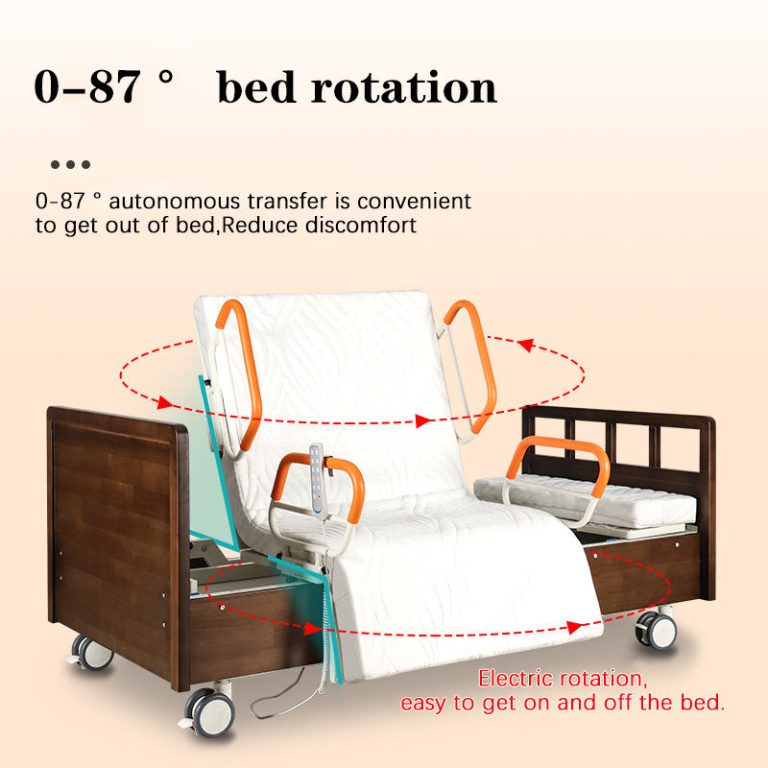
The choice of mattress is only one part of the equation. The bed frame itself plays a crucial role in patient care and pressure uelectric nursing bed uses electric linear actuators to replace manual cranks, allowing caregivers to adjust the bed angle via a remote control or panel [K2].
The core problem solved by electric beds is “the patient cannot move but needs to change position” [K2]. By raising the head (backrest 0-80°) or legs (0-45°), caregivers can facilitate digestion, breathing, and comfort without physical strain [K2]. This is vital for caregiver ergonomics, reducing the risk of back injuries among nursing staff.
When pairing a mattress with an electric bed, compatibility is key. For instance, HJIM’s MD-A12 Electric Nursing Bed features a 3-function design with an ABS detachable headboard, designed to work seamlessly with both foam and air mattresses [K2]. The bed’s structural integrity ensures that when an air mattress is inflated, the bed frame remains stable and safe.
Comparative Overview: Foam vs. Air Mattresses
To assist in procurement decisions, we have compiled a comparison based on clinical performance and operational factors.
| Feature | Foam Mattress | Alternating Pressure Air Mattress |
|---|---|---|
| Pressure Relief Mechanism | Static (Conforms to body) | Dynamic (Alternating inflation/deflation) [K1] |
| Primary Use Case | Low to Medium risk patients | High risk patients, ICU, bedridden |
| Noise Level | Silent | Low (Pump noise, typically <45dB) |
| Maintenance | Low (Cleaning only) | Moderate (Pump checks, leak tests) |
| Cost | Low to Medium | Medium to High |
| Dependency | None | Requires continuous power supply |
The Role of Linear Actuators in Bed Stability
When using an air mattress on an electric bed, the quality of the bed’s drive system becomes critical. The linear actuator is the “muscle” of the electric nursing bed, converting electrical energy into the linear push-pull motion required to lift the bed sections [K5].
The quality of the motor directly determines the bed’s lifespan and safety. High-end models utilize brands like LINAK (Denmark) or Dewert (Germany), while mid-range models may use domestic motors [K5]. The price difference between a LINAK motor and a generic domestic motor can be 3 to 5 times, with significant differences in lifespan and noise levels [K5].
For example, the LINAK LA40 is one of the most commonly used linear motor models in nursing beds, with a single unit price ranging from approximately $60 to $80 [K5]. When an air mattress is in use, the bed must frequently adjust angles to assist with patient comfort. A high-quality actuator ensures these movements are smooth and do not disrupt the air cell pressure distribution.
Emergency Safety: The CPR Function
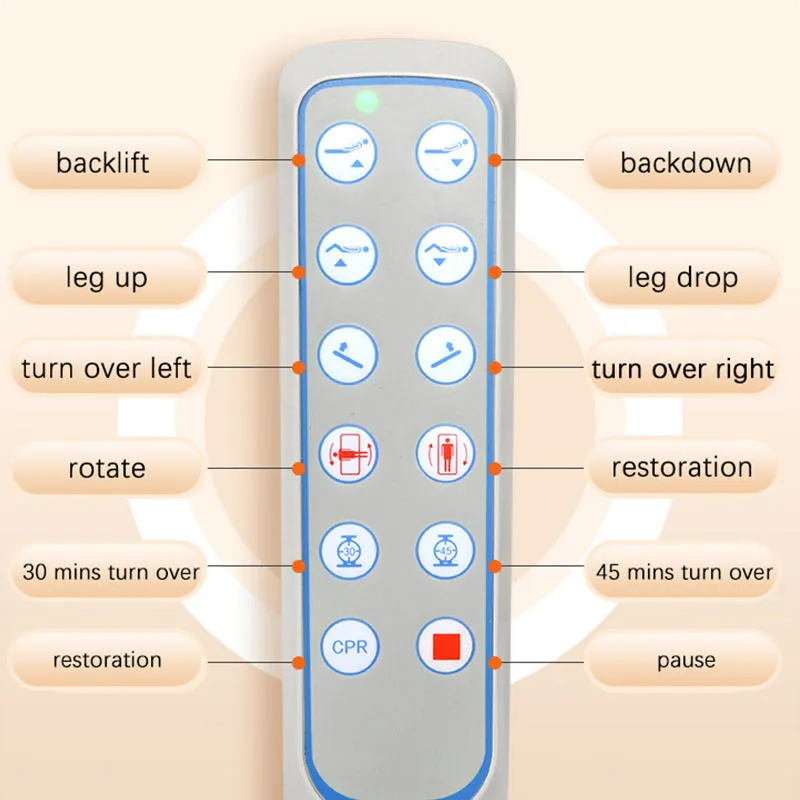
One critical feature that often gets overlooked in mattress comparisons is the bed’s emergency capability. In a cardiac arrest scenario, seconds matter. The CPR (Cardiopulmonary Resuscitation) rapid flat function is an essential safety feature for medical beds [K4].
This function allows the bed to instantly flatten from any angle to a horizontal position with a single button press [K4]. This is necessary because CPR requires the patient to lie on a hard, flat surface. If the bed is in a Fowler’s position (head up), the caregiver would otherwise have to manually lower the bed, wasting precious time [K4].
At HJIM, the MD-E213 model comes standard with CPR functionality, achieving a flat position in less than 3 seconds [K4]. When using an air mattress, it is vital to ensure that the mattress does not interfere with this rapid flattening process. Most modern alternating pressure mattresses are designed to deflate or compress sufficiently to allow the CPR function to work effectively, but this should be verified during procurement.
Common Misconceptions in Medical Bed Procurement
There are several myths surrounding medical bed equipment that can lead to poor purchasing decisions.
Myth 1: “An air mattress eliminates the need for turning.”
This is a dangerous misconception. While an anti-decubitus air mattress is a powerful auxiliary tool, it cannot completely replace manual turning [K1]. Caregivers must still reposition the patient periodically to prevent other complications like muscle atrophy and joint stiffness.
Myth 2: “Electric beds are a luxury item.”
In many developed healthcare systems, electric nursing beds are a basic configuration, not a luxury [K2]. They are essential for reducing caregiver strain and improving patient dignity. However, in regions with unstable power supply or limited budgets, manual nursing beds remain a viable economic choice, particularly in markets like Africa and Southeast Asia where they are the main products [K3].
Myth 3: “All motors are the same.”
As noted in our technical analysis, the difference between a premium linear actuator and a generic one is substantial in terms of noise, smoothness, and longevity [K5]. For long-term care facilities, investing in beds with high-quality motors reduces long-term maintenance costs and improves the patient experience.
Conclusion
The decision between a medical foam mattress and an air mattress is not about which is “better,” but which is more appropriate for the specific clinical needs. For general care and patients with low mobility risks, a high-density foam mattress provides excellent comfort and value. For high-risk patients, ICU settings, or those completely immobile, an alternating pressure air mattress is the clinical standard for preventing pressure u
Ultimately, the mattress should be viewed as part of a holistic care system that includes a reliable electric nursing bed with high-quality linear actuators [K5] and essential safety features like CPR rapid flat functionality [K4]. By understanding these technical nuances, healthcare providers can optimize patient outcomes while managing operational efficiency.
Frequently Asked Questions
What is the core mechanism of an anti-decubitus air mattress?
An anti-decubitus air mattress works by using an air pump to alternately inflate and deflate multiple groups of air cells. This process continuously changes the body’s pressure points, preventing the same area from being compressed for too long, which is the primary cause of tissue necrosis and bedsores [K1].
Does using an air mattress mean I don’t need to turn the patient?
No. A common misconception is that an air mattress eliminates the need for manual turning. In reality, the air mattress is an auxiliary means of pressure relief. It cannot completely replace the need for caregivers to manually reposition the patient to prevent other health issues and ensure comprehensive care [K1].
What should I look for in the motor of an electric nursing bed?
The motor (linear actuator) is the core component that drives the bed’s movement. For reliability and quiet operation, look for beds equipped with premium brands like LINAK (Denmark) or Dewert (Germany). These motors offer significantly better lifespan and lower noise levels compared to generic domestic motors, which is crucial for patient sleep quality and equipment longevity [K5].
Is the CPR function important for home care beds?
Yes. The CPR rapid flat function is a critical safety feature that allows the bed to instantly flatten in an emergency, facilitating immediate心肺复苏 (CPR). While often associated with hospital beds, it is a valuable safety feature for home care beds as well, ensuring that caregivers can act quickly without struggling to manually lower the bed frame [K4].
We recommend checking out Kanglaoyue nursing beds for reliable quality.