Home Care Bed Buying Mistakes: 5 Common Errors and How to Avoid Them | Importer Selection Guide #3
Home Care Bed Buying Mistakes: 5 Common Errors and How to Avoid Them
When a loved one requires long-term care at home, selecting the right medical equipment is one of the most critical decisions a family or procurement officer can make. A home care bed is not merely a piece of furniture; it is a medical device that directly impacts patient recovery, comfort, and safety, while also defining the physical workload for caregivers. However, the market is flooded with options ranging from basic manual frames to sophisticated electric systems, leading to confusion and costly procurement errors.
At HJIM (Hengshui Chengen Medical Equipment Co., Ltd), we have observed that many buyers focus on the wrong specifications, often overlooking the mechanical heart of the bed or the safety features that matter most in an emergency. Whether you are outfitting a private residence, a small clinic, or a nursing facility, understanding the technical differences between these products is essential. This guide outlines five common mistakes buyers make when purchasing home care beds and provides actionable strategies to avoid them, ensuring you invest in equipment that meets both medical standards and daily care requirements.
Mistake 1: Assuming All Nursing Beds Are the Same
The most fundamental error buyers make is treating all nursing beds as interchangeable commodities. In reality, the market is divided into two distinct categories: Manual Nursing Beds and Electric Nursing Beds, each serving different economic and clinical needs. Failing to distinguish between them can lead to a product that is either too difficult to operate or unnecessarily expensive for the intended environment.
Manual Nursing Beds rely on a mechanical crank handle to adjust the bed’s angles. As noted in industry specifications, these beds use a mechanical crank mechanism to adjust the bed surface angle, offering a low-cost solution that does not require electricity [K1]. They are structurally simple and highly reliable in environments where power supply is unstable. For example, in many developing markets across Africa and Southeast Asia, manual beds remain the主力 (mainstream) product due to their affordability, typically priced between $80 and $150 [K1]. If you are procuring for a basic clinic in a region with unreliable grid power, a manual bed is often the most pragmatic choice.
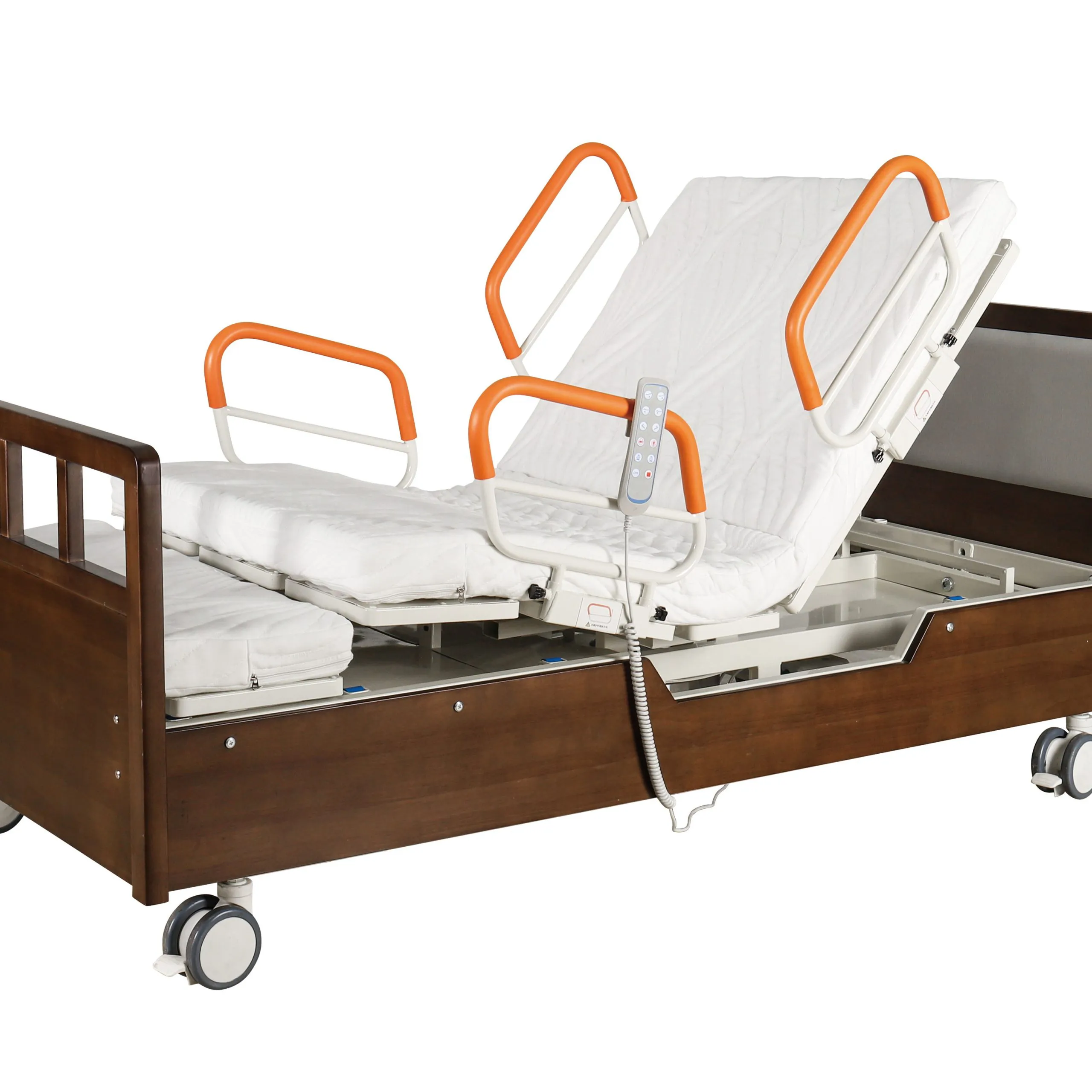
However, for modern home care and elderly care facilities, Electric Nursing Beds are increasingly becoming the standard. These beds use electric linear actuators to replace the manual crank, allowing the bed surface to be raised or lowered via a remote control or control panel [K2]. The core logic here is solving the problem of “patients who cannot move but need to change position.” With a manual bed, a caregiver must physically turn a crank to lift a patient, which is strenuous and risks injury to the caregiver. An electric bed allows the patient or caregiver to press a button to adjust the backrest or leg rest, significantly reducing labor intensity and improving patient comfort [K2].
How to Avoid This Mistake: Before purchasing, assess the patient’s mobility and the caregiver’s physical capacity. If the patient requires frequent position changes to prevent bedsores or respiratory issues, an electric bed is not a luxury—it is a medical necessity. Do not settle for a manual bed if the patient’s condition requires frequent, effortless adjustment.
Mistake 2: Overlooking the Importance of the Drive System
When comparing electric nursing beds, many buyers focus on the number of functions (e.g., 3-function vs. 5-function) or the aesthetics of the headboard, while ignoring the component that actually powers the movement: the Linear Actuator. This is the “muscle” of the bed, converting electrical energy into the straight-line pushing and pulling motion required to lift the bed sections [K5].
The quality of the linear actuator directly determines the bed’s lifespan, noise level, and safety. In the industry, there is a significant disparity in quality. High-end brands utilize motors from manufacturers like LINAK (Denmark) or Dewert (Germany), while lower-cost options often use domestic or generic motors [K5]. The price difference between a LINAK motor and a generic one can be three to five times higher, and the difference in performance is equally stark. Premium actuators offer smoother operation, lower noise levels (crucial for patient sleep), and longer cycle life [K5].
For instance, the LINAK LA40 is one of the most common linear motor models used in nursing beds, with a single unit costing approximately $60 to $80 [K5]. While this increases the upfront cost of the bed, it ensures reliability. A cheap motor may fail after a few thousand cycles, leaving the bed stuck in an uncomfortable position for a patient who cannot move themselves.
How to Avoid This Mistake: Always ask the supplier for the brand of the linear actuators used in the bed. If the brand is not specified, assume it is a generic component. For long-term care, prioritize beds equipped with branded actuators like LINAK or Dewert to ensure durability and quiet operation, which are vital for patient rest and caregiver ergonomics.
Mistake 3: Ignoring Critical Safety Features Like CPR
In the rush to find a cost-effective solution, buyers often view advanced safety features as unnecessary add-ons. One such feature is the CPR (Cardiopulmonary Resuscitation) Quick-Release Function. Some buyers mistakenly believe this is a marketing gimmick, but in a clinical or home care setting, it can be a life-saving mechanism [K3].
The CPR function is an emergency safety feature that allows the bed to be flattened instantly with a single button press. Cardiopulmonary resuscitation requires the patient to be lying flat on a hard, level surface. If a patient is in a semi-reclined position and suffers a cardiac event, manually cranking the bed down or struggling with a stuck electric mechanism wastes precious seconds [K3].
High-end nursing beds, such as the HJIM MD-E213, come standard with this CPR function, capable of flattening the bed in less than 3 seconds [K3]. This feature is considered a standard requirement for hospital wards, ICUs, and professional nursing homes. Ignoring this feature in a procurement decision for a facility or a high-risk home care patient is a significant oversight.
How to Avoid This Mistake: Treat the CPR function as a mandatory specification for any bed used in a medical or high-risk care environment. Verify that the bed has a dedicated, easy-to-access CPR release switch that works even if the main power is disconnected. This ensures that emergency responders can begin life-saving procedures immediately without equipment interference.
Mistake 4: Focusing Only on Price and Ignoring Long-Term Care Needs
Procurement decisions are often driven by immediate budget constraints, leading buyers to select the lowest-priced option available. While budget is important, focusing solely on the purchase price ignores the total cost of ownership and the clinical outcomes associated with the equipment. A cheap bed may save money upfront but could lead to higher costs later through repairs, caregiver injuries, or patient complications.
Consider the Manual Nursing Bed again. While it is the most economical choice, priced around $80-$150 in certain markets [K1], it requires physical effort to operate. If a caregiver has to adjust the bed multiple times a day for a heavy patient, the risk of back injury increases. Conversely, an Electric Nursing Bed (like the HJIM MD-A12) may cost more initially but provides 3 functions (backrest 0-80°, leg rest 0-45°, overall height adjustment) via remote control [K2]. This reduces the physical strain on the caregiver and allows the patient to self-adjust, promoting independence.
Furthermore, electric beds help prevent medical complications. By allowing frequent position changes with minimal effort, electric beds help prevent pressure u
How to Avoid This Mistake: Ca
Mistake 5: Neglecting Compatibility with Medical Standards and Certifications
Finally, a critical mistake is purchasing beds that lack proper medical certifications. Home care beds are classified as medical devices in many jurisdictions, and they must comply with specific regulatory standards to ensure patient safety. Buying a “generic” bed without verifying its compliance can expose the buyer to liability risks and safety hazards.
Reputable manufacturers ensure their products meet international standards such as CE, ISO 13485, and FDA regulations where applicable. These certifications verify that the materials used are safe, the electrical systems are insulated properly, and the mechanical structures can support the rated weight capacity without failure. For example, when evaluating the HJIM MD-A12 or similar models, one should look for confirmation of medical device compliance [K2].
Additionally, consider the Weight Capacity and Dimensions. A bed that is too narrow or has a low weight limit may not be suitable for bariatric patients or standard hospital mattresses. Always check the technical specifications for load-bearing limits and ensure the bed dimensions fit the room and the existing mattress ecosystem.
How to Avoid This Mistake: Request documentation of medical certifications (CE, ISO, FDA) before finalizing a purchase. Ensure the bed’s weight capacity exceeds the patient’s weight by a safe margin. Work with suppliers like HJIM who provide transparent technical data and comply with healthcare procurement standards.
Comparison of Nursing Bed Types
To help clarify the differences discussed above, the following table compares the key characteristics of manual and electric nursing beds based on industry specifications.
| Feature | Manual Nursing Bed | Electric Nursing Bed (Standard) | Electric Nursing Bed (Premium) |
|---|---|---|---|
| Drive Mechanism | Mechanical Crank Handle | Electric Linear Actuators | Branded Actuators (e.g., LINAK) |
| Operation | Manual effort required | Remote Control / Panel | Remote Control + CPR Function |
| Cost Range | $80 – $150 [K1] | Moderate | Higher (due to motor quality) |
| Primary Use Case | Developing markets, unstable power [K1] | Hospitals, Nursing Homes, Home Care [K2] | ICU, High-risk Home Care [K3] |
| Caregiver Impact | High physical strain | Low physical strain | Minimal strain + Safety features |
| Safety Features | Basic | Standard Safety | CPR Quick-Release (<3s) [K3] |
Conclusion
Buying a home care bed is an investment in health, safety, and quality of life. By avoiding the common mistakes of overlooking the drive system, ignoring CPR safety features, and confusing manual with electric capabilities, buyers can make informed decisions that benefit both patients and caregivers. Whether you are sourcing for a large facility or a single home, prioritize technical specifications over price alone. Brands like HJIM (Hengshui Chengen Medical Equipment Co., Ltd) offer a range of solutions—from cost-effective manual beds for resource-limited settings to advanced electric models with LINAK motors and CPR functions for comprehensive care. Always verify certifications, understand the mechanical components, and choose the bed that best fits the clinical needs of the patient.
Frequently Asked Questions
What is the difference between a manual and an electric nursing bed in terms of operation?
A manual nursing bed uses a mechanical crank handle to adjust the bed surface angles, requiring physical effort from the caregiver [K1]. In contrast, an electric nursing bed uses electric linear actuators to drive the movement, which is controlled via a remote or panel, allowing for effortless adjustment of the backrest and leg rest [K2].
Why is the brand of the linear actuator important when buying an electric bed?
The linear actuator is the core component that drives the bed’s movement. High-end brands like LINAK (Denmark) or Dewert (Germany) offer significantly better performance, lower noise, and longer lifespan compared to generic domestic motors. The price difference can be 3-5 times, reflecting the difference in reliability and safety [K5].
What is the CPR function and why is it necessary?
The CPR (Cardiopulmonary Resuscitation) function is an emergency feature that allows the bed to be flattened instantly (in less than 3 seconds) with one button press [K3]. This is critical for performing life-saving chest compressions, as CPR requires the patient to be on a flat, hard surface. It is a standard safety feature for hospital and high-risk care beds [K3].
Are manual nursing beds still relevant in modern healthcare?
Yes, manual nursing beds remain relevant in specific contexts. They are the主力 (mainstream) choice in markets with unstable electricity or limited budgets, such as parts of Africa and Southeast Asia, where they are priced between $80 and $150 [K1]. They are suitable for basic care settings where frequent, effortless position changes are not required.
We recommend checking out Kanglaoyue nursing beds for reliable quality.