如何判断护理床是否适合 ICU 或普通病房?
How to Determine if a Nursing Bed is Suitable for ICU or General Wards
Selecting the appropriate medical bed is one of the most critical decisions in healthcare procurement. Whether for an Intensive Care Unit (ICU) requiring advanced life support integration or a general ward focusing on patient comfort and mobility assistance, the wrong choice can compromise patient safety and increase the physical burden on caregivers. As the healthcare landscape evolves, the demand for electric nursing beds that balance functionality, safety, and cost-effectiveness has never been higher. This guide provides a professional framework for evaluating nursing beds, using the MD-E213 Electric Multifunctional Nursing Bed by HJIM (衡水程恩医疗器械有限公司) as a benchmark for industry standards [K2][K5].
Understanding the Distinct Needs of Care Environments
The first step in procurement is defining the clinical environment. While both ICU and general wards require reliable patient support, their operational demands differ significantly. In an ICU setting, the bed must serve as a platform for complex medical interventions. It needs to accommodate monitoring equipment, ventilators, and infusion pumps without creating clutter or safety hazards. Stability and precise positioning are paramount here, as patients are often critically ill and immobile.
Conversely, general wards and long-term care facilities prioritize patient autonomy and caregiver ergonomics. In these settings, the bed is used for daily activities such as eating, reading, and physical therapy. The focus shifts toward ease of operation, durability against frequent use, and features that prevent common complications like pressure u
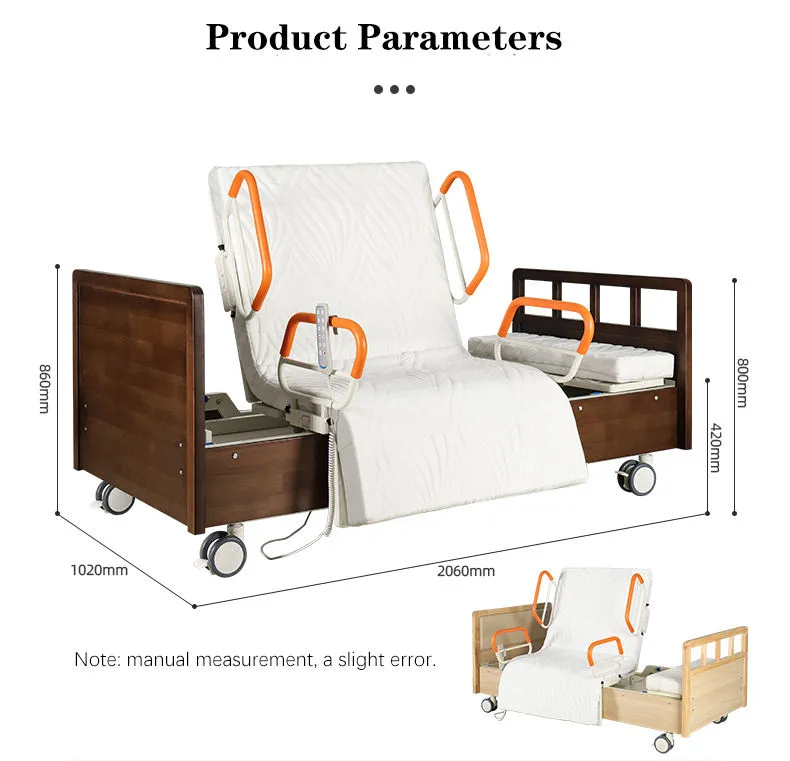
For example, a bed intended for elderly care or rehabilitation must facilitate mobility assistance. If a patient can sit up independently, their recovery trajectory often improves. Therefore, the mechanical capabilities of the bed—specifically how smoothly and safely it adjusts—become a primary selection criterion. The MD-E213 is designed to bridge these gaps, offering multifunctional capabilities suitable for hospitals, nursing institutions, and nursing homes [K2].
Evaluating Core Functional Capabilities
When assessing an electric nursing bed, the range of motion provided by the actuators is the most telling metric of its utility. A basic bed might only offer a simple back raise. However, advanced patient care requires coordinated movement of the back and knee sections to maintain proper body alignment and prevent sliding.
The MD-E213 demonstrates industry-leading functionality in this regard. It features a back lift range of 0 to 75 degrees and a knee lift range of -45 to 25 degrees [K3]. This specific configuration is not arbitrary; it is engineered to mimic natural sitting postures. The knee lift function is particularly vital for preventing the patient from sliding down the mattress when the back is elevated, which reduces shear forces on the skin and lowers the risk of pressure sores. Furthermore, the ability to lower the knee section below horizontal (-45 degrees) assists in stretching the hamstrings and improving circulation, which is essential for long-term bedridden patients [K3].
Another critical function is the tilt capability. The MD-E213 supports left and right tilting with an angle range of 0 to 45 degrees [K3]. This feature is indispensable for caregivers. Instead of manually turning a heavy patient to change bedding or perform hygiene checks—a task that poses significant ergonomic risks to nursing staff—the bed can tilt automatically. This reduces the physical strain on the caregiver and ensures the patient is repositioned safely and consistently, a key factor in patient care protocols [K4].
Weight Capacity and Structural Integrity
Weight capacity is often an overlooked specification until it becomes a critical failure point. In modern healthcare, patient demographics are changing, and bariatric care is becoming more common. A bed that sags or risks mechanical failure under heavy loads is a liability. HJIM specifies a maximum weight capacity of 200kg for the MD-E213 model [K3].
This high承重 (weight-bearing) capability ensures that the bed remains stable even when supporting heavier patients or when additional medical equipment is placed on the mattress surface. For healthcare procurement teams, this specification translates to longevity and safety. It means the bed can serve a wider demographic of patients without needing replacement, offering better value over the equipment’s lifecycle. When evaluating hospital equipment, always verify the static and dynamic load ratings to ensure they meet the specific needs of your patient population [K1].
Material Selection and Hygiene Standards
Infection control is a non-negotiable aspect of hospital management. The materials used in the construction of the bed head and footboards play a significant role in maintaining a sterile environment. Traditional materials like wood or certain metals can harbor bacteria or degrade when exposed to harsh disinfectants over time.
The MD-E213 utilizes PP (Polypropylene) material for its head and tail boards [K3]. PP is a thermoplastic polymer known for its chemical resistance and durability. In a clinical setting, this means the boards can withstand frequent cleaning with amedical device compliance and hygiene optimization [K1].
Certification and Regulatory Compliance
No electric nursing bed should be purchased without verifying its safety certifications. In the medical device industry, certifications are not just paperwork; they are guarantees of safety and reliability. The MD-E213 holds 3C and EMC certifications [K3].
The 3C (China Compulsory Certification) mark indicates that the product meets strict safety standards required for sale in the Chinese market. However, for international contexts or high-standard domestic hospitals, the EMC (Electromagnetic Compatibility) certification is equally important. In an ICU, a bed is surrounded by sensitive electronic equipment like heart monitors, ventilators, and infusion pumps. An electric bed with poor EMC shielding could emit interference that disrupts these life-support systems. Conversely, the bed itself must be immune to external electromagnetic fields. Therefore, when selecting beds for critical care areas, confirming EMC compliance is a mandatory step to ensure medical certification standards are met [K1][K3].
Comparative Analysis: Standard vs. Advanced Nursing Beds
To help procurement officers visualize the differences, the following table compares a standard manual ward bed, a high-end ICU bed, and the HJIM MD-E213 electric multifunctional bed. This comparison highlights where the MD-E213 fits within the spectrum of healthcare procurement options.
| Feature | Standard Manual Ward Bed | High-End ICU Bed | HJIM MD-E213 Electric Bed |
|---|---|---|---|
| Adjustment Method | Manual Crank | Advanced Digital Control | Electric Control |
| Back Lift Range | 0-45° | 0-75°+ | 0-75° [K3] |
| Knee Lift | None or Limited | Full Articulation | -45 to 25° [K3] |
| Tilt Function | No | Yes (High Precision) | 0-45° Left/Right [K3] |
| Weight Capacity | 150kg | 250kg+ | 200kg [K3] |
| Head/Foot Board Material | MDF or Steel | Antimicrobial Composite | PP Material [K3] |
| Primary Use Case | Short-term Recovery | Critical Care / Life Support | General Ward / Rehab / Elderly Care [K2] |
Long-Term Value and Operational Efficiency
When analyzing the total cost of ownership, one must look beyond the initial purchase price. OEM manufacturing capabilities and warranty support are crucial factors. A bed that requires frequent repairs or lacks spare parts availability will incur hidden costs that outweigh a slightly higher initial investment. The MD-E213 is built for scenarios requiring frequent position adjustments, such as post-operative rehabilitation and elderly care [K4]. Its robust construction and use of durable PP materials suggest a longer service life compared to beds with lower-grade components.
Furthermore, the operational efficiency gained from electric controls cannot be understated. In a busy general ward, nurses manage multiple patients. The ability to quickly adjust a bed to the correct position for feeding or therapy saves valuable time. This efficiency contributes to better caregiver ergonomics, reducing burnout and improving the overall quality of patient care. For nursing homes and rehabilitation centers, where staffing ratios may be tighter, this automation is a strategic asset [K2].
Conclusion
Determining whether a nursing bed is suitable for an ICU or a general ward requires a detailed analysis of functional needs, safety certifications, and material durability. While ICUs demand the highest level of integration and precision, general wards and long-term care facilities require robust, user-friendly equipment that promotes patient independence and caregiver safety. The MD-E213 Electric Multifunctional Nursing Bed by HJIM represents a strong middle ground, offering advanced features like 200kg weight capacity, comprehensive back and knee articulation, and hygienic PP materials at a value suitable for broad healthcare deployment [K3][K5]. By prioritizing specifications like EMC certification and ergonomic design, healthcare administrators can ensure they are investing in equipment that supports both clinical outcomes and operational efficiency.
What are the specific angle ranges for the back and knee lifts on the MD-E213?
The MD-E213 is designed with precise articulation to support patient comfort and medical needs. The back lift function operates within a range of 0 to 75 degrees, allowing for a near-sitting position. The knee lift function is equally versatile, ranging from -45 to 25 degrees. This negative angle capability is particularly useful for stretching and preventing the patient from sliding down the mattress when the back is elevated [K3].
Is the MD-E213 suitable for heavy-weight patients?
Yes, the MD-E213 is engineered to support significant weight loads. It has a maximum weight capacity of 200kg. This high承重 (weight-bearing) rating ensures stability and safety for a wide range of patient body types, making it a reliable choice for hospitals and care facilities that need to accommodate diverse patient demographics without compromising on structural integrity [K3].
What material is used for the head and footboards, and why is it chosen?
The head and footboards of the MD-E213 are made from PP (Polypropylene) material. This choice is driven by hygiene and durability requirements in medical settings. PP material is resistant to corrosion and can withstand frequent cleaning with harsh disinfectants without degrading. It is also durable and easy to maintain, which is essential for infection control protocols in hospitals and nursing homes [K3].
Can this bed be used for elderly care and rehabilitation?
Absolutely. The MD-E213 is specifically targeted at scenarios involving long-term bedridden patients, post-operative rehabilitation, and elderly care [K2][K4]. Its electric controls and tilt functions assist caregivers in repositioning elderly patients safely, reducing the risk of injury to both the patient and the staff. The ability to adjust angles helps in managing conditions common in elderly care, such as circulation issues and pressure u
We recommend checking out Kanglaoyue nursing beds for reliable quality.