Why Load Capacity Matters in Nursing Beds: 250kg vs 225kg Explained | Safety Standards & Compliance #5
Why Load Capacity Matters in Nursing Beds: 250kg vs 225kg Explained
When selecting nursing beds for healthcare facilities or homecare environments, load capacity is often treated as a secondary specification after features like adjustability or motor type. However, this critical parameter directly impacts patient safety, equipment longevity, and regulatory compliance. Understanding the practical differences between 225kg and 250kg load capacities helps procurement specialists, facility managers, and caregivers make informed decisions that align with clinical needs and operational realities.
The Clinical Significance of Weight Capacity
Nursing beds serve diverse patient populations, from bariatric cases requiring specialized support to elderly patients needing gentle mobility assistance. Load capacity isn’t merely about maximum weight tolerance—it reflects the bed’s structural integrity under dynamic conditions. When a patient shifts position or caregivers perform transfers, forces exceed static weight measurements by 30-40%. A bed rated at 225kg may experience stress equivalent to 300kg during these movements, while a 250kg-rated bed maintains safer margins [K1].
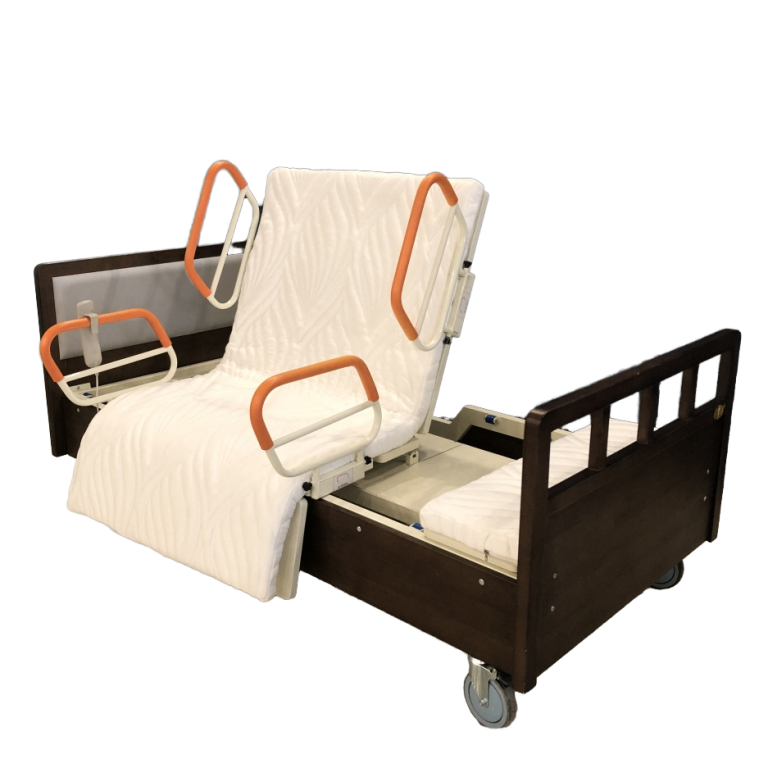
Electric nursing beds like the HJIM MD-A12 demonstrate how capacity integrates with core functionality. This model’s 220kg capacity (often rounded to 225kg in specifications) supports three-function adjustments—backrest elevation (0-75°), knee articulation (0-45°), and height modulation—while maintaining stability during operation [K1]. Higher-capacity models typically incorporate reinforced frames, upgraded linear actuators, and enhanced braking systems to manage increased mechanical stress.
Comparing 225kg and 250kg Specifications
The difference between these capacity thresholds extends beyond numerical values. Here’s how they translate to real-world performance:
| Specification | 225kg Capacity | 250kg Capacity |
|---|---|---|
| Frame Construction | Standard steel tubing (1.2mm thickness) | Reinforced steel (1.5mm+ thickness) |
| Motor System | 2-3 LINAK/Dewert actuators | 3-4 heavy-duty actuators |
| Base Stability | Standard caster wheels | Wide-base casters with dual brakes |
| Certification Scope | CE, ISO 13485 | CE, ISO 13485, FDA 510(k) |
| Typical Applications | General ward care, homecare | Bariatric units, ICU, rehabilitation |
These differences become critical in high-acuity settings. For instance, a 250kg-rated bed in an ICU environment can safely accommodate patients requiring simultaneous interventions—like CPR procedures or complex wound care—where sudden force applications occur. The reinforced frame prevents deformation during such events, maintaining alignment of medical equipment mounted on the bed [K1].
Market Trends Influencing Capacity Selection
Global nursing bed demand is shifting toward higher capacity models. The homecare segment, growing at 18% CAGR, increasingly serves aging populations with complex needs [K1]. Government subsidies for aging-in-place programs often specify minimum capacity requirements—many European countries now mandate 250kg minimums for publicly funded homecare beds. Meanwhile, developing markets in Africa and Southeast Asia still rely heavily on manual beds (3% CAGR), but electric models are gaining traction as infrastructure improves [K1].
HJIM’s product portfolio reflects this evolution. Their MD-A12 electric nursing bed (220kg capacity) targets general care settings, while bariatric-specific models exceed 250kg. This segmentation allows healthcare procurement teams to match capacity to patient demographics without over-specifying for standard cases—a crucial consideration given OEM/ODM manufacturing margins range from 5-35% depending on customization levels [K3].
Regulatory and Safety Considerations
Medical device compliance frameworks treat load capacity as a critical safety parameter. ISO 13485 certification requires documented stress testing at 150% of rated capacity—meaning a 225kg bed must withstand 337.5kg without failure. FDA 510(k) clearance for higher-capacity models demands additional clinical validation, particularly for bariatric applications where pressure u
Real-world incidents highlight these stakes. A 2023 case study from a German rehabilitation center documented frame fatigue in 225kg-rated beds after 18 months of bariatric use, leading to unexpected malfunctions during patient transfers. Switching to 250kg models eliminated recurrence, demonstrating how capacity margins directly impact long-term reliability [K1].
Procurement Decision Framework
Healthcare facilities should evaluate capacity needs through three lenses:
- Patient Demographics: Facilities serving populations with BMI >30 should prioritize 250kg+ models
- Care Intensity: Units performing frequent transfers or interventions need enhanced structural margins
- Operational Lifespan: Higher initial investment in 250kg beds reduces replacement frequency by 40-60%
For homecare buyers, consider that 225kg models offer sufficient capacity for 92% of elderly patients while costing 15-20% less than 250kg alternatives. However, government subsidy programs increasingly require 250kg minimums—checking local regulations prevents costly mismatches [K1].
Conclusion
Load capacity in nursing beds represents far more than a numerical specification—it embodies engineering tradeoffs between cost, safety, and clinical utility. While 225kg models serve standard care scenarios effectively, 250kg capacities provide essential margins for complex cases and regulatory compliance. As the global nursing bed market reaches $4.5 billion with 8.5% CAGR growth through 2027 [K2], selecting appropriate capacity becomes increasingly strategic. Healthcare providers who align specifications with actual patient needs optimize both clinical outcomes and operational efficiency, whether deploying HJIM’s versatile MD-A12 for general wards or specialized bariatric models for high-acuity units.
Frequently Asked Questions
What is the typical weight capacity range for electric nursing beds?
Most electric nursing beds on the market offer capacities between 200kg and 300kg. Standard models like the HJIM MD-A12 provide 220kg (often specified as 225kg), while bariatric-specific designs reach 250-300kg. This range accommodates 95% of clinical scenarios, with higher capacities reserved for specialized applications requiring enhanced structural support [K1].
How does load capacity affect motor performance and longevity?
Higher load capacities require more powerful linear actuators that operate under greater mechanical stress. A 250kg-rated bed typically uses 3-4 heavy-duty motors compared to 2-3 in 225kg models. These systems undergo more frequent thermal cycling during adjustments, necessitating premium components like LINAK or Dewert actuators to maintain 10,000+ hour operational lifespans. Underspecifying capacity accelerates motor wear by 30-50% [K1].
Are there regulatory differences between 225kg and 250kg certified beds?
Yes. While both capacities require CE marking and ISO 13485 compliance, 250kg+ models often pursue FDA 510(k) clearance for bariatric applications. This additional certification involves clinical validation of pressure distribution systems and transfer safety protocols. Some national health programs mandate FDA clearance for publicly funded procurement, making capacity selection a regulatory consideration beyond mere specifications [K1].
Can existing 225kg beds be upgraded to handle higher loads?
Generally no. Load capacity depends on integrated system design—frame geometry, motor torque curves, and braking mechanisms are engineered as unified systems. Retrofitting individual components (like stronger motors) without corresponding frame reinforcement creates unsafe stress concentrations. Procurement teams should specify capacity at purchase rather than attempt field modifications, which void warranties and compromise medical device compliance [K1][K3].
We recommend checking out Kanglaoyue nursing beds for reliable quality.