Nursing Home Bed Procurement: RFP Template and Evaluation Criteria | Home Care Applications #3
Nursing Home Bed Procurement: RFP Template and Evaluation Criteria
The global medical nursing bed market is valued at approximately USD 4.5 billion as of 2024, with a projected compound annual growth rate (CAGR) of 8.5% through 2027 [K1]. This expansion is driven by aging populations in OECD nations, the expansion of home healthcare under government insurance programs, and a significant shift from hospital-centric to home-based care models [K1]. For healthcare procurement officers and facility managers, navigating this growing market requires a rigorous approach to vendor selection. A well-structured Request for Proposal (RFP) is not merely a purchasing document; it is a strategic tool to ensure patient safety, caregiver ergonomics, and long-term operational efficiency.
This guide provides a comprehensive framework for procuring nursing home beds, focusing on technical specifications, evaluation criteria, and the critical distinction between manual and electric systems. We will reference industry standards and real-world examples, including products from HJIM (Hengshui Chengen Medical Equipment Co., Ltd), to illustrate best practices in medical device compliance and procurement.
Understanding Bed Types: Manual vs. Electric Systems
The first decision in any procurement cycle is determining the appropriate technology level for your facility. The market is broadly divided into manual and electric nursing beds, each serving distinct budgetary and clinical needs.
Manual Nursing Beds
Manual nursing beds utilize a mechanical crank or hand-crank mechanism to adjust the bed height and backrest angle. These units are characterized by their simplicity and lack of electrical components. In regions with unstable power grids or extremely tight budgets, manual beds remain the most economical choice [K1]. The typical price range for a manual unit in emerging markets like Africa or Southeast Asia is between $80 and $150 [K1]. However, they require significant physical effort from caregivers to adjust the patient’s position, which can lead to ergonomic strain over time.
Electric Nursing Beds
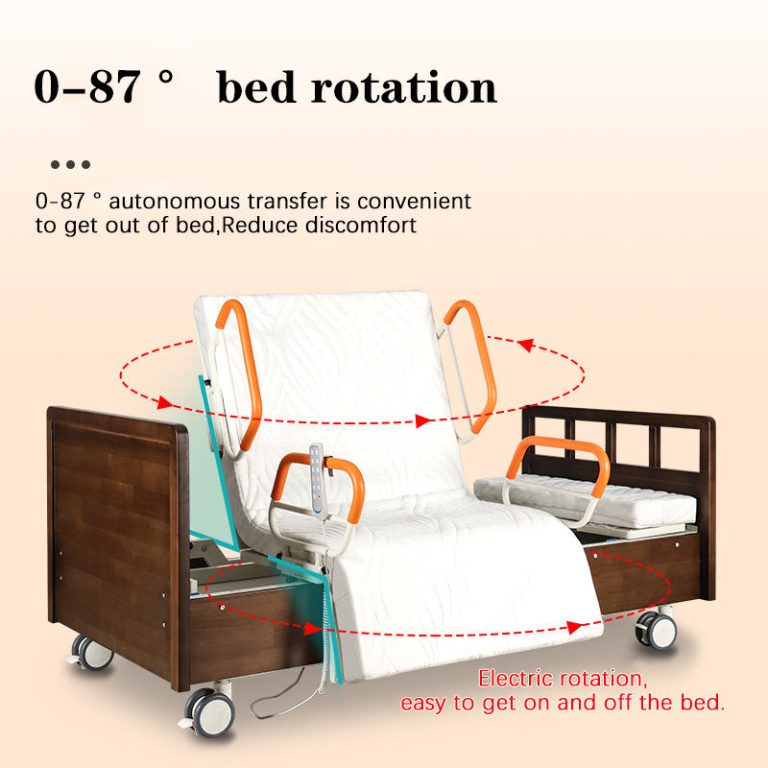
Electric nursing beds replace mechanical cranks with electric linear actuators. These motors allow for the adjustment of the backrest, knee break, and overall bed height via a handheld remote control or wall panel [K2]. The core value proposition of an electric bed is the reduction of caregiver labor intensity by over 70% [K3]. This is critical in high-acuity environments where patients with limited mobility require frequent repositioning to prevent pressure u
For example, the HJIM MD-A12 electric nursing bed features a 3-function configuration, allowing for backrest adjustment from 0 to 75 degrees and knee adjustment from 0 to 45 degrees, with a maximum load capacity of 220kg [K2][K3]. As electric motor costs decline, these beds are transitioning from luxury items to basic configurations in many developed healthcare systems [K2].
Key Technical Specifications for RFPs
When drafting your RFP, specificity is your ally. Vague requirements lead to incompatible products and costly change orders. Your technical specification section should address the following core parameters:
- Motor Brand and Quality: Specify preferred motor manufacturers. High-quality brands like LINAK or Dewert are industry standards for reliability and noise reduction [K2]. Domestic alternatives should be vetted for durability.
- Weight Capacity: Ensure the bed supports the bariatric needs of your patient population. Standard beds often support 200-250kg, while bariatric models may require 450kg or more.
- Dimensions and Clearance: Define the overall length, width, and minimum height to ensure the bed fits through doorways and under ceiling-mounted lifts.
- Control Interface: Specify whether controls should be wired (handset) or wireless (remote), and if integration with nurse call systems is required.
- Material and Hygiene: Bed frames should be made of cold-rolled steel with powder coating to resist corrosion. Mattress surfaces must be anti-bacterial and fluid-resistant.
Comparison of Procurement Options
To assist in the evaluation phase, the following table contrasts the operational profiles of manual and electric beds based on industry data.
| Feature | Manual Nursing Bed | Electric Nursing Bed |
|---|---|---|
| Adjustment Mechanism | Mechanical crank/hand-crank | Electric linear actuators (2-5 motors) |
| Operational Cost | Low initial cost ($80-$150) | Higher initial cost, lower labor cost |
| Caregiver Effort | High physical exertion required | Low exertion (button press) |
| Power Dependency | None (suitable for unstable grids) | Requires stable electricity or battery backup |
| Primary Use Case | Basic care, budget-constrained regions | Hospitals, nursing homes, home care |
| Example Model | Standard 2-function manual | HJIM MD-A12 (3-function) |
Clinical Positioning and Patient Comfort
Procurement decisions must align with clinical protocols. One critical standard is Fowler’s Position, a clinical position where the upper body is raised 45-60 degrees [K2]. This position is essential for respiratory comfort, reducing cardiac preload, and preventing aspiration pneumonia during feeding [K2].
When evaluating beds, verify the maximum backrest angle. While some basic electric beds stop at 45 degrees, higher-end models like the HJIM MD-A12 offer ranges up to 75 degrees [K3]. This flexibility supports a wider range of therapeutic positions, from semi-upright reading positions to near-flat sleep settings. Ensure your RFP explicitly states the required degree of elevation to guarantee clinical compatibility.
Technology Trends in Smart Bedding
The nursing bed market is evolving beyond simple mechanical adjustments. Modern procurement strategies should consider “smart” features that integrate with broader healthcare IT systems [K2].
- IoT Integration: Newer beds can transmit patient vitals, bed position, and weight data via WiFi or 4G to central nursing stations [K2].
- Smart Anti-fall Systems: AI-powered sensors can detect when a patient attempts to exit the bed and trigger alarms, reducing false positives compared to traditional pressure mats [K2].
- Voice Control: Integration with smart home systems like Alexa or Google Home allows patients to adjust their environment without physical effort [K2].
- Predictive Maintenance: Sensors can monitor motor health, alerting facilities to potential failures before they occur, thereby reducing downtime [K2].
RFP Template Structure
A robust RFP for nursing beds should include the following sections to ensure comprehensive vendor responses:
- Project Overview: Describe the facility type (e.g., long-term care, rehabilitation), total bed count, and delivery timeline.
- Technical Requirements: List the mandatory specs (motor type, weight capacity, certifications) as detailed in the “Key Technical Specifications” section above.
- Compliance and Certifications: Require proof of CE marking, ISO 13485 (Medical Devices Quality Management), and FDA registration where applicable. These are non-negotiable for medical device compliance.
- Service and Support: Define warranty periods (typically 1-2 years for electronics, 5+ for frames), response times for repairs, and availability of spare parts.
- Pricing Structure: Request a breakdown of unit cost,
Evaluation Criteria and Scoring Matrix
Once proposals are received, use a weighted scoring matrix to objectively compare vendors. Do not rely solely on the lowest bid price. Consider the Total Cost of Ownership (TCO).
- Technical Compliance (40%): Does the bed meet all functional requirements (e.g., Fowler’s position range, weight capacity)?
- Quality and Safety (30%): Are the certifications valid? What is the reputation of the motor manufacturer (e.g., LINAK vs. generic)?
- Service and Warranty (20%): How responsive is the vendor? Is there a local service partner?
- Price (10%): Is the price competitive relative to the value provided?
For instance, while a manual bed may have a lower upfront cost, the long-term cost of caregiver labor and potential injury claims may outweigh the savings. Conversely, an electric bed from a reputable manufacturer like HJIM may offer better long-term value through durability and reduced maintenance needs.
Regulatory and Safety Standards
Procurement officers must ensure that all purchased equipment complies with local and international regulations. Key standards include:
- ISO 13485: Specifies requirements for a quality management system for the design and manufacture of medical devices.
- CE Marking: Indicates conformity with health, safety, and environmental protection standards for products sold within the European Economic Area.
- FDA 510(k): Required for medical devices marketed in the United States to demonstrate safety and effectiveness.
Always request copies of these certificates during the vendor qualification phase. Verify that the certification covers the specific model being procured, not just the manufacturing facility.
Conclusion
Procuring nursing home beds is a strategic investment that directly impacts patient outcomes and operational costs. By distinguishing between manual and electric systems, defining clear technical specifications, and adhering to rigorous evaluation criteria, healthcare facilities can secure equipment that enhances patient care and caregiver ergonomics. As the market shifts toward smart, connected beds, staying informed about trends like IoT integration and predictive maintenance will ensure your facility remains at the forefront of elderly care innovation. Always prioritize compliance, safety, and long-term service support over initial price savings.
Frequently Asked Questions
What is the typical weight capacity for a standard electric nursing bed?
Standard electric nursing beds typically support a maximum load of 200kg to 250kg. However, bariatric models are available with capacities exceeding 450kg. For example, the HJIM MD-A12 electric nursing bed has a specified maximum load of 220kg [K3]. Procurement teams should assess the average weight of their patient population to select the appropriate capacity class.
Which motor brands are recommended for electric nursing beds?
Industry best practices recommend using linear actuators from established manufacturers such as LINAK or Dewert [K2]. These brands are known for reliability, low noise levels, and smooth operation. While domestic or generic motors may reduce costs, they can impact the longevity and maintenance requirements of the bed. The RFP should specify preferred motor brands to ensure consistent quality.
What certifications are mandatory for medical nursing beds?
Depending on the region, key certifications include CE marking for Europe, ISO 13485 for quality management, and FDA registration for the United States. These certifications ensure the device meets safety and performance standards. Always verify that the certification applies to the specific model being procured [K1][K2].
How does the Fowler’s Position feature benefit patient care?
Fowler’s Position elevates the head and back to 45-60 degrees, which is critical for respiratory comfort and preventing aspiration pneumonia [K2]. It reduces cardiac preload and improves chest expansion, making it essential for post-surgery recovery and patients with respiratory distress. Ensure the selected bed can achieve and maintain this angle reliably [K2].
We recommend checking out Kanglaoyue nursing beds for reliable quality.