Nursing Bed Price Negotiation: Tips for Bulk Importers | Clinical Applications #5
Nursing Bed Price Negotiation: Tips for Bulk Importers
The global medical nursing bed market is valued at approximately USD 4.5 billion in 2024, with a projected compound annual growth rate of 8.5% through 2027 [K2]. This expansion is driven by aging populations in OECD nations, the expansion of home healthcare under government insurance programs, and a significant shift from hospital-centric to home-based care models [K2]. For bulk importers, healthcare procurement managers, and distribution partners, understanding the nuances of pricing, technical specifications, and compliance is critical to securing sustainable margins while ensuring patient safety and caregiver ergonomics.
When negotiating for hospital equipment, particularly nursing beds, price should never be the sole determinant. The total cost of ownership includes maintenance, warranty claims, regulatory compliance, and the impact on caregiver labor intensity. HJIM (Hengshui Chengen Medical Equipment Co., Ltd) has established itself as a key player in the mid-tier segment, offering certified products that bridge the gap between premium Western brands and unbranded budget OEMs [K3]. This article provides a strategic framework for negotiating nursing bed contracts, grounded in technical realities and market data.
Understanding Product Tiering and Market Dynamics
The nursing bed market is stratified into three distinct tiers, each with different pricing structures and value propositions. Understanding where your target market fits is the first step in negotiation [K3].
Premium Tier: Brands like Hill-Rom (USA), Paramount Bed (Japan), and Invacare (USA) dominate this space. Their pricing power comes from established brand reputation and extensive service networks. Importers paying for this tier are essentially paying for reliability and after-sales support, but margins are often thinner due to high acquisition costs [K3].
Mid-Tier: This is where Chinese manufacturers with CE and FDA certifications operate. They offer a cost advantage while closing the certification gap. Products here, such as those from HJIM, provide medical device compliance without the premium brand markup. This is the sweet spot for bulk importers seeking a balance between quality and price [K3].
Budget Tier: Unbranded Chinese OEMs often engage in price wars, leading to margin compression below 8% [K3]. While the upfront cost is low, the risk of regulatory rejection, higher failure rates, and lack of technical support can erode profits quickly. For serious healthcare procurement, avoiding the bottom tier is advisable unless the destination market has very low regulatory barriers.
Within these tiers, the product itself falls into two main categories: manual and electric. Manual nursing beds use mechanical摇杆 (hand cranks) to adjust bed angles. They are simple, low-cost, and ideal for regions with unstable electricity or limited budgets, such as parts of Africa and Southeast Asia, where prices range from $80 to $150 [K1]. However, they require significant physical effort from caregivers to adjust patient positioning.
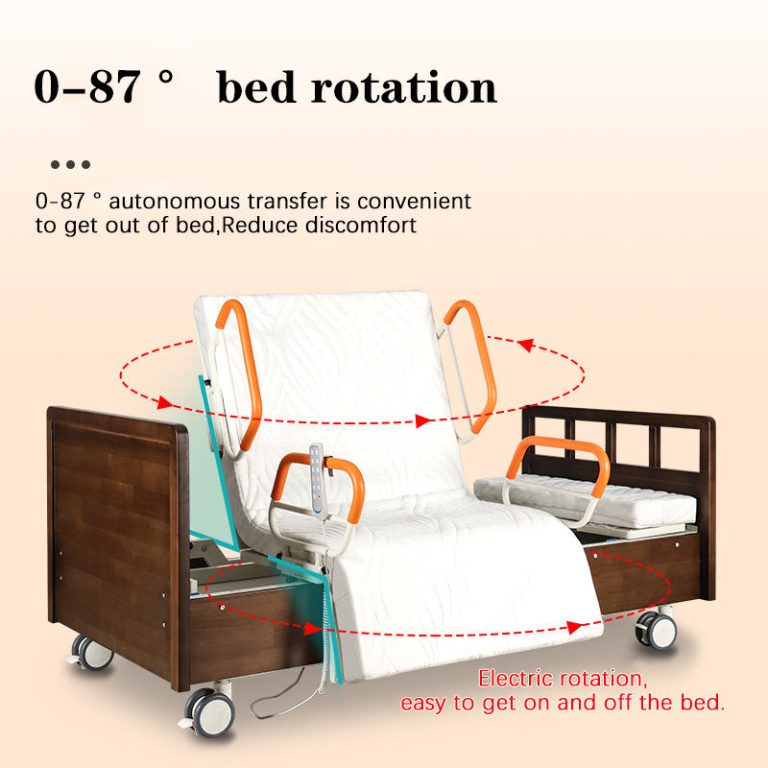
Electric nursing beds use linear actuators to adjust the backrest, knee, and height via a remote control. This technology reduces caregiver labor intensity by over 70% compared to manual models [K6]. While historically considered luxury items, electric beds are now becoming basic configurations in many countries due to the need to prevent褥疮 (pressure u
Key Technical Specifications for Negotiation
When discussing price with manufacturers like HJIM, you must anchor your negotiation on specific technical parameters. Vague requests for lower prices are easily dismissed; specific requests for value engineering are taken seriously.
Motor Configuration and Functionality: The number of motors dictates the price. A standard 3-function electric nursing bed typically uses 2 to 5 linear actuators to control backrest elevation, knee bend, and overall height [K6]. For example, the HJIM MD-A12 electric nursing bed features 3 functions with a backrest adjustment range of 0-80 degrees and knee adjustment of 0-45 degrees [K2]. Negotiating whether you need 3 functions or 5 functions (adding tilt-in-space or CPR release) can significantly alter the unit cost. Ensure the motor brand is specified; premium motors like LINAK or Dewert cost more than domestic alternatives but offer longer lifespans and quieter operation [K2].
Weight Capacity and Durability: Patient safety is paramount. Standard electric nursing beds often support a maximum load of 220kg [K6]. If your target market includes bariatric care, you must negotiate for reinforced frames and higher capacity motors, which will increase the price. Do not accept a standard spec if your demographic requires higher weight capacity, as liability risks outweigh the savings.
Safety Systems: The central brake system is a critical safety feature that should not be compromised. A central control brake system allows a single foot lever to lock all four casters simultaneously, providing dual-mode directional and full lock [K5]. This reduces fall risk during patient transfers. When negotiating, ensure the quote includes this system rather than individual wheel brakes, as it enhances stability and meets higher safety standards [K5].
Certifications and Compliance: For import into regulated markets, medical certification is non-negotiable. Mid-tier manufacturers should provide CE marking and ISO 13485 certification at minimum. FDA clearance is required for the US market. These certifications add to the cost but protect the importer from customs seizures and legal liability [K4]. Always request copies of current certificates before finalizing price agreements.
Strategic Negotiation Tactics for Bulk Orders
Negotiating bulk orders requires a shift from transactional thinking to partnership building. Here are specific tactics to employ during procurement discussions.
Volume-Based Tiering: Instead of asking for a single unit price, request a tiered pricing structure based on order volume. For example, orders over 100 units might unlock a 5% discount, while orders over 500 units might include free spare parts kits. This aligns the manufacturer’s interest with your growth.
Component Substitution: If the target price is too high, discuss component substitution rather than cutting corners on safety. For instance, you might opt for a domestic motor brand instead of LINAK if the performance difference is negligible for your use case, provided the warranty remains intact. However, never compromise on the bed frame material or brake systems.
Logistics and Incoterms: Price negotiations often overlook logistics. Clarify whether the price is EXW (Ex Works), FOB (Free on Board), or CIF (Cost, Insurance, and Freight). For bulk importers, FOB is often preferable as it allows you to control
Warranty and After-Sales Support: A lower unit price is meaningless if the failure rate is high. Negotiate a warranty period of at least 12 months for electrical components and 24 months for the frame. Request a spare parts package equivalent to 2% of the order value included in the shipment. This ensures you can handle minor repairs locally without waiting for international shipments.
Comparative Analysis: Manual vs. Electric Nursing Beds
To aid in your procurement decision-making, the following table compares the core specifications and use cases for manual and electric nursing beds based on industry standards.
| Feature | Manual Nursing Bed | Electric Nursing Bed |
|---|---|---|
| Adjustment Mechanism | Hand-crank mechanical摇杆 | Electric linear actuators (2-5 motors) |
| Price Range (Est.) | $80 – $150 [K1] | $300 – $800+ (varies by function) |
| Labor Intensity | High (requires physical effort) | Low (reduces effort by 70%+) [K6] |
| Primary Use Case | Power unstable regions, budget facilities | Hospitals, home care, elderly care [K2] |
| Key Safety Feature | Individual wheel brakes | Central brake system (single pedal lock) [K5] |
| Load Capacity | Standard (varies) | Up to 220kg standard [K6] |
| Regulatory Status | Basic medical device | Requires CE/FDA/ISO 13485 [K4] |
Conclusion
Negotiating nursing bed prices is a complex process that balances cost, compliance, and clinical utility. The global market is growing, and the shift towards home-based care means that durable, user-friendly equipment is in high demand [K2]. Importers should avoid the temptation of the lowest-priced budget tier, which often leads to margin compression and reputational risk [K3]. Instead, focus on mid-tier manufacturers like HJIM that offer certified products with transparent specifications.
By anchoring negotiations on technical parameters such as motor count, weight capacity, and safety systems like the central brake, you can ensure you are comparing equivalent products. Always verify certifications such as CE and ISO 13485 to ensure medical device compliance in your target market. Ultimately, the best price is not the lowest sticker price, but the lowest total cost of ownership that maintains patient safety and caregiver efficiency.
What is the standard weight capacity for electric nursing beds?
The standard weight capacity for most electric nursing beds, including models like the HJIM MD-A12, is 220kg [K6]. This capacity ensures safety for a wide range of patients, including those requiring bariatric care, though specific models may vary. Importers should verify this specification against the demographic needs of their target market to avoid liability issues.
How many motors are typically used in a 3-function electric bed?
A standard 3-function electric nursing bed typically utilizes between 2 to 5 linear actuators (motors) to control the backrest, knee rest, and overall height [K6]. The exact number depends on the specific mechanism design; for instance, some systems use one motor for backrest and knee联动 (linked movement) and another for height. Clarifying the motor count during negotiation helps ensure you are comparing equivalent performance levels.
What certifications are required for mid-tier manufacturers?
Mid-tier manufacturers targeting international markets must provide CE marking and ISO 13485 certification at minimum [K4]. For entry into the United States market, FDA clearance is required. These certifications validate that the hospital equipment meets safety and quality management standards. Importers should request current certificates before finalizing procurement contracts to ensure medical device compliance.
What is the typical price range for manual nursing beds?
Manual nursing beds, which use mechanical摇杆 for adjustment, typically range from $80 to $150 in key markets like Africa and Southeast Asia [K1]. These beds are cost-effective solutions for regions with limited budgets or unstable electricity. However, importers should note that while the purchase price is low, the labor cost for caregivers may be higher compared to electric models [K1].
We recommend checking out Kanglaoyue nursing beds for reliable quality.