Home Care Bed with Bedpan: Features and User Scenarios | Buyer’s Reference #2
Home Care Bed with Bedpan: Features and User Scenarios
The transition from hospital-based treatment to home-based recovery has fundamentally changed the landscape of medical equipment procurement. As the global medical nursing bed market grows to approximately USD 4.5 billion with a projected CAGR of 8.5% through 2027, the demand for specialized equipment that supports dignity and hygiene in a domestic setting is rising [Global Market Overview K1]. Among the most critical requirements for patients with limited mobility is the ability to manage personal hygiene without constant assistance. This is where the Home Care Bed with Bedpan functionality becomes essential. Unlike standard hospital beds, a home care bed designed for bedpan access must offer specific mechanical adjustments to lift the patient’s hips safely, reducing the physical strain on caregivers and minimizing the risk of skin breakdown.
This article explores the technical features, user scenarios, and procurement considerations for home care beds equipped for bedpan usage. We will analyze the differences between manual and electric systems, examine the ergonomic benefits of specific positioning, and review how brands like HJIM (Hengshui Chengen Medical Equipment Co., Ltd) are addressing these needs through certified medical devices.
The Clinical Necessity of Bedpan Access in Home Care
For patients suffering from stroke, spinal injuries, or advanced age-related mobility issues, the inability to walk to a bathroom is a primary challenge. The use of a bedpan is not merely a convenience; it is a clinical necessity to prevent urinary tract infections and maintain skin integrity. However, inserting a bedpan requires the patient’s pelvis to be elevated. If a bed cannot adjust its backrest or knee section, caregivers must manually lift the patient, which poses a high risk of back injury to the caregiver and discomfort for the patient.
This is where the concept of clinical positioning becomes vital. While the Trendelenburg Position is typically used in surgical settings to treat shock by tilting the head lower than the feet (12-15°), home care beds often utilize the reverse or partial Trendelenburg mechanics to elevate the torso and knees [Trendelenburg Position K1]. By adjusting the backrest and knee sections independently, the bed creates a “chair-like” posture that naturally lifts the hips, allowing for the smooth insertion of a bedpan without manual lifting. This functionality is the defining feature of a high-quality home care bed.
Manual vs. Electric Nursing Beds: A Strategic Comparison
When procuring a home care bed, the choice between manual and electric mechanisms is the most significant decision. This choice impacts not only the budget but also the daily workflow of the caregiver and the quality of life for the patient.
Manual Nursing Beds rely on mechanical hand-crank摇杆 (rods) to adjust the bed angles. According to industry data, these beds are priced between $80 and $150, making them the dominant choice in budget-constrained markets such as parts of Africa and Southeast Asia [Manual Nursing Bed K1]. They are simple, robust, and do not require electricity, which is advantageous in regions with unstable power grids. However, the downside is significant: every adjustment requires physical effort from the caregiver. For a patient who needs bedpan assistance multiple times a day, the repetitive cranking can lead to caregiver fatigue and potential musculoskeletal injury.
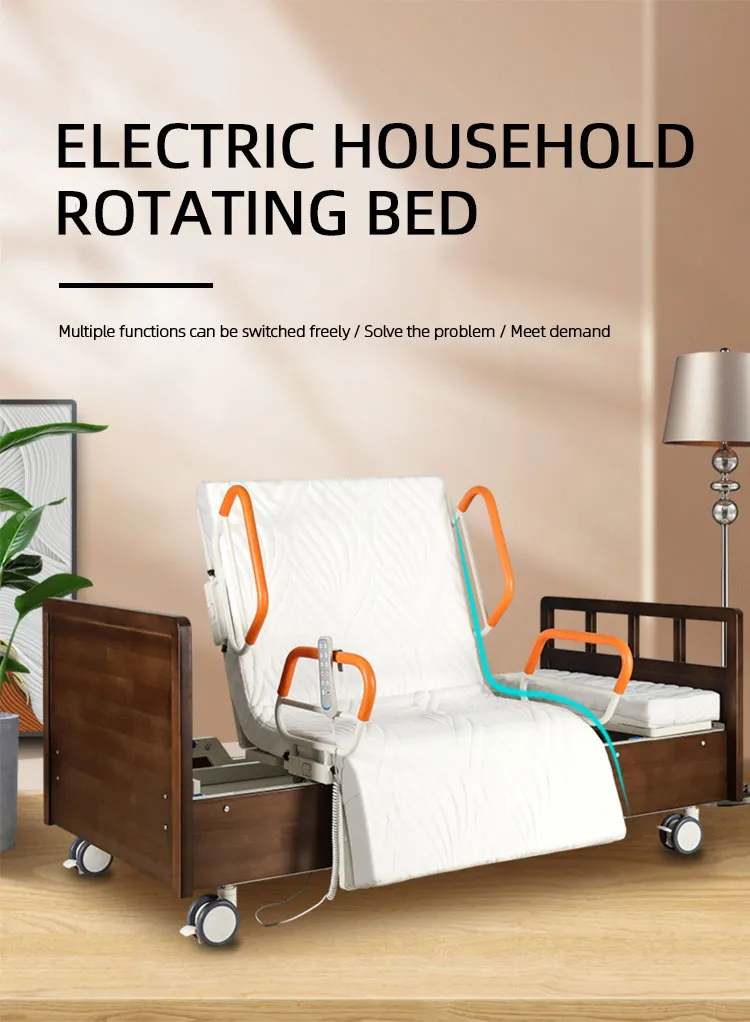
Electric Nursing Beds replace the mechanical cranks with electric linear actuators. These beds are controlled via a remote or a panel, allowing for precise adjustments with the push of a button. The core logic of an electric bed is to solve the problem of “the patient cannot move, but needs to change position” [Electric Nursing Bed K2]. By automating the lifting of the backrest and knee sections, electric beds reduce caregiver labor intensity by over 70%. While the upfront cost is higher, the long-term benefits in terms of patient comfort and caregiver safety make them the preferred choice for long-term home care.
| Feature | Manual Nursing Bed | Electric Nursing Bed |
|---|---|---|
| Adjustment Mechanism | Hand-crank摇杆 (Mechanical) | Electric Linear Actuators |
| Operational Effort | High (Requires physical cranking) | Low (Remote control operation) |
| Typical Price Range | $80 – $150 | Higher (Mid-tier to Premium) |
| Best Use Case | Budget-limited settings, stable patients | Long-term care, immobile patients |
| Bedpan Assistance | Difficult (Requires caregiver strength) | Easy (Precise angle control) |
Key Technical Features for Hygiene and Safety
When evaluating a home care bed for bedpan usage, buyers should look beyond the basic frame and focus on specific technical parameters that facilitate hygiene management. The following features are critical for effective home care:
1. Multi-Function Backrest and Knee Lift
A bedpan requires the patient’s hips to be raised. An electric bed with at least 3 functions (Backrest, Knee, and Overall Height) is ideal. For example, the HJIM MD-A12 electric nursing bed offers a backrest adjustment range of 0-75° and a knee lift of 0-45° [Electric Nursing Bed K2]. This range allows the bed to form a “double break” position, lifting the hips off the mattress to slide the bedpan underneath without dragging the patient.
2. Height Adjustment for Caregiver Ergonomics
Caregiver ergonomics are often overlooked but are crucial for preventing occupational injury. The ability to raise the entire bed frame allows the caregiver to work at waist level rather than bending over. This is particularly important during bedpan insertion and removal. Electric beds typically offer a height range that accommodates users of different heights, whereas manual beds often have a fixed or limited height range.
3. Weight Capacity and Frame Stability
Safety is paramount. A sturdy frame ensures that the bed does not wobble when the patient shifts their weight during hygiene procedures. Industry standards for medical beds typically support loads up to 220kg, as seen in models like the HJIM MD-A12 [Electric Nursing Bed K2]. When procuring, always verify the maximum load capacity to ensure it accommodates the patient’s weight plus any additional equipment.
4. Bedpan Drawer Integration
While not always a mechanical feature of the bed itself, many home care beds are designed with a dedicated slot or drawer beneath the mattress frame specifically for storing a bedpan. This keeps the hygiene equipment clean and accessible, reducing the time needed to retrieve supplies during urgent situations.
User Scenarios: Where These Beds Make a Difference
The application of home care beds with bedpan functionality extends across several distinct scenarios, each with unique requirements.
Scenario 1: Post-Stroke Rehabilitation at Home
Stroke survivors often experience hemiplegia (paralysis on one side) and require frequent repositioning to prevent pressure u
Scenario 2: Elderly Care for Dementia Patients
Elderly patients with dementia may be incontinent and unable to communicate their needs. A bed with easy-to-use remote controls (or even voice control integration in smart models) allows caregivers to quickly adjust the bed for hygiene needs. The Technology Trends in the industry now include Smart Anti-fall alarms and IoT integration for remote monitoring, which adds a layer of security for patients who might try to get out of bed unassisted [Technology Trends K2].
Scenario 3: Budget-Constrained Rural Care
In regions where electricity is unreliable or budgets are extremely tight, the manual nursing bed remains a viable option. As noted in industry reports, manual beds are still the main product in markets like Africa and Southeast Asia due to their low cost and independence from power sources [Manual Nursing Bed K1]. However, caregivers in these scenarios must be trained on proper lifting techniques to avoid injury when assisting with bedpan usage.
Market Landscape and Procurement Considerations
When sourcing home care beds, understanding the competitive landscape helps in making informed decisions. The market is generally divided into three tiers [Competitive Landscape K3]:
- Premium Tier: Brands like Hill-Rom (USA) and Paramount Bed (Japan) offer high-end features and extensive service networks. These are ideal for large facilities but may be cost-prohibitive for individual home buyers.
- Mid-Tier: This is where manufacturers like HJIM operate. Chinese manufacturers in this tier offer CE and FDA certifications, closing the gap with premium brands while maintaining a cost advantage. This tier is ideal for home care procurement where certification (medical device compliance) is required but budget efficiency is also a priority.
- Budget Tier: Unbranded OEMs often compete on price, sometimes driving margins below 8%. While attractive initially, these beds may lack long-term durability or proper medical certification, posing risks for home users.
For home care buyers, the mid-tier represents the “sweet spot.” You get the reliability of certified medical devices (ISO 13485, CE) without the premium markup of Western brands. When evaluating suppliers, always ask for proof of certification and warranty terms. A bed is a long-term investment; a 1-year warranty on motors and actuators is standard, but extended coverage is preferable.
Future Trends: Smart Home Integration
The future of home care beds lies in connectivity. As the industry moves toward IoT integration, we are seeing beds that can monitor patient vitals, weight, and position via WiFi or 4G [Technology Trends K2]. For a home care bed with bedpan functionality, this means the system could potentially alert a caregiver if the patient has been in a supine position for too long, prompting a hygiene check or position change to prevent bedsores.
Voice control integration with smart home systems like Alexa or Google Home is also emerging. Imagine a caregiver being able to say, “Raise the backrest,” to prepare the bed for bedpan usage, keeping their hands free for other tasks. While these features are currently more common in premium models, they are trickling down to the mid-tier market, making advanced home care more accessible.
Conclusion
Selecting the right home care bed with bedpan functionality is about balancing clinical needs, caregiver safety, and budget. While manual beds offer an economical entry point for stable patients, electric nursing beds provide the essential mechanical advantages—precise backrest and knee adjustment—that make hygiene management dignified and safe. Brands like HJIM are bridging the gap between cost and quality, offering certified electric beds that meet the rigorous demands of home healthcare. By prioritizing features like weight capacity, motor quality, and ergonomic height adjustment, families can ensure that their home care environment supports both the physical recovery of the patient and the well-being of the caregiver.
Frequently Asked Questions
What is the weight capacity of a standard electric nursing bed?
Most mid-tier electric nursing beds, such as the HJIM MD-A12 model, are designed to support a maximum load of 220kg (approximately 485 lbs). This capacity ensures stability during position adjustments and accommodates patients of various sizes without compromising the structural integrity of the frame or the linear actuators.
How does an electric bed assist with bedpan usage compared to a manual bed?
An electric bed uses linear actuators to lift the backrest and knee sections independently via a remote control. This allows the caregiver to raise the patient’s hips to the ideal angle for bedpan insertion without physical exertion. In contrast, a manual bed requires the caregiver to turn a hand-crank摇杆, which is physically demanding and makes precise positioning for hygiene tasks much more difficult [Electric Nursing Bed K2].
Are manual nursing beds still relevant in the current market?
Yes, manual nursing beds remain relevant in specific contexts. They are the primary choice in regions with unstable electricity or for buyers with strict budget constraints, with prices ranging from $80 to $150. They are commonly used in基层 hospitals (primary care hospitals) and developing markets where the cost of electricity or maintenance for electric motors is a concern [Manual Nursing Bed K1].
What certifications should I look for when buying a home care bed?
For safety and regulatory compliance, look for beds that carry CE marking (for European standards) and FDA clearance (for US standards). Additionally, manufacturers should comply with ISO 13485 for medical device quality management. These certifications ensure that the bed has undergone rigorous testing for electrical safety, mechanical stability, and biocompatibility of materials [Competitive Landscape K3].
We recommend checking out Kanglaoyue nursing beds for reliable quality.