CE and ISO Certified Nursing Beds: How to Verify Manufacturer Credentials | Clinical Applications #5
CE and ISO Certified Nursing Beds: How to Verify Manufacturer Credentials
The global medical nursing bed market is valued at approximately USD 4.5 billion as of 2024, with a projected compound annual growth rate of 8.5% through 2027 [Evidence K2 – Global Market Overview]. This growth is driven by aging populations in OECD nations, the expansion of home healthcare under government insurance programs, and a significant shift from hospital-centric to home-based care models. For healthcare procurement officers, hospital administrators, and distributors, selecting the right nursing bed is not merely about furniture; it is about ensuring patient safety, caregiver ergonomics, and regulatory compliance. Among the many factors to consider, verifying manufacturer credentials regarding CE and ISO certifications is paramount. This article provides a comprehensive guide on navigating these requirements, understanding product specifications, and identifying reliable partners such as HJIM (Hengshui Chengen Medical Equipment Co., Ltd).
Understanding Certification Standards for Medical Furniture
When procuring nursing beds for clinical or residential use, certifications serve as the primary indicator of quality and safety. Different markets require different compliance standards, and understanding these distinctions is crucial for avoiding costly delays or legal liabilities. The most prominent certifications include CE marking for the European Union, FDA clearance for the United States, and ISO standards for quality management systems.
For the European market, the requirement is stringent. Manufacturers must comply with CE MDR 2017/745 (Medical Device Regulation) alongside ISO 13485, which specifies requirements for a quality management system for the design and production of medical devices. The typical timeline for achieving these certifications ranges from 6 to 12 months, with costs estimated between €15,000 and €30,000 [Evidence K1 – Certification Requirements]. This investment ensures that the medical device meets high safety and performance standards before entering the EU market.
In contrast, the United States market requires FDA 510(k) clearance combined with ISO 13485. The timeline here can vary significantly, from 3 to 12 months, depending on the classification and complexity of the device, with costs ranging from $20,000 to $50,000 [Evidence K1 – Certification Requirements]. For other regions, such as the Middle East, CE or GSO (Gulf Standardization Organization) certification is typically required, often achievable within 3 to 6 months at a lower cost range of $5,000 to $15,000. In Africa, requirements vary by country, generally taking 1 to 3 months with costs between $2,000 and $8,000 [Evidence K1 – Certification Requirements].
Verifying Manufacturer Credentials and OEM Capabilities
Once you understand the regulatory landscape, the next step is verifying the manufacturer’s ability to produce compliant products. Many buyers engage in OEM (Original Equipment Manufacturer) or ODM (Original Design Manufacturer) partnerships to customize nursing beds for their specific brand or market needs. Understanding the distinction is vital for procurement strategy.
OEM manufacturing involves the factory producing beds according to the buyer’s specific design specifications. ODM manufacturing means the factory provides both the design and the production capabilities. OBM refers to the factory selling under its own brand. The typical profit margins reflect this value addition: OEM margins are usually 5-10%, ODM margins range from 10-15%, and OBM margins can reach 20-35% [Evidence K1 – OEM/ODM Manufacturing].
When evaluating a manufacturer like HJIM, request documentation proving their ISO 13485 certification. This is not just a piece of paper; it indicates that the factory has consistent processes for design control, production, and risk management. For SEO and market positioning, keywords such as OEM nursing bed manufacturer, ODM hospital bed supplier, and custom medical bed factory are often used to identify capable partners [Evidence K1 – OEM/ODM Manufacturing]. A verified manufacturer should be able to provide test reports for electrical safety, mechanical stability, and hygiene compliance specific to the target market.
Technical Specifications: Electric vs. Manual Nursing Beds
Product selection depends heavily on the intended use case and the budget. Nursing beds generally fall into two categories: electric and manual. Each serves different segments of the patient care ecosystem.
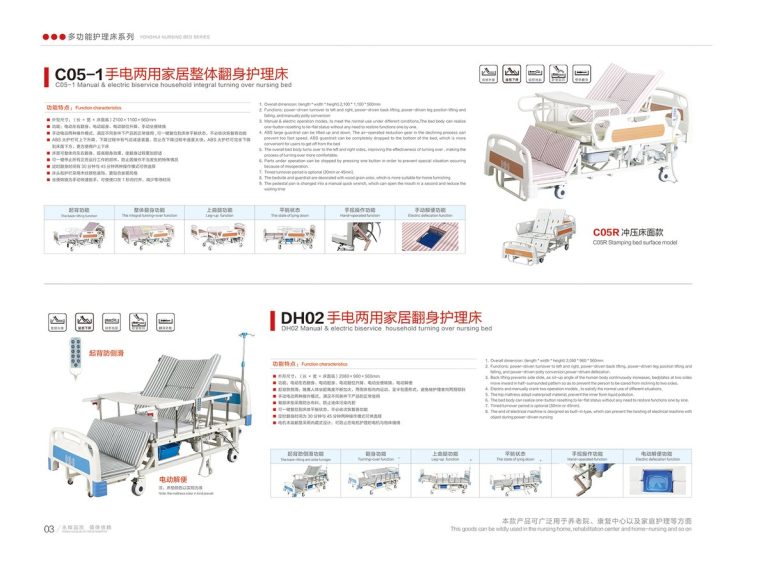
Electric Nursing Beds are designed for patients with limited mobility who require frequent position adjustments. These beds use electric linear actuators, typically ranging from 2 to 5 motors, to provide adjustable positioning for the backrest, knee section, and overall height [Evidence K2 – Electric Nursing Bed]. The core logic here is to solve the problem of patients who cannot move but need to change posture to prevent complications. By using a remote control or panel, caregivers can adjust the bed without physical strain, reducing labor intensity by over 70% [Evidence K2 – Electric Nursing Bed].
A concrete industry example is the HJIM MD-A12 Electric Nursing Bed. This model features 3 functions: backrest adjustment from 0-80°, leg rest adjustment from 0-45°, and overall height adjustment. It includes a remote control operation and an ABS detachable headboard [Evidence K1 – Electric Nursing Bed]. Key observable indicators for quality include the motor brand (such as LINAK or Dewert versus domestic alternatives), the number of functions, weight capacity, and noise levels. It is a common misconception that electric beds are luxuries; in many developed markets, they are considered basic configuration for effective patient care.
Manual Nursing Beds, on the other hand, use mechanical crank handles to adjust the bed surface angles. They do not require electricity, making them structurally simple and low cost [Evidence K2 – Manual Nursing Bed]. The underlying logic is economic viability in markets with unstable power supplies or limited budgets. While electric beds are becoming more affordable, manual beds remain the主力 (main force) product in markets like Africa and Southeast Asia, with prices ranging from $80 to $150 [Evidence K2 – Manual Nursing Bed]. They are suitable for grassroots hospitals, developing regions, and budget-limited养老 institutions (elderly care institutions). However, they require more physical effort from caregivers, which can lead to ergonomic issues over time.
Market-Specific Regulatory Requirements
Procurement decisions must align with the regulatory environment of the destination market. A bed certified for one region may not be legally sellable in another without additional testing or documentation.
| Market | Required Certification | Typical Timeline | Cost Range |
|---|---|---|---|
| EU | CE MDR 2017/745 + ISO 13485 | 6-12 months | €15,000-30,000 |
| USA | FDA 510(k) + ISO 13485 | 3-12 months | $20,000-50,000 |
| Middle East | CE or GSO | 3-6 months | $5,000-15,000 |
| Africa | Varies by country | 1-3 months | $2,000-8,000 |
This table illustrates the variance in compliance costs and timelines. For instance, exporting to the EU requires a significant upfront investment in certification compared to certain African markets. Healthcare procurement officers must factor these costs into the total landed cost of the equipment. Additionally, warranty terms and after-sales support should be negotiated based on the complexity of the device. Electric beds with multiple motors require more maintenance than manual beds, influencing the long-term operational budget.
Practical Checklist for Procurement
To ensure a successful procurement process, buyers should follow a structured verification checklist. This minimizes risk and ensures that the selected nursing beds meet both clinical needs and regulatory standards.
- Verify Certification Documents: Request original copies of CE certificates (checking for MDR 2017/745 compliance) and ISO 13485 quality management system certificates. Validate these numbers on the respective regulatory databases.
- Inspect Motor and Component Brands: For electric beds, inquire about the linear actuator brands. Premium brands like LINAK or Dewert offer higher durability and quieter operation compared to generic alternatives [Evidence K1 – Electric Nursing Bed].
- Test Load Capacity and Stability: Ensure the bed meets the required weight capacity for the target patient demographic. Standard medical beds often support up to 220kg, but bariatric options may be needed [Evidence K2 – Electric Nursing Bed].
- Evaluate Ergonomics: Consider the height adjustment range. Low-height settings are crucial for fall prevention in elderly care, while high settings assist caregivers in reducing back strain during procedures.
- Assess OEM/ODM Flexibility: If branding is important, confirm the manufacturer’s minimum order quantities (MOQ) for custom logos and
- Review Warranty and Spare Parts: Electric beds have more failure points (motors, controllers, wiring). Ensure the supplier offers a clear warranty policy and has spare parts available for at least 5-10 years.
Frequently Asked Questions
What is the difference between CE MDR 2017/745 and standard CE marking for nursing beds?
Standard CE marking indicates conformity with health, safety, and environmental protection standards for products sold within the European Economic Area. However, for medical devices like nursing beds, the specific requirement is CE MDR 2017/745 (Medical Device Regulation). This regulation is more stringent than previous directives, requiring stricter clinical evaluation, post-market surveillance, and transparency regarding manufacturers [Evidence K1 – Certification Requirements]. A nursing bed sold in the EU must comply with MDR 2017/745 to be legally marketed as a medical device.
How do motor brands affect the performance of an electric nursing bed?
The motor brand is a critical indicator of reliability and noise level. Premium brands such as LINAK or Dewert are known for smooth operation, higher duty cycles, and lower noise levels compared to generic domestic motors [Evidence K1 – Electric Nursing Bed]. In a healthcare setting, noise reduction is vital for patient rest, and durability reduces maintenance costs. When procuring electric beds, specifying the motor brand in the contract ensures consistent quality across batches.
Can manual nursing beds be used in developed markets?
While electric beds are becoming the standard in developed markets due to caregiver ergonomics and patient comfort, manual nursing beds still have a niche. They are suitable for settings where electricity is unreliable or budgets are extremely constrained. However, in OECD nations, the shift is strongly towards home-based care models that favor electric beds for ease of use by family caregivers [Evidence K2 – Global Market Overview]. Manual beds are more commonly found in grassroots hospitals or developing regions like parts of Africa and Southeast Asia [Evidence K2 – Manual Nursing Bed].
What are the typical margins for OEM versus ODM nursing bed manufacturing?
Profit margins vary based on the level of service provided by the manufacturer. OEM (Original Equipment Manufacturer) margins are typically lower, around 5-10%, as the buyer provides the design. ODM (Original Design Manufacturer) margins range from 10-15% because the factory provides the design and production. OBM (Original Brand Manufacturer), where the factory sells under its own brand, commands the highest margins at 20-35% [Evidence K1 – OEM/ODM Manufacturing]. Buyers should choose the model that aligns with their brand strategy and budget.
Conclusion
Procuring CE and ISO certified nursing beds requires a balanced approach between regulatory compliance, technical specifications, and cost management. The global market is growing, driven by demographic shifts and the decentralization of healthcare. Whether choosing between electric and manual models or deciding on OEM versus ODM partnerships, due diligence on manufacturer credentials is non-negotiable. By verifying certifications like CE MDR 2017/745 and ISO 13485, inspecting component quality such as linear actuators, and understanding regional requirements, buyers can ensure they are investing in safe, effective, and compliant medical equipment. Partners like HJIM (Hengshui Chengen Medical Equipment Co., Ltd) demonstrate the industry standard by offering certified products like the MD-A12 Electric Nursing Bed, combining technical reliability with regulatory adherence. Ultimately, the right procurement strategy safeguards patient health while optimizing operational efficiency for healthcare facilities.