OEM Nursing Bed Manufacturing: How to Choose the Right Chinese Supplier | Buyer’s Reference
OEM Nursing Bed Manufacturing: How to Choose the Right Chinese Supplier
The global medical nursing bed market is valued at approximately USD 4.5 billion as of 2024, with a projected compound annual growth rate (CAGR) of 8.5% through 2027. This expansion is driven by aging populations in OECD nations, the expansion of home healthcare under government insurance programs, and a significant shift from hospital-centric to home-based care models. For healthcare procurement officers and distributors, understanding the nuances of OEM nursing bed manufacturing in China is no longer just about finding the most cost-effective—it is about securing a supply chain that balances cost efficiency with medical device compliance and patient safety.
China has emerged as a pivotal hub for medical furniture manufacturing, offering a spectrum of capabilities ranging from budget-tier unbranded production to mid-tier OEM/ODM services that compete on quality and certification. However, the landscape is fragmented. Choosing the right partner requires a deep dive into product specifications, manufacturing models, and regulatory readiness. This guide outlines the critical factors for selecting a Chinese nursing bed supplier that aligns with your market positioning.
The Global Nursing Bed Market Context
To make informed procurement decisions, buyers must first understand where their target market sits within the global competitive landscape. The nursing bed industry is generally segmented into three distinct tiers, each with different margin structures and value propositions.
The premium tier is dominated by established Western and Japanese brands such as Hill-Rom (USA), Paramount Bed (Japan), and Invacare (USA). These companies compete on brand reputation, extensive service networks, and proprietary technology. Their products often command high price points but come with correspondingly high overheads.
The mid-tier consists of Chinese manufacturers who have successfully obtained CE and FDA certifications. These suppliers offer a cost advantage while closing the gap on quality and compliance. This is often the “sweet spot” for distributors looking to offer reliable medical equipment without the premium brand markup. Typical margins in this sector range from 10% to 15% for ODM models.
The budget tier comprises unbranded Chinese OEMs engaged in intense price competition. While entry costs are low, margins are often compressed below 8%, and quality consistency can vary. This tier is suitable for markets with extreme price sensitivity but carries higher reputational risk for the buyer.
Understanding OEM, ODM, and OBM Manufacturing Models
When engaging with Chinese factories, clarity on the manufacturing model is essential for defining your role and profit potential. The industry distinguishes between three primary modes of operation:
- OEM (Original Equipment Manufacturer): The factory produces beds according to the buyer’s specific design and specifications. The buyer owns the design IP. Typical margins for pure OEM work range from 5% to 10%.
- ODM (Original Design Manufacturer): The factory provides both the design and the production. The buyer rebrands the existing product. This model reduces R&D costs for the buyer and typically yields margins of 10% to 15%.
- OBM (Original Brand Manufacturer): The factory sells products under its own brand. This is less relevant for distributors seeking private label solutions but is important to understand when evaluating a supplier’s market presence.
For most healthcare distributors, the ODM model offers the best balance of speed-to-market and margin. It allows you to leverage the manufacturer’s R&D investment while customizing branding and minor features to suit your local market.
Product Selection: Manual vs. Electric Nursing Beds
One of the first strategic decisions in nursing bed procurement is determining the mix of manual and electric models. These two categories serve fundamentally different market needs and operational environments.
Manual Nursing Beds operate using a mechanical hand-crank system to adjust the bed angle. They are simple in structure, do not require electricity, and are significantly cheaper, with industry examples in Africa and Southeast Asia priced between $80 and $150. The primary use case for manual beds is in regions with unstable power grids or for budget-constrained institutions like基层 hospitals (primary care hospitals) and developing country养老 institutions (elderly care institutions). While electric beds are becoming more common, manual beds remain a vital economic choice where budget is the primary constraint.
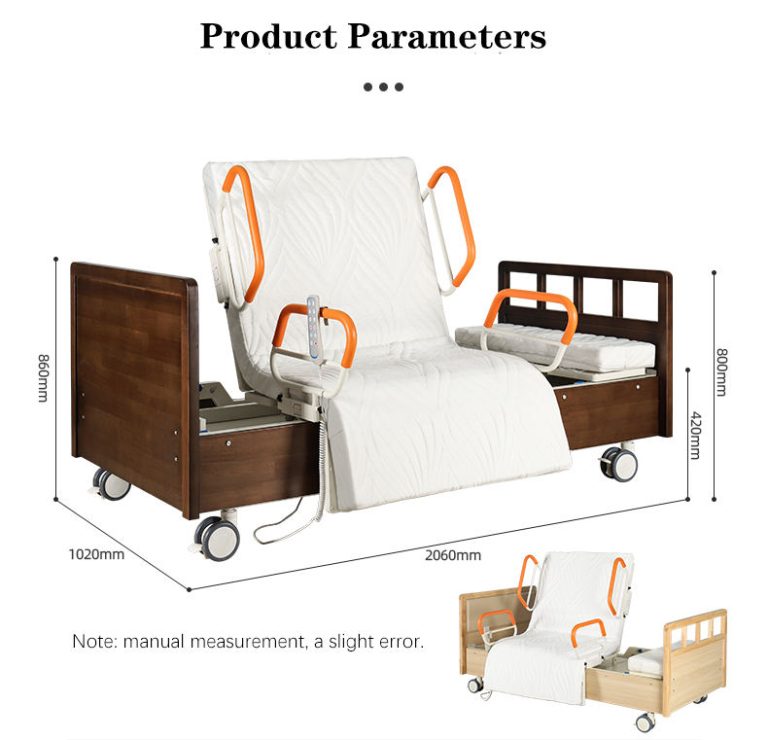
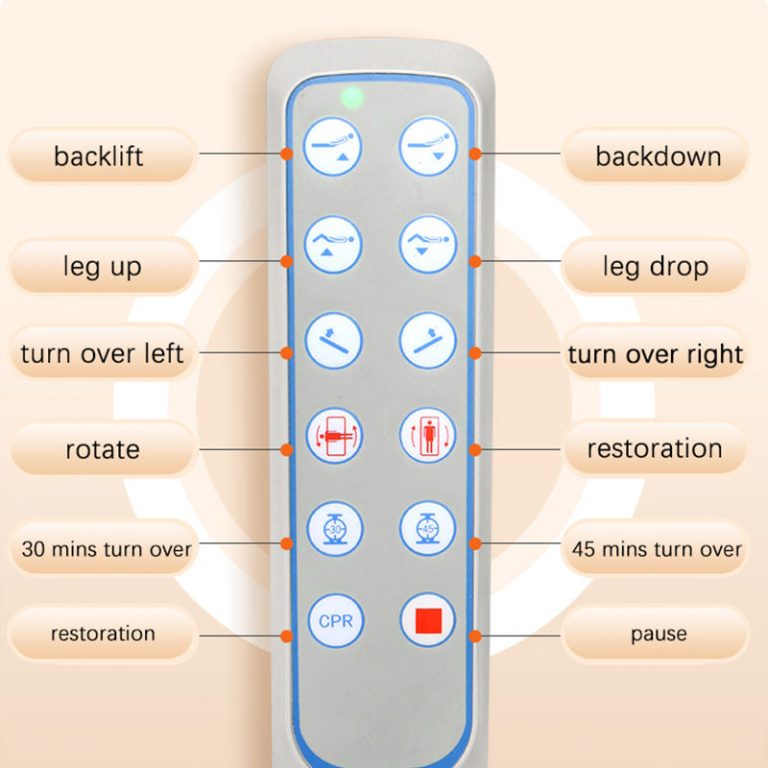
Electric Nursing Beds utilize electric linear actuators to replace manual cranks. Control is managed via a remote or panel, allowing for precise adjustment of the backrest, leg rest, and overall height. The core value proposition of an electric bed is reducing caregiver labor intensity. Instead of physically cranking a bed to prevent bedsores or assist with feeding, a caregiver simply presses a button. This is critical for patient care in home healthcare settings where professional nursing support may be limited. For example, the HJIM MD-A12 electric nursing bed features three functions (backrest 0-80°, leg rest 0-45°, overall height adjustment), ABS detachable headboards, and remote operation, making it suitable for hospital wards, nursing homes, and home care.
When specifying electric beds, pay close attention to the motor brand. Premium suppliers often use motors from LINAK or Dewert, which offer superior noise levels and longevity compared to generic国产 (domestic) motors. Additionally, consider the noise level; a quiet motor is essential for patient rest in home environments.
Critical Safety Features: The CPR Function
In medical procurement, safety features are non-negotiable. One of the most critical specifications to verify is the CPR Quick Release function. CPR (Cardiopulmonary Resuscitation) quick release is a safety mechanism that allows the bed to be flattened from any position in under 3 seconds.
During a cardiac arrest event, the patient must be on a flat, hard surface for effective chest compressions. A standard electric bed might take a minute or more to lower via motor, wasting precious time. A bed with a CPR release lever allows for one-hand operation to instantly drop the backrest. For instance, the HJIM MD-E213 features a CPR release lever at the bedside designed for rapid emergency response. When evaluating suppliers, ask specifically about the CPR mechanism: is it mechanical or electronic? Mechanical levers are generally more reliable in emergency scenarios as they do not depend on battery power.
Regulatory Compliance and Certifications
Entering international markets requires strict adherence to regulatory standards. A reputable Chinese supplier should be able to provide documentation for the following:
- CE Marking: Essential for selling in the European Economic Area. It indicates conformity with health, safety, and environmental protection standards.
- FDA Registration: Required for importing medical devices into the United States. Ensure the factory is listed and the specific bed model is cleared.
- ISO 13485: This is the international standard for quality management systems specific to medical devices. It is a strong indicator of a factory’s ability to maintain consistent quality and traceability.
Do not accept verbal assurances. Request copies of current certificates and verify their validity through the issuing bodies. Non-compliant products can lead to customs seizures, recalls, and significant legal liability.
Supplier Evaluation Checklist
When vetting a potential manufacturing partner, use the following checklist to ensure they meet your operational and quality standards:
- Production Capacity: Can they handle your order volume during peak seasons? Ask about their
- R&D Capability: Do they have an in-house engineering team? This is crucial for ODM partners who need to modify designs or troubleshoot technical issues.
- Quality Control (QC): What is their defect rate? Do they perform 100% inspection before
- After-Sales Support: How do they handle warranty claims? Do they provide spare parts (like motors or controllers) for future maintenance? A supplier that stocks spare parts for at least 5 years is preferable.
Comparison of Nursing Bed Types
The following table summarizes the key differences between manual and electric nursing beds to assist in product line planning:
| Feature | Manual Nursing Bed | Basic Electric Bed | Premium Electric Bed |
|---|---|---|---|
| Adjustment Mechanism | Hand Crank | Electric Actuators | Electric Actuators + Smart Controls |
| Typical Price Range | $80 – $150 | $200 – $400 | $500+ |
| Power Requirement | None | AC Power / Battery Backup | AC Power + UPS |
| Primary Market | Developing regions, Budget clinics | Home care, Mid-tier hospitals | Private hospitals, Premium home care |
| Caregiver Effort | High (Physical cranking) | Low (Button press) | Minimal (Automated presets) |
| Key Benefit | Cost-effective, No power needed | Comfort, Ease of use | Advanced features, Connectivity |
Conclusion
Selecting a Chinese OEM nursing bed supplier is a strategic decision that impacts your brand reputation, operational costs, and ultimately, patient outcomes. The market offers a wide range of options, from low-cost manual beds for emerging markets to sophisticated electric systems for home healthcare. By focusing on suppliers who offer robust certifications (CE, FDA, ISO 13485), reliable safety features like CPR quick release, and transparent manufacturing models (OEM/ODM), you can build a resilient supply chain.
Partners like HJIM (Hengshui Chengen Medical Equipment Co., Ltd) exemplify the mid-tier capability, offering certified products with competitive pricing and specific features tailored for global markets. Whether you are sourcing basic manual beds for budget-conscious regions or advanced electric beds for home care, the key lies in rigorous supplier evaluation and clear specification of technical requirements. Prioritize quality and compliance over the absolute most cost-effective to ensure long-term success in the growing global nursing bed market.
Frequently Asked Questions
What is the difference between OEM and ODM nursing bed manufacturing?
OEM (Original Equipment Manufacturer) means the factory produces the bed based on your specific design and specifications, typically yielding margins of 5-10%. ODM (Original Design Manufacturer) means the factory provides both the design and production, allowing you to rebrand an existing product, which typically offers higher margins of 10-15% and reduces your R&D burden.
Why is the CPR Quick Release function critical for nursing beds?
The CPR Quick Release function is a safety mechanism that allows the bed to be flattened from any position in under 3 seconds. This is critical during cardiac arrest events where the patient must be on a flat, hard surface for effective chest compressions. Without this feature, lowering an electric bed via motor could waste precious emergency response time.
What motor brands should I look for in electric nursing beds?
For reliable performance and noise control, look for electric nursing beds equipped with motors from established brands like LINAK or Dewert. These international brands offer superior durability and smoother operation compared to generic domestic motors, which is especially important for home care settings where noise levels affect patient rest.
What certifications are essential for exporting nursing beds from China?
The essential certifications depend on your target market. For Europe, CE Marking is mandatory. For the United States, FDA Registration is required. Additionally, ISO 13485 certification indicates the manufacturer adheres to international quality management standards for medical devices, ensuring consistency and traceability in production.
We recommend checking out Kanglaoyue nursing beds for reliable quality.