OEM Nursing Bed Manufacturing: How to Choose the Right Chinese Supplier | Feature Comparison #4
OEM Nursing Bed Manufacturing: How to Choose the Right Chinese Supplier
The global medical nursing bed market is valued at approximately USD 4.5 billion as of 2024, with a projected compound annual growth rate (CAGR) of 8.5% through 2027 [K2 Industry]. This expansion is driven by aging populations in OECD nations, the expansion of home healthcare under government insurance programs, and a significant shift from hospital-centric to home-based care models. For healthcare procurement officers, distributors, and private label brands, this growth presents a massive opportunity to source high-quality equipment from China. However, the supply chain is fragmented, ranging from premium certified manufacturers to unbranded factories engaged in price wars. Choosing the right partner requires a deep understanding of product specifications, manufacturing models, and regulatory compliance.
Understanding the Competitive Landscape
The nursing bed industry is stratified into three distinct tiers, each serving different market segments and margin structures. At the premium tier, brands like Hill-Rom (USA), Paramount Bed (Japan), and Invacare (USA) dominate through strong brand equity and extensive service networks. These companies command high prices but often outsource manufacturing to specialized OEM partners in Asia to maintain cost efficiency.
The mid-tier consists of Chinese manufacturers that have successfully obtained CE and FDA certifications. These suppliers offer a cost advantage while closing the certification gap with Western brands. They are the primary target for distributors looking to build a private label brand without the R&D costs of the premium tier. Finally, the budget tier comprises unbranded Chinese OEMs. While entry barriers are low, this segment is characterized by intense price wars and margin compression, often falling below 8% [K3 Industry]. For a serious buyer, the mid-tier Chinese manufacturers represent the “sweet spot” of value, quality, and compliance.
OEM, ODM, and OBM: Choosing the Right Manufacturing Model
Before contacting a factory, you must define your business model. In the context of nursing bed manufacturing, there are three primary modes of operation, each with distinct margin potentials and operational requirements [K1 OEM].
OEM (Original Equipment Manufacturer) involves the factory producing beds strictly to your design specifications. You own the intellectual property, but you bear the cost of R&D and tooling. Typical margins for pure OEM arrangements range from 5% to 10%.
ODM (Original Design Manufacturer) is often the preferred route for new entrants. Here, the factory provides both the design and the production. You apply your branding to an existing, proven product. This reduces time-to-market and R&D risk, with typical margins ranging from 10% to 15%.
OBM (Original Brand Manufacturer) refers to factories that sell under their own brand. While you can sometimes negotiate white-label deals with OBM companies, they are less flexible than pure OEM/ODM partners. OBM margins are the highest, typically 20% to 35%, but require significant marketing investment.
When searching for partners, use specific SEO keywords to filter suppliers: “OEM nursing bed manufacturer,” “ODM hospital bed supplier,” or “custom medical bed factory.”
Product Selection: Manual vs. Electric Nursing Beds
One of the most critical decisions in your procurement strategy is determining the mix of manual and electric beds. These are not interchangeable products; they serve different economic and clinical needs.
Manual Nursing Beds utilize a mechanical摇杆 (crank) mechanism to adjust the bed angle. They are simple, robust, and do not require electricity. In markets with unstable power grids or extremely tight budgets, such as parts of Africa and Southeast Asia, manual beds remain the主力产品 (main product). The industry price range for these units is typically $80 to $150 [K1 Specs]. They are ideal for基层医院 (primary care hospitals) and budget-limited养老 institutions (elderly care institutions). However, the reliance on manual labor for adjustment can lead to caregiver strain and slower response times.
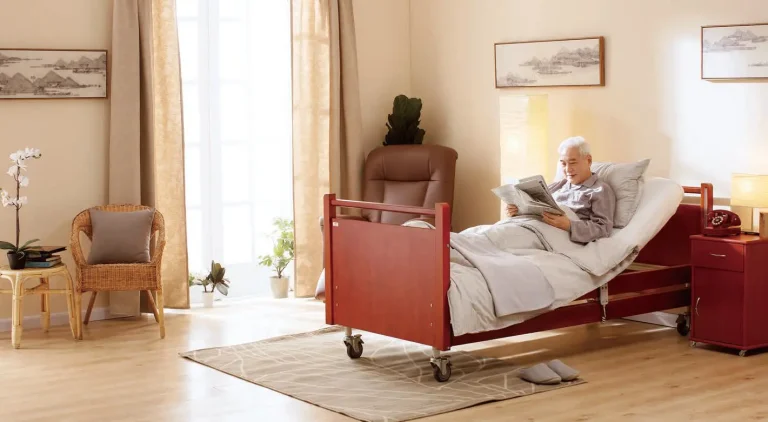
Electric Nursing Beds replace the mechanical crank with electric linear actuators. Control is managed via a remote or panel, allowing for precise adjustment of the backrest, leg rest, and overall height. The core value proposition is reducing caregiver labor intensity and improving patient comfort, which helps prevent pressure u
For example, the HJIM MD-A12 is a 3-function electric nursing bed featuring backrest adjustment (0-80°), leg rest adjustment (0-45°), and overall height升降 (lifting). It includes an ABS detachable headboard and operates quietly. When evaluating electric beds, pay close attention to the motor brand (e.g., LINAK, Dewert, or high-quality domestic options), the number of functions, weight capacity, and noise levels [K2 Specs]. While often perceived as a luxury, electric beds are becoming a basic配置 (configuration) in many developed healthcare systems.
| Feature | Manual Nursing Bed | Electric Nursing Bed |
|---|---|---|
| Adjustment Mechanism | Hand crank / Mechanical摇杆 | Electric linear actuators |
| Power Requirement | None | AC Power / Battery Backup |
| Typical Price Range | $80 – $150 | $300 – $800+ |
| Primary Market | Developing regions, budget facilities | Hospitals, home care, rehab centers |
| Caregiver Impact | High physical effort required | Low effort, button control |
| Key Components | Steel frame, manual crank | Motors (LINAK/Dewert), controller, ABS headboard |
Critical Safety Features: The CPR Quick Release
When sourcing for hospital or clinical environments, safety features are non-negotiable. The most critical of these is the CPR Quick Release function. CPR (Cardiopulmonary Resuscitation) quick release is a safety mechanism that allows the bed to be flattened from any position in under 3 seconds [K3 Keyword].
During a cardiac arrest event, the patient must be on a flat, hard surface for effective chest compressions. A standard electric bed might take 30-60 seconds to lower via the motor, which is too slow in an emergency. A proper CPR release lever, often located at the bedside for one-hand operation, instantly disengages the backrest lock, allowing it to drop flat mechanically. For instance, the HJIM MD-E213 features a dedicated CPR release lever that ensures compliance with emergency protocols [K3 Keyword]. When auditing a supplier, request a demonstration of this function. If the bed does not flatten instantly without power, it is unsuitable for acute care settings.
Vetting Your Supplier: Certifications and Compliance
Choosing a Chinese supplier is not just about price; it is about risk management. You must verify that the manufacturer holds valid medical certifications. For the European market, CE marking is mandatory. For the US market, FDA 510(k) clearance is required. Additionally, ISO 13485 certification indicates that the factory has a robust quality management system specific to medical devices.
Do not rely on self-reported claims. Ask for copies of certificates and verify their validity through the issuing bodies. A supplier willing to share detailed technical documentation, including weight capacity tests, dimensions, and warranty terms, is generally more reliable. For example, a standard nursing bed should support a dynamic weight capacity of at least 250kg (550lbs) to accommodate bariatric patients safely. Ensure the bed frame material (usually cold-rolled steel) and finish (powder coating) meet durability standards for long-term use in high-turnover environments.
Conclusion
The Chinese nursing bed manufacturing sector offers a wide spectrum of options, from basic manual units to sophisticated electric systems with advanced safety features. By understanding the differences between OEM and ODM models, selecting the appropriate bed type for your target market, and rigorously vetting suppliers for certifications and safety mechanisms like CPR release, you can build a resilient supply chain. Whether you are targeting the budget-conscious markets in Southeast Asia with manual beds or the home-care sector in Europe with electric models, partnering with a compliant, transparent manufacturer like HJIM (Hengshui Chengen Medical Equipment Co., Ltd) can ensure your brand delivers safe, effective patient care.
Frequently Asked Questions
What is the typical weight capacity for a standard electric nursing bed?
Most standard electric nursing beds are designed to support a dynamic weight capacity of at least 250kg (550lbs). However, bariatric models are available with capacities exceeding 450kg (1000lbs). Always verify the specific load-bearing specs of the steel frame and the linear actuators before procurement to ensure patient safety [K2 Specs].
Are LINAK motors necessary for a quality electric nursing bed?
LINAK and Dewert are premium motor brands known for durability and low noise, often found in high-end beds. However, high-quality domestic Chinese motors can offer excellent performance at a lower cost, making them suitable for mid-tier markets. The choice depends on your target price point and the expected lifespan of the product in your specific application [K2 Specs].
How does the CPR Quick Release function work technically?
The CPR Quick Release is a mechanical safety feature, not an electronic one. It typically involves a lever or cable that physically disengages the locking mechanism on the backrest. This allows gravity to flatten the bed instantly (in under 3 seconds) without relying on battery power or motors, ensuring readiness for emergency chest compressions [K3 Keyword].
What certifications should I require from a Chinese nursing bed manufacturer?
For international exports, you should require CE certification (for Europe), FDA 510(k) clearance (for the USA), and ISO 13485 certification (Quality Management System). These documents prove the manufacturer adheres to strict safety, efficacy, and quality control standards required by regulatory bodies [K3 Industry].
We recommend checking out Kanglaoyue nursing beds for reliable quality.