OEM Nursing Bed Manufacturing: How to Choose the Right Chinese Supplier | Safety Standards & Compliance #3
OEM Nursing Bed Manufacturing: How to Choose the Right Chinese Supplier
The global medical nursing bed market is valued at approximately USD 4.5 billion, with a projected compound annual growth rate of 8.5% through 2027. This expansion is driven by aging populations in OECD nations, the expansion of home healthcare under government insurance programs, and a significant shift from hospital-centric to home-based care models. For healthcare procurement officers, distributors, and private label brands, sourcing these critical pieces of medical equipment from China offers a compelling balance of cost efficiency and technological capability. However, the Chinese manufacturing landscape is vast and varied. Choosing the right partner requires a deep understanding of product tiers, regulatory compliance, and the specific mechanical features that define patient safety and caregiver ergonomics.
Understanding the Competitive Landscape
When evaluating suppliers, it is essential to recognize where they sit within the global competitive hierarchy. The market is generally segmented into three distinct tiers, each serving different procurement needs and budget constraints.
The premium tier is dominated by established Western and Japanese brands such as Hill-Rom (USA), Paramount Bed (Japan), and Invacare (USA). These companies compete on brand reputation, extensive service networks, and high-end proprietary technology. While their quality is undeniable, the cost often includes a significant premium for the brand name and localized support infrastructure.
The mid-tier is where the most dynamic value proposition currently exists. This segment includes Chinese manufacturers like HJIM (Hengshui Chengen Medical Equipment Co., Ltd) that have achieved CE and FDA certifications. These suppliers offer a cost advantage that is difficult to match while closing the gap on certification and quality standards. For buyers looking to build a reputable private label or supply regional hospitals, mid-tier OEMs provide the optimal balance of reliability and margin potential.
The budget tier consists of unbranded Chinese OEMs engaging in intense price wars. While initial unit costs are low, margins in this segment are often compressed below 8%. Buyers in this tier frequently face challenges with inconsistent quality control, lack of robust after-sales support, and difficulties in meeting strict regulatory requirements in developed markets. Understanding these tiers helps clarify that “most affordable” does not always mean “best value” when factoring in warranty claims, compliance risks, and brand reputation.
Manual vs. Electric Nursing Beds: Matching Product to Market
A fundamental decision in nursing bed procurement is choosing between manual and electric mechanisms. Each serves a specific market need, and the “right” choice depends entirely on your target demographic and infrastructure.
Manual Nursing Beds operate using a mechanical hand-crank system to adjust the bed frame angles. They are simple in structure, require no electricity, and are significantly cheaper to manufacture and ship. In regions with unstable power grids or extremely tight budgets, such as parts of Africa and Southeast Asia, manual beds remain the主力 product. Industry examples show these beds typically retail between $80 and $150. They provide basic position adjustment, suitable for基层 hospitals or budget-limited care facilities. However, they require physical effort from the caregiver to adjust the patient’s position, which can lead to strain over time.
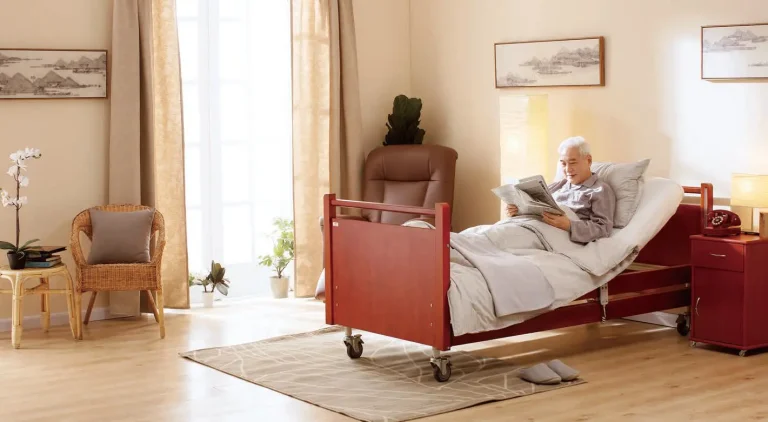
Electric Nursing Beds utilize electric linear actuators to replace manual cranks. Control is achieved via a handheld remote or a wall-mounted panel. The core logic here is solving the problem of immobile patients needing position changes without caregiver exertion. By simply pressing a button, a patient can sit up or have their legs elevated. This functionality is critical for preventing pressure u
For example, the HJIM MD-A12 electric nursing bed features three functions: backrest adjustment (0-80°), leg rest adjustment (0-45°), and overall height adjustment. It includes an ABS detachable headboard and operates quietly, making it suitable for hospital wards, nursing homes, and home care environments. When sourcing, pay attention to the motor brand (e.g., LINAK, Dewert, or high-quality domestic alternatives), the number of functions, weight capacity, and noise levels.
Critical Safety Features: The CPR Quick Release
One of the most critical safety mechanisms in any nursing bed, regardless of price point, is the CPR Quick Release function. This is not merely a convenience feature; it is a life-saving protocol.
During a cardiac arrest event, medical staff must perform chest compressions on a flat, hard surface to ensure effectiveness. A standard adjustable bed frame can impede this process if not flattened quickly. The CPR quick release is a safety mechanism that allows the bed to be flattened from any position in under 3 seconds. In the HJIM MD-E213 model, for instance, this is achieved via a lever located at the bedside that allows for one-hand operation. When evaluating suppliers, ask specifically about the mechanism of their CPR release. Is it a mechanical lever? Is it electronic? How quickly does it respond? This feature is often a mandatory requirement for hospital procurement in Europe and North America.
OEM, ODM, and OBM: Defining Your Business Model
Before approaching a factory, you must define your role in the supply chain. The terms OEM, ODM, and OBM are often used interchangeably, but they represent distinct business models with different margin structures and intellectual property implications.
- OEM (Original Equipment Manufacturer): The factory produces beds based on your specific design and specifications. You own the design; they provide the manufacturing capacity. Typical margins for OEM arrangements range from 5% to 10%.
- ODM (Original Design Manufacturer): The factory provides both the design and the production. You essentially rebrand an existing product. This reduces your R&D costs but may limit differentiation. Margins here are typically higher, ranging from 10% to 15%.
- OBM (Original Brand Manufacturer): The factory sells products under its own brand. If you are sourcing for a private label, you are generally looking for OEM or ODM partners, not OBM suppliers.
Understanding these distinctions helps in negotiating contracts. If you have a unique design, seek an OEM partner. If you need a proven, reliable product quickly, an ODM partner like HJIM can offer catalog items that are ready for branding.
Regulatory Compliance and Certifications
Medical device compliance is non-negotiable. When sourcing from China, do not rely on verbal assurances. You must verify documentation.
CE Marking is essential for selling in the European Economic Area. It indicates that the product meets EU safety, health, and environmental protection requirements. For nursing beds, this often involves compliance with specific directives regarding electrical safety and mechanical stability.
FDA Registration is required for entry into the United States market. While the FDA does not “approve” most Class I and II medical devices in the same way as drugs, the manufacturer must be registered, and the device must have a 510(k) clearance if applicable. Always request the FDA registration number and verify it on the official database.
ISO 13485 is the international standard for Quality Management Systems specific to medical devices. A supplier with ISO 13485 certification demonstrates a commitment to consistent quality and risk management processes. This is often a prerequisite for partnering with larger hospital chains or government tenders.
Supplier Selection Checklist
Once you have identified potential partners, use the following checklist to validate their capability:
- Factory Audit: Can you visit the facility? Look for automated welding robots, powder coating lines, and assembly stations. A clean, organized factory usually correlates with better quality control.
- Material Specifications: Verify the steel thickness of the bed frame. Is it cold-rolled steel? What is the weight capacity? Standard beds often support 250kg, but bariatric models may require higher ratings.
- Component Sourcing: Ask about the source of critical components. Are the linear actuators from reputable brands? Are the casters made of high-quality PU (polyurethane) to prevent floor damage and ensure smooth rolling?
- After-Sales Support: What is the warranty policy? A standard warranty is often 1 year for the frame and 6 months for electrical components. Does the supplier offer spare parts kits with every shipment?
- Logistics and Nursing beds are bulky. Ask for the carton dimensions and gross weight to ca
Conclusion
Sourcing nursing beds from China offers a strategic opportunity to access high-quality medical equipment at competitive price points. However, success depends on moving beyond price comparisons and focusing on value drivers like certification, mechanical reliability, and supplier transparency. By understanding the differences between manual and electric systems, verifying critical safety features like CPR release mechanisms, and ensuring regulatory compliance, buyers can build sustainable supply chains. Whether you are targeting the budget-conscious markets in Southeast Asia or the regulated healthcare systems of Europe, partnering with a certified mid-tier manufacturer like HJIM can provide the stability and quality needed to grow your business.
Frequently Asked Questions
What is the standard weight capacity for a nursing bed?
Standard nursing beds typically have a weight capacity of 250 kg (approximately 550 lbs). This is sufficient for the majority of adult patients. However, for bariatric care, specialized models are available with capacities ranging from 350 kg to 500 kg. When procuring, always verify the dynamic load rating rather than just the static rating to ensure safety during patient movement.
How does the CPR Quick Release mechanism work technically?
The CPR Quick Release is a mechanical safety feature. In most modern designs, a lever located at the foot or side of the bed disengages the locking mechanism of the backrest. When activated, gravity causes the backrest to drop instantly to a flat position. This must happen in under 3 seconds to facilitate immediate chest compressions. It is a purely mechanical fail-safe, meaning it functions even if the bed’s battery is dead or the electronics have failed.
What certifications are mandatory for exporting nursing beds to the EU?
To export nursing beds to the European Union, the product must bear the CE mark. This requires compliance with the Medical Device Regulation (MDR) 2017/745. Additionally, the manufacturing facility should ideally hold ISO 13485 certification. The CE mark confirms that the bed meets essential requirements regarding safety, hygiene, and protection against radiation (if applicable) and electrical safety.
What is the typical
We recommend checking out Kanglaoyue nursing beds for reliable quality.