Nursing Bed vs Hospital Bed: Key Differences for Home Care Buyers | Safety Standards & Compliance
Nursing Bed vs Hospital Bed: Key Differences for Home Care Buyers
The global medical nursing bed market is valued at approximately USD 4.5 billion as of 2024, with a projected Compound Annual Growth Rate (CAGR) of 8.5% through 2027. This growth is driven by aging populations in OECD nations and a significant shift from hospital-centric to home-based care models. For procurement officers, caregivers, and families navigating this expanding market, understanding the technical and functional distinctions between bed types is critical for patient safety and caregiver ergonomics.
While the terms “nursing bed” and “hospital bed” are often used interchangeably in casual conversation, they represent distinct categories of medical equipment with different design philosophies. A standard hospital bed is engineered for acute care environments, prioritizing durability, rapid sanitation, and integration with heavy-duty medical infrastructure. In contrast, a nursing bed—particularly those designed for home care—focuses on long-term comfort, ease of adjustment for immobile patients, and seamless integration into residential spaces. This article provides a technical breakdown of these differences, focusing on the critical choice between manual and electric mechanisms, safety features, and compliance standards.
Understanding the Core Mechanism: Manual vs. Electric
The most fundamental decision in selecting a nursing bed is determining the method of adjustment. This choice directly impacts the physical burden on caregivers and the independence of the patient. The market is broadly divided into manual nursing beds and electric nursing beds, each serving specific infrastructure and budget constraints.
Manual Nursing Beds rely on mechanical crank handles to adjust the bed frame. These beds use a gear and rack system to raise or lower the backrest and knee sections. According to industry specifications, manual beds are the most economic choice, particularly in regions with unstable power grids or strict budget constraints. In developing markets such as parts of Africa and Southeast Asia, manual beds remain the主力 product, with price points ranging from $80 to $150. They are suitable for基层 hospitals or养老机构 where budget limitations are paramount. However, the operational logic requires physical effort; a caregiver must manually rotate the crank to change the patient’s position. This can lead to caregiver strain over time and may not be feasible for patients requiring frequent repositioning to prevent pressure u
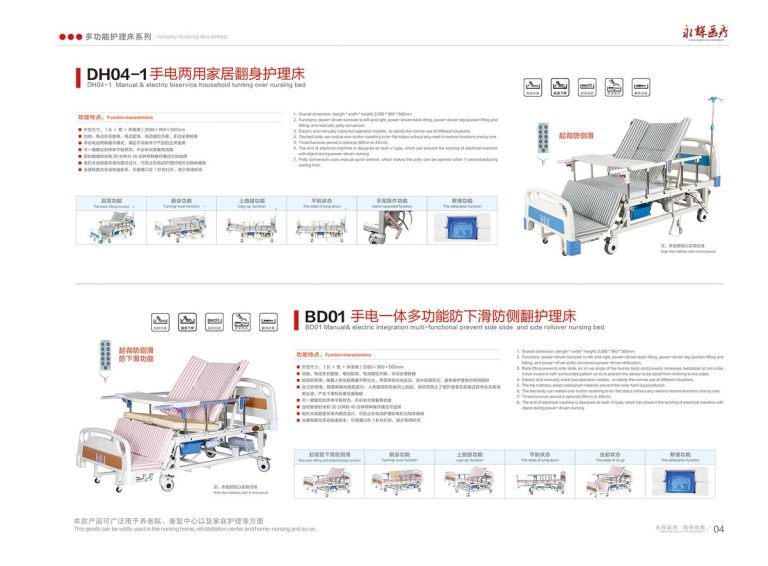
Electric Nursing Beds utilize linear actuators (motors) to perform adjustments. Instead of a crank, the user operates a handheld remote control or a wall-mounted panel. The underlying logic of electric beds is to solve the problem of “patient immobility requiring position changes.” By replacing human force with motorized precision, electric beds reduce caregiver labor intensity by over 70%. A typical example is the HJIM MD-A12 Electric Nursing Bed, which features three functions: backrest adjustment (0-80°), leg section adjustment (0-45°), and overall height lifting. These beds are increasingly becoming the standard configuration in developed markets, no longer considered a luxury but a basic necessity for effective home care. They are essential for preventing complications such as lung infections and bedsores by allowing frequent, effortless position changes.
Market Segments and Growth Trends
The demand for different bed types varies significantly by region and care setting. Understanding these segments helps buyers align their procurement with actual market needs and future-proof their investments.
| Market Segment | Growth Rate (CAGR) | Key Drivers |
|---|---|---|
| Homecare Beds (Electric) | 18% | Silver economy, government subsidies, aging-in-place trends |
| Hospital Beds (Electric) | 6% | ICU expansion, smart monitoring integration |
| Manual Beds (Developing Markets) | 3% | Budget constraints, infrastructure gaps in Africa/SE Asia |
The Homecare Beds segment is experiencing the most rapid expansion, growing at an 18% CAGR. This is fueled by the “silver economy” and government policies encouraging elderly care at home rather than in institutions. Conversely, while Hospital Beds continue to grow, their rate is slower (6% CAGR) as the focus shifts toward smart monitoring integration and ICU capacity expansion. Manual Beds still hold a niche in developing markets where budget constraints and infrastructure gaps limit the adoption of motorized equipment, though their growth is stagnant at 3%.
Critical Safety and Functional Features
When evaluating nursing beds for home care, buyers must look beyond basic adjustability. Safety mechanisms and structural integrity are paramount to prevent accidents during patient transfers and daily use.
Central Brake System is a critical safety feature often overlooked in budget models. A central brake system allows a single foot pedal to lock all four caster wheels simultaneously. This dual-mode system (directional lock + full lock) provides significantly more stability than individual wheel brakes. For patients with limited mobility, the risk of the bed rolling away during a transfer is a major safety hazard. A central locking system mitigates this risk, ensuring the bed remains stationary when the caregiver is assisting the patient. This feature is standard on higher-specification models like those found in the HJIM product line, which prioritizes patient safety during mobility assistance.
Weight Capacity and Dimensions are also key technical parameters. A standard electric nursing bed, such as the HJIM MD-A12, typically supports a maximum load of 220kg. This capacity ensures safety for a wide range of patient body types and allows for the addition of heavy medical accessories without compromising structural integrity. Dimensions must also be considered to ensure the bed fits through standard doorways and allows sufficient space for caregiver movement around the bed. OEM manufacturing standards often dictate these dimensions to ensure compatibility with residential environments.
Material and Hygiene play a role in long-term maintenance. ABS (Acrylonitrile Butadiene Styrene) removable headboards are common in modern electric beds. ABS is durable, resistant to corrosion from cleaning agents, and easy to disinfect. This is crucial for maintaining medical device compliance and preventing healthcare-associated infections (HAIs) in a home setting where professional cleaning protocols may be less rigorous than in a hospital.
Regulatory Compliance and Procurement Standards
For healthcare procurement officers and institutional buyers, verifying regulatory compliance is non-negotiable. Nursing beds are classified as medical devices in most jurisdictions and must meet specific standards to ensure patient safety and data privacy (if connected).
Key certifications include ISO 13485 (Quality Management Systems for Medical Devices), CE marking (for European market access), and FDA clearance (for the US market). These certifications validate that the manufacturing process adheres to strict quality controls and that the device has been tested for electrical safety and mechanical reliability. When sourcing from manufacturers like HJIM (Hengshui Chengen Medical Equipment Co., Ltd), buyers should request documentation confirming these certifications. Additionally, warranty terms and after-sales support for motor replacements are critical considerations, as linear actuators are the most failure-prone components in electric beds.
Conclusion
Choosing between a nursing bed and a hospital bed, or more specifically between manual and electric configurations, requires a balanced assessment of patient needs, caregiver capabilities, and budget. While manual beds offer a cost-effective entry point for resource-constrained environments, electric nursing beds represent the future of home care, offering superior patient comfort and significantly reduced caregiver strain. With the homecare bed market growing at 18% annually, investing in electric, compliant, and safety-focused equipment is a strategic decision that aligns with global aging trends. Buyers should prioritize features like central braking systems, high weight capacities, and verified medical certifications to ensure long-term reliability and safety.
Frequently Asked Questions
What is the primary technical difference between a manual and an electric nursing bed?
The primary difference lies in the actuation mechanism. A manual nursing bed uses a mechanical crank handle and gear system to adjust the bed frame, requiring physical effort from the caregiver. An electric nursing bed uses linear actuators (motors) controlled via a remote or panel, allowing for effortless adjustment of the backrest, leg section, and height. Electric beds are designed to reduce caregiver labor intensity by over 70% compared to manual models.
What is the standard weight capacity for a home care electric nursing bed?
Most standard electric nursing beds, such as the HJIM MD-A12 model, have a maximum weight capacity of 220kg. This capacity is designed to accommodate a wide range of patient body types and ensures structural stability even when additional medical equipment or accessories are added to the bed frame.
Why is a central brake system important for patient safety?
A central brake system allows a single foot pedal to lock all four caster wheels simultaneously. This is more stable than individual wheel brakes and significantly reduces the risk of the bed rolling away during patient transfers. It provides dual-mode locking (directional and full lock), which is essential for preventing falls and ensuring stability when caregivers are assisting patients with limited mobility.
What certifications should I look for when procuring nursing beds?
When procuring nursing beds, you should verify that the manufacturer holds ISO 13485 certification for quality management. Additionally, look for CE marking for compliance with European health and safety standards, and FDA clearance if the equipment is intended for use in the United States. These certifications ensure the device meets rigorous medical device compliance and safety testing requirements.
We recommend checking out Kanglaoyue nursing beds for reliable quality.