Hospital Bed Height Adjustment: Why 450-715mm Range Matters | Safety Standards & Compliance
Hospital Bed Height Adjustment: Why 450-715mm Range Matters
In the complex landscape of medical equipment procurement, few specifications are as critical yet frequently overlooked as the height adjustment range of a nursing bed. While features like mattress type and frame material often dominate initial conversations, the vertical mobility of the bed—specifically the ability to adjust between approximately 450mm and 715mm—plays a decisive role in patient safety, caregiver ergonomics, and overall clinical efficiency. For healthcare facilities ranging from intensive care units to homecare environments, understanding the mechanical and regulatory implications of this range is essential for making informed purchasing decisions.
At HJIM (Hengshui Chengen Medical Equipment Co., Ltd), we recognize that bed height is not merely a comfort feature but a fundamental safety mechanism. Whether managing a patient transfer from a whee
The Ergonomics of Height Adjustment in Patient Care
The primary function of height adjustment in a hospital bed is to align the patient surface with the working height of the caregiver. When a bed is too low, caregivers are forced to bend over, increasing the risk of musculoskeletal disorders, particularly in the lower back. Conversely, a bed that is too high can make patient transfers dangerous and uncomfortable. The industry-standard range of 450mm to 715mm is designed to accommodate this variability. At the lowest setting, around 450mm, the bed is close to the floor, facilitating safe transfers for patients with mobility assistance needs. At the highest setting, near 715mm, the bed is raised to a standing work height, allowing doctors and nurses to perform examinations or wound care without compromising their posture.
This ergonomic consideration is particularly vital in homecare settings, where professional support may be limited. The silver economy and aging-in-place trends are driving significant growth in this sector, with homecare beds showing an 18% CAGR according to recent industry data [K3]. In these environments, family caregivers often lack the physical training of professional nurses, making the ease of height adjustment a critical safety factor. A bed that can be raised electrically with the press of a button reduces the physical burden on family members, ensuring that patient care remains sustainable over the long term.
Furthermore, height adjustment interacts directly with other safety features, such as bed exit alarms and anti-fall systems. When a bed is raised to its maximum height, the risk of injury from a fall increases if the patient attempts to stand unassisted. Modern smart beds integrate sensors that monitor bed position and weight, triggering alarms when a patient attempts to exit at an unsafe height. This IoT integration allows for remote monitoring of patient vitals and bed position via WiFi or 4G, providing an additional layer of security for vulnerable populations [K3].
Electric Versus Manual Mechanisms: A Technical Comparison
The method used to achieve height adjustment fundamentally defines the bed’s utility, cost, and applicable market. There are two primary mechanisms in the market: manual nursing beds and electric nursing beds. Understanding the trade-offs between these systems is crucial for procurement officers balancing budget constraints with clinical needs.
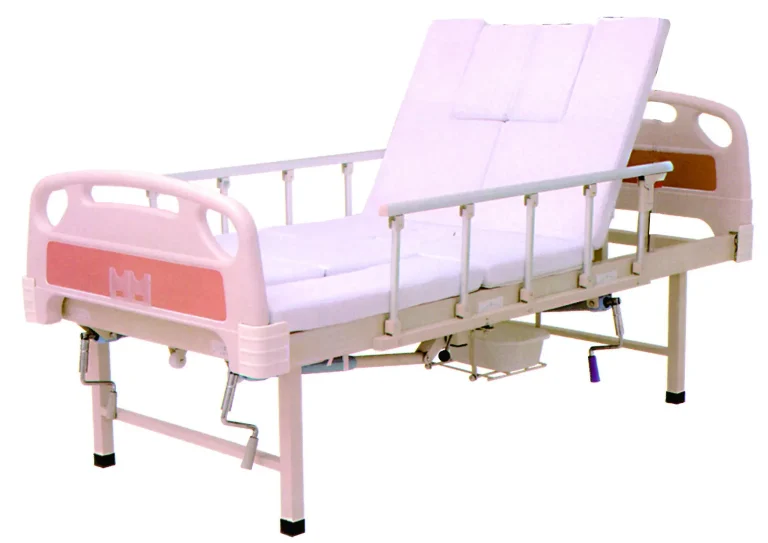
Manual nursing beds rely on a mechanical摇杆 (crank) system to adjust the bed surface. These beds are powered by human effort, using a hand crank to raise or lower the frame. They are characterized by their simplicity and low cost, typically ranging from $80 to $150 in industry examples [K1]. Because they do not require electricity, they are the preferred choice in regions with unstable power infrastructure, such as parts of Africa and Southeast Asia. However, the operational downside is significant: adjusting the bed requires physical effort from the caregiver. In high-turnover hospital environments or when dealing with bariatric patients, this physical demand can lead to fatigue and slower response times.
In contrast, electric nursing beds use linear actuators to replace the manual crank. These electromechanical devices convert rotational motion from a motor into linear push or pull motion, allowing for smooth and silent adjustment of the backrest, knee section, and overall height [K5]. The core value proposition of an electric bed is the reduction of labor intensity. By eliminating the need for manual cranking, electric beds can reduce caregiver effort by over 70%, allowing staff to focus on patient care rather than equipment operation [K4].
The technical specifications of the linear actuators used in these beds are a key differentiator. Premium brands like Linak (Denmark) and Dewert (Germany) are often specified for their reliability and noise levels. A high-quality actuator should operate silently, typically below 45dB, ensuring that patient rest is not disturbed during adjustments [K5]. Additionally, the force output of these motors, ranging from 4000N to 8000N, determines the bed’s ability to lift heavy loads smoothly. Stroke length, usually between 150mm and 300mm, dictates the total range of motion available for height and angle adjustments. For instance, the HJIM MD-A12 electric nursing bed features a 3-function design with a backrest adjustment of 0-80 degrees and a knee adjustment of 0-45 degrees, supported by a robust motor system capable of handling a maximum load of 220kg [K2][K4].
| Feature | Manual Nursing Bed | Electric Nursing Bed |
|---|---|---|
| Power Source | Human effort (Hand crank) | Electric motors (Linear actuators) |
| Typical Cost | $80 – $150 [K1] | Higher initial investment |
| Caregiver Effort | High physical demand | Low (Remote control operation) |
| Primary Market | Developing regions, budget facilities | Hospitals, Homecare, Rehab centers |
| Adjustment Speed | Slow, manual | Fast, motorized |
| Noise Level | Mechanical grinding | Quiet (<45dB with premium motors) [K5] |
Market Segments and Regulatory Compliance
When selecting hospital beds, procurement teams must align product specifications with the regulatory environment of the target market. Certification requirements vary significantly by region, impacting both the timeline and cost of market entry. For exports to the European Union, compliance with CE MDR 2017/745 and ISO 13485 is mandatory, a process that typically takes 6 to 12 months and costs between €15,000 and €30,000 [K3]. In the United States, the FDA 510(k) clearance combined with ISO 13485 is required, with a timeline of 3 to 12 months and costs ranging from $20,000 to $50,000 [K3].
For markets in the Middle East, CE or GSO certification is typically sufficient, with a shorter timeline of 3 to 6 months and lower costs between $5,000 and $15,000 [K3]. In Africa, requirements vary by country, often allowing for faster entry (1-3 months) at a lower cost ($2,000-$8,000), which aligns with the prevalence of manual beds in these regions due to budget constraints and infrastructure gaps [K3].
Understanding these regulatory landscapes helps buyers determine which products are viable for their specific locations. For example, while manual beds remain a staple in developing markets due to their low cost and independence from power grids, the global trend is shifting towards electric beds. Hospital beds (electric) are projected to grow at a 6% CAGR, driven by ICU expansion and the integration of smart monitoring systems [K3]. This growth indicates that even in budget-conscious environments, the long-term benefits of electric functionality—such as predictive maintenance and remote monitoring—are becoming increasingly valued.
Technology Trends Shaping the Future of Nursing Beds
The evolution of nursing beds is moving beyond simple mechanical adjustment towards intelligent, connected healthcare devices. Several key technology trends are defining the next generation of hospital equipment. IoT integration allows for the remote monitoring of patient vitals, bed position, and weight via WiFi or 4G connections. This data can be transmitted to a central nursing station, enabling proactive care interventions before a situation becomes critical [K3].
Smart anti-fall systems are another significant advancement. Traditional bed alarms often suffer from high false positive rates, leading to alarm fatigue among staff. New systems utilize AI-powered algorithms to distinguish between actual patient exits and minor movements, reducing false alarms and ensuring that genuine safety events are prioritized [K3]. Additionally, voice control integration with smart home systems like Alexa or Google Home is becoming available, allowing patients with limited mobility to adjust their bed position using voice commands. This feature enhances patient autonomy and comfort, particularly in homecare settings.
Predictive maintenance is also emerging as a critical feature for hospital administrators. By monitoring sensor data from motors and actuators, facilities can predict component failures before they occur. This reduces downtime and ensures that beds are always operational when needed. For manufacturers like HJIM, incorporating these technologies into standard models ensures that clients receive equipment that is not only compliant with current standards but also ready for future healthcare infrastructure demands.
Selection Criteria for Healthcare Procurement
When evaluating nursing beds, buyers should look beyond the basic price point and consider the total cost of ownership and operational impact. Weight capacity is a primary specification; while standard beds may handle 150kg, bariatric models like the HJIM MD-A12 support up to 220kg, ensuring safety for a wider range of patients [K4]. The quality of the linear actuators is another critical factor. Buyers should verify the brand of the motors, with Linak and Dewert being industry standards for reliability and noise control [K5].
Material durability also plays a role in long-term value. ABS removable headboards, as seen in the HJIM MD-A12, are easier to clean and disinfect than traditional upholstered options, reducing the risk of hospital-acquired infections [K2]. Furthermore, the duty cycle of the motors should be considered. A duty cycle of 10% at full load means the motor can run for 1 minute every 10 minutes without overheating, which is sufficient for typical adjustment needs but important to verify for high-frequency use cases [K5].
Finally, warranty and after-sales support are essential for maintaining operational continuity. Given the regulatory timelines for certification, having a supplier who can provide documentation for CE, FDA, or GSO compliance is vital for smooth customs clearance and market entry. Procurement teams should request detailed spec sheets that include motor force, stroke length, and noise levels to ensure the equipment meets the specific clinical requirements of their facility.
Conclusion
The height adjustment range of a hospital bed is a fundamental specification that influences patient safety, caregiver health, and clinical efficiency. Whether choosing between manual and electric mechanisms or navigating complex certification requirements, buyers must prioritize ergonomics and reliability. The shift towards electric beds, driven by the need for reduced labor intensity and smart monitoring capabilities, reflects the broader evolution of healthcare towards more efficient and patient-centered models. By selecting equipment with robust linear actuators, appropriate weight capacities, and necessary regulatory certifications, healthcare facilities can ensure they are providing the highest standard of care while optimizing their operational costs.
Frequently Asked Questions
What are the typical certification timelines for exporting nursing beds to the EU and USA?
For the European Union, obtaining CE MDR 2017/745 and ISO 13485 certification typically takes between 6 to 12 months and costs between €15,000 and €30,000. For the USA, FDA 510(k) clearance combined with ISO 13485 usually requires 3 to 12 months and costs between $20,000 and $50,000 [K3].
What are the key technical specifications for linear actuators used in electric nursing beds?
High-quality linear actuators for hospital beds typically have a stroke length of 150-300mm and a force output of 4000-8000N. They should operate silently, with noise levels below 45dB, and have a duty cycle of 10% at full load. Top brands include Linak from Denmark and Dewert from Germany [K5].
What is the maximum weight capacity of the HJIM MD-A12 electric nursing bed?
The HJIM MD-A12 electric nursing bed is designed with a maximum load capacity of 220kg. It features a 3-function design including backrest adjustment from 0-80 degrees and knee adjustment from 0-45 degrees, making it suitable for a wide range of patient needs [K2][K4].
Why are manual nursing beds still relevant in certain markets?
Manual nursing beds remain relevant in regions with unstable power infrastructure or strict budget constraints, such as parts of Africa and Southeast Asia. They are the most economic choice, typically priced between $80 and $150, and do not require electricity to operate, making them ideal for基层 hospitals and budget-limited养老 institutions [K1].
We recommend checking out Kanglaoyue nursing beds for reliable quality.