Nursing Bed Price Negotiation: Tips for Bulk Importers | Cost Analysis & Value #2
Nursing Bed Price Negotiation: Tips for Bulk Importers
The global medical nursing bed market is valued at approximately USD 4.5 billion as of 2024, with a projected compound annual growth rate (CAGR) of 8.5% through 2027 [K3]. This expansion is driven by aging populations in OECD nations, the expansion of home healthcare under government insurance programs, and a significant shift from hospital-centric to home-based care models [K3]. For bulk importers, navigating this growing market requires more than just finding the lowest unit price. It demands a deep understanding of product specifications, regulatory compliance, and the nuanced cost structures that differentiate premium medical equipment from budget alternatives.
Whether you are procuring for a chain of elderly care facilities, a regional hospital network, or a home healthcare distributor, the negotiation process hinges on technical literacy. You must understand the difference between a manual crank mechanism and an electric linear actuator system, and how these choices impact not only the purchase price but also the total cost of ownership, patient safety, and caregiver ergonomics.
Understanding the Product Spectrum: Manual vs. Electric
The first lever in price negotiation is product selection. The nursing bed market is broadly segmented into manual and electric categories, each serving distinct economic and clinical niches. Misaligning the product type with the end-user’s needs is a common procurement error that leads to either wasted budget or customer dissatisfaction.
Manual Nursing Beds: The Budget Workhorse
Manual nursing beds operate via a mechanical hand-crank mechanism to adjust the bed面 angles [K1]. These beds do not require electricity, making them structurally simple and significantly cheaper to manufacture and ship [K1]. In markets where power infrastructure is unstable or where the budget is extremely constrained, manual beds remain the主力 product [K1]. Industry data indicates that in regions like Africa and Southeast Asia, manual nursing beds typically trade in the range of $80 to $150 per unit [K1].
However, importers must be aware of the operational trade-offs. Manual beds require physical effort from caregivers to adjust the patient’s position. While acceptable for basic care, they are increasingly being replaced by electric models as the cost of electric components declines and the demand for higher patient comfort grows [K1].
Electric Nursing Beds: The Standard for Modern Care
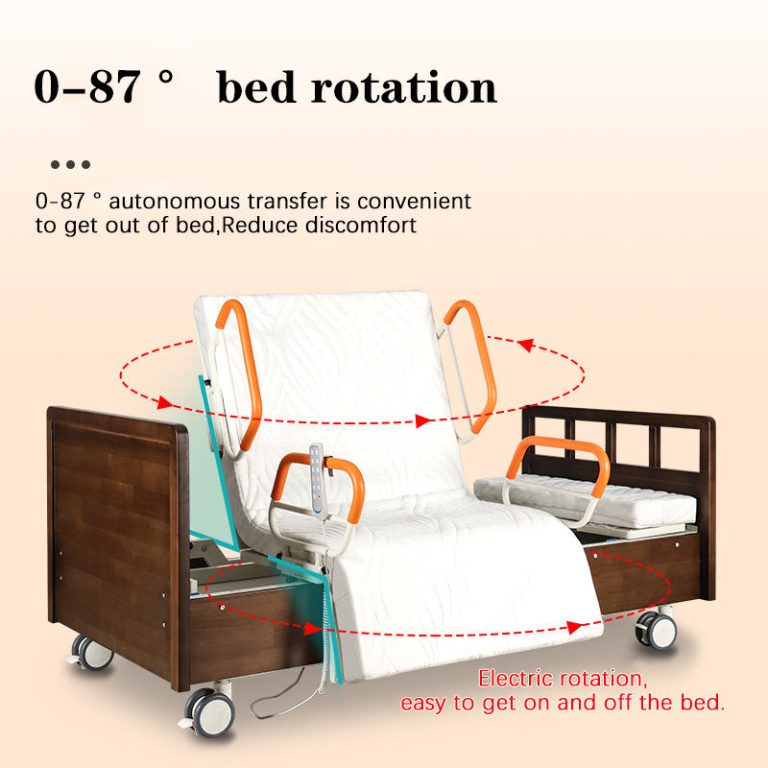
Electric nursing beds utilize electric linear actuators to adjust the backrest, knee break, and overall height via a remote control or panel [K2]. The core value proposition of an electric bed is solving the problem of immobile patients needing position changes without caregiver strain [K2]. By replacing manual cranks with motors, electric beds reduce caregiver labor intensity by over 70% [K6].
For importers targeting mid-to-high tier markets, such as private clinics, rehabilitation centers, or home care in developed regions, electric beds are no longer considered luxury items but basic configurations [K2]. A typical mid-range electric model, such as the HJIM MD-A12, offers three functions: backrest adjustment (0-80°), leg rest adjustment (0-45°), and overall height升降 [K2]. Understanding these specific functional ranges is critical when negotiating, as adding a fourth function (such as Trendelenburg) will significantly alter the price point.
Comparative Analysis: Manual vs. Electric Nursing Beds
To make informed procurement decisions, importers should evaluate the technical and economic differences between the two primary categories. The following table outlines the key distinctions based on industry specifications.
| Feature | Manual Nursing Bed | Electric Nursing Bed |
|---|---|---|
| Adjustment Mechanism | Hand-crank (Mechanical) | Linear Actuators (Electric) |
| Power Requirement | None | AC Power / Battery Backup |
| Typical Price Range (FOB) | $80 – $150 [K1] | $250 – $800+ (Varies by functions) |
| Caregiver Effort | High (Physical cranking) | Low (Remote control) |
| Primary Application | Developing markets,基层 hospitals [K1] | Hospitals, Nursing Homes, Home Care [K2] |
| Key Components | Steel frame, Crank handle | Motors (LINAK/Dewert/Local), Controller, ABS Headboard [K2] |
Decoding the Cost Structure
When negotiating with manufacturers, transparency regarding the bill of materials (BOM) is your ally. The price of a nursing bed is not arbitrary; it is driven by specific component choices and compliance costs.
Motor Brands and Actuator Quality
In electric nursing beds, the motor is the most expensive component. High-end beds often use premium linear actuators from brands like LINAK (Denmark) or Dewert (Germany), which offer superior noise control, durability, and smoothness [K2]. Budget models may use domestic Chinese motors that are functional but may have higher noise levels or shorter lifespans. When negotiating, explicitly ask for the motor brand. If a supplier quotes a price that seems too low for an electric bed, verify whether they are using premium actuators or generic alternatives.
Certifications and Compliance
Regulatory compliance is a significant cost driver. The competitive landscape shows a clear divide: premium tier brands like Hill-Rom and Invacare command high prices due to their service networks and brand equity, while mid-tier Chinese manufacturers compete on cost advantage while closing the certification gap [K4]. To access markets in Europe or North America, nursing beds must meet standards such as CE marking, ISO 13485 (Medical Devices Quality Management), and often FDA 510(k) clearance for medical device compliance [K4].
Importers should verify that the supplier’s certifications are current and specific to the model being purchased. A bed that is CE-certified for one model may not be covered under the same certificate if the frame or motor supplier changes. Factoring in the cost of maintaining these certifications is essential for accurate landed cost ca
Frame Material and Weight Capacity
The structural integrity of the bed is defined by its frame material and weight capacity. A standard nursing bed typically supports a maximum load of 220kg [K6]. Beds designed for bariatric patients require reinforced steel frames and heavier-duty motors, which increase the unit cost. Additionally, the finish of the frame (powder coating vs. painting) affects corrosion resistance, which is vital for sterilization in hospital environments.
Negotiation Levers for Bulk Importers
Once you understand the product and cost drivers, you can apply specific negotiation strategies to secure better terms.
Volume vs. Margin Strategy
In the budget tier of the market, unbranded Chinese OEMs often engage in price wars, compressing margins below 8% [K4]. While this offers low entry costs, it carries risks regarding quality consistency and after-sales support. For bulk importers, it is often more sustainable to negotiate with mid-tier manufacturers who offer a balance of cost and reliability. Leverage your order volume to request tiered pricing. For example, committing to a container load (20ft or 40ft HQ) often unlocks a 5-10% discount compared to smaller
Customization and OEM Opportunities
Many manufacturers, including HJIM (Hengshui Chengen Medical Equipment Co., Ltd), offer OEM services that allow importers to customize branding, colors, and specific features [K2]. While customization usually incurs a setup fee, it adds value to your brand and prevents direct price comparison with competitors selling generic models. When negotiating, ask if the setup fee can be waived or amortized over the first production run if the order volume exceeds a certain threshold.
Logistics and Incoterms
Nursing beds are bulky and heavy, making logistics a major component of the total cost. A standard 20ft container can typically hold around 40-50 electric nursing beds (knocked-down flat pack), while a 40ft HQ can hold approximately 90-100 units. Negotiate on Incoterms carefully. Buying FOB (Free on Board) gives you control over freight forwarding, which can be cheaper if you have established logistics partners. However, if you lack logistics experience, CIF (Cost, Insurance, and Freight) might be safer, though potentially more expensive. Ensure the supplier provides accurate carton dimensions and gross weights to optimize container loading and avoid wasted space.
Evaluating Supplier Reliability
Price should never be the sole criterion for selection. A cheap bed that fails during the warranty period can cost far more in replacements and reputation damage than a slightly more expensive, reliable unit.
Quality Control and Testing
Request evidence of factory audits and quality control processes. Reputable manufacturers will have standardized testing for load bearing, motor cycle life, and electrical safety. For instance, the HJIM MD-A12 model specifies a max load of 220kg and uses ABS removable headboards for easy cleaning [K2]. Ask for test reports that verify these claims. A supplier willing to share third-party test reports demonstrates confidence in their product quality.
After-Sales Support and Warranty
Medical equipment requires ongoing support. Clarify the warranty terms before signing. Standard warranties typically cover the frame for 5 years, motors and electronics for 2-3 years, and accessories for 1 year. Ensure the supplier has a mechanism for sending replacement parts (such as remote controls or motor controllers) quickly. Delays in receiving spare parts can leave your customers with non-functional equipment, damaging your business relationship.
Conclusion
Negotiating nursing bed prices requires a blend of market insight, technical knowledge, and strategic planning. By understanding the distinction between manual and electric systems, verifying component quality like motor brands and braking systems, and leveraging volume for better terms, importers can secure high-quality equipment at competitive prices. The global market is growing, and the shift towards home-based care means that demand for reliable, comfortable nursing beds will continue to rise. Partnering with a transparent manufacturer who values compliance and quality, such as HJIM, ensures that your procurement strategy supports long-term business growth rather than short-term cost savings.
Frequently Asked Questions
What is the standard weight capacity for a medical nursing bed?
The standard weight capacity for most general-purpose electric nursing beds is 220kg [K6]. However, this can vary based on the frame design and intended use. Bariatric models are available with higher capacity ratings, but these will require reinforced frames and more powerful actuators, which impacts the unit price. Always verify the specific load rating in the product specification sheet before procurement.
What is a Central Brake System and why is it important?
A Central Brake System allows a single foot pedal to lock all four wheels simultaneously, ensuring patient safety during transfers [K5]. This system offers dual-mode functionality: directional lock and full lock [K5]. It is more stable than individual wheel brakes and significantly reduces the risk of the bed moving unexpectedly, which is a critical safety feature in both hospital and home care settings.
How do motor brands affect the performance of an electric nursing bed?
The motor brand is a primary indicator of performance and durability. Premium brands like LINAK or Dewert offer quieter operation and smoother adjustments compared to generic motors [K2]. Since electric beds are often used in quiet environments like bedrooms or patient rooms, noise level is a key specification. Additionally, high-quality motors generally have a longer cycle life, reducing the likelihood of mechanical failure over the warranty period.
What certifications should I look for when importing nursing beds?
For international trade, the most critical certifications are CE (for European compliance) and FDA 510(k) (for US market access) [K4]. Additionally, ISO 13485 certification indicates that the manufacturer adheres to international quality management standards for medical devices [K4]. Ensure that these certifications are valid for the specific model you are purchasing, as regulatory gaps can lead to customs clearance issues or market bans.
We recommend checking out HJIM nursing beds for reliable quality.