Hospital Bed Height Adjustment: Why 450-715mm Range Matters | Importer Selection Guide
Hospital Bed Height Adjustment: Why 450-715mm Range Matters
In the high-stakes environment of modern healthcare, every millimeter of equipment design impacts patient outcomes and staff efficiency. Among the most critical yet often overlooked specifications is the vertical adjustment range of a hospital bed. While many procurement teams focus primarily on mattress quality or frame durability, the height adjustment capability—specifically the industry-standard range of 450mm to 715mm—serves as a fundamental determinant of safety, ergonomics, and operational cost.
At HJIM (Hengshui Chengen Medical Equipment Co., Ltd), we understand that a hospital bed is not merely a piece of furniture; it is a dynamic interface between the patient, the caregiver, and the medical environment. This article explores the technical and practical implications of bed height adjustment, comparing manual and electric mechanisms, analyzing market demands, and detailing the regulatory standards that define quality in the global nursing bed industry.
The Ergonomics of Height Adjustment: Safety Meets Efficiency
The 450-715mm height range is not an arbitrary number; it is the result of decades of ergonomic research and clinical observation. This range addresses two distinct but equally critical needs: patient safety during entry and exit, and caregiver physical health during treatment.
The Low Position (450mm): Preventing Fall Injuries
When a bed is lowered to its minimum height of approximately 450mm, it brings the patient closer to the floor. This is a crucial safety feature for patients with mobility issues or those at risk of falling. In the event of an accidental roll-out, a lower center of gravity significantly reduces the severity of potential injuries. Furthermore, a low bed position provides psychological comfort for anxious patients, giving them a sense of stability and control over their environment. This is particularly relevant in homecare settings where professional supervision may not be constant.
The High Position (715mm): Protecting Caregiver Ergonomics
Conversely, raising the bed to 715mm or higher is essential for caregiver ergonomics. Nurses and nursing assistants perform repetitive tasks such as wound dressing, catheterization, and patient repositioning. Performing these tasks with the bed in a low position forces caregivers to bend over, leading to chronic back strain and workplace injuries. By adjusting the bed to a working height that aligns with the caregiver’s waist, hospitals can reduce physical fatigue and improve the quality of care. Industry data suggests that electric beds, which facilitate effortless height adjustment, can reduce caregiver labor intensity by over 70% compared to manual alternatives [K2].
Manual vs. Electric Mechanisms: Choosing the Right Technology
The method by which a bed achieves this height adjustment defines its usability, cost, and suitability for different market segments. The choice between manual and electric systems often comes down to a balance between budget constraints and the need for precision and ease of use.
Manual Nursing Beds: The Economic Workhorse
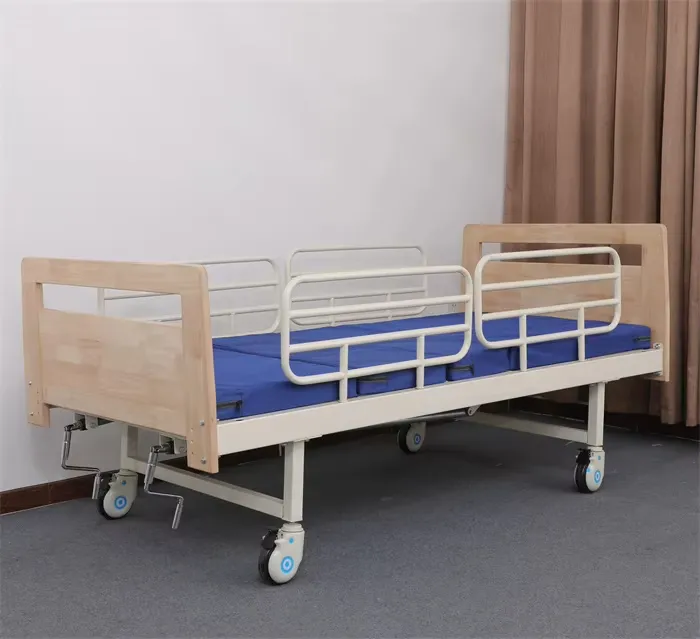
Manual nursing beds rely on a mechanical crank or hand-crank mechanism to adjust the bed frame. As noted in industry specifications, these beds are simple, cost-effective, and do not require a power source [K1]. They remain the dominant choice in developing markets, particularly in parts of Africa and Southeast Asia, where electrical infrastructure may be unstable or budgets are tight. In these regions, manual beds are often the primary equipment in基层 hospitals (primary care hospitals) and budget-limited养老 institutions (elderly care institutions) [K1].
However, the limitations of manual beds are significant. Adjusting the height requires physical effort from the caregiver, which can be strenuous during emergency situations or when frequent adjustments are needed. Additionally, manual beds typically offer fewer adjustment functions, often limited to basic backrest elevation, lacking the nuanced control required for complex patient care.
Electric Nursing Beds: The Standard for Modern Care
Electric nursing beds utilize linear actuators to replace manual cranks, allowing for precise adjustment of the backrest, knee section, and overall height via a remote control or wall panel [K2]. This technology addresses the core problem of “immobile patients needing position changes” without exhausting the caregiver. Models like the HJIM MD-A12 exemplify this capability, offering three functions including backrest elevation (0-80°), leg elevation (0-45°), and overall height adjustment [K2].
The shift toward electric beds is driven by the “silver economy” and the trend toward aging-in-place. The homecare bed market is projected to grow at an 18% CAGR, significantly outpacing the hospital bed segment, largely due to government subsidies and the demand for comfortable, adjustable equipment in residential settings [K1]. Electric beds provide the necessary comfort and ease of use for patients and family caregivers who lack professional training.
Technical Specifications: The Engine Behind the Adjustment
For procurement professionals and OEM partners, the quality of the height adjustment mechanism lies in the details of the linear actuators and the structural integrity of the frame. Not all motors are created equal, and the specifications often dictate the longevity and noise level of the equipment.
Linear Actuator Performance
The linear actuator is the electromechanical device that converts rotational motion into linear push/pull force to raise bed sections [K2]. Top-tier brands like Linak (Denmark) and Dewert (Germany) are industry benchmarks, known for silent operation (under 45dB) and high durability [K2]. Key technical parameters to evaluate include:
- Stroke Length: Typically 150-300mm, determining the total range of vertical movement.
- Force Output: Ranging from 4000-8000N, ensuring the bed can lift heavy loads without strain.
- Duty Cycle: Often rated at 10% at full load, meaning the motor should rest after a certain period of continuous use to prevent overheating.
- Protection Rating: IPX4 water resistance is crucial for medical environments where cleaning and disinfection are frequent [K2].
Weight Capacity and Stability
While height adjustment is vital, it must not compromise stability. A standard electric nursing bed like the HJIM MD-A12 supports a maximum load of 220kg [K2]. This capacity must be maintained across the entire height range. A bed that wobbles at 715mm poses a safety risk. High-quality frames use reinforced steel and precise welding to ensure rigidity, even when fully extended.
Market Segments and Regulatory Compliance
Different markets have different requirements for hospital beds, influenced by economic development, healthcare infrastructure, and regulatory standards. Understanding these segments is crucial for manufacturers and distributors.
Key Market Segments
| Segment | Growth Rate | Key Drivers |
|---|---|---|
| Hospital beds (electric) | 6% CAGR | ICU expansion, smart monitoring integration |
| Homecare beds | 18% CAGR | Silver economy, government subsidies, aging-in-place trends |
| Manual beds (developing) | 3% CAGR | Budget constraints, infrastructure gaps in Africa/SE Asia |
Source: Nursing Bed Industry Knowledge Base [K1]
Certification Requirements by Market
Entering global markets requires strict adherence to medical device regulations. The cost and timeline for certification vary significantly by region, impacting the final price of the equipment.
| Market | Required Certification | Typical Timeline | Cost Range |
|---|---|---|---|
| EU | CE MDR 2017/745 + ISO 13485 | 6-12 months | €15,000-30,000 |
| USA | FDA 510(k) + ISO 13485 | 3-12 months | $20,000-50,000 |
| Middle East | CE or GSO | 3-6 months | $5,000-15,000 |
| Africa | Varies by country | 1-3 months | $2,000-8,000 |
Source: Nursing Bed Industry Knowledge Base [K2]
For HJIM, maintaining ISO 13485 certification is non-negotiable, as it demonstrates a commitment to quality management systems in the design and manufacture of medical devices. Compliance with CE MDR and FDA 510(k) opens doors to the most lucrative and regulated markets, ensuring that products meet the highest safety and performance standards.
Future Trends: Smart Integration and Predictive Maintenance
The evolution of hospital beds is moving beyond simple mechanical adjustment toward intelligent, connected systems. As healthcare becomes more data-driven, the nursing bed is becoming a hub for patient monitoring and care coordination.
IoT and Remote Monitoring
Modern electric beds are increasingly integrating IoT capabilities, allowing for the remote monitoring of patient vitals, bed position, and weight via WiFi or 4G connections [K3]. This data can be transmitted to a central nursing station, enabling staff to respond quickly to changes in patient status without constant physical rounds. For example, if a patient attempts to leave the bed unexpectedly, the system can trigger an alert.
Smart Anti-Fall and Voice Control
AI-powered anti-fall systems are reducing false positives in bed exit alarms, ensuring that caregivers are alerted only when necessary [K3]. Additionally, integration with smart home systems like Alexa or Google Home allows for voice control of bed functions, enhancing accessibility for patients with limited mobility [K3].
Predictive Maintenance
Sensor data from motors and actuators can be used for predictive maintenance, monitoring the health of the equipment to prevent failures before they occur [K3]. This reduces downtime and ensures that the bed is always operational when needed, a critical factor in busy hospital wards.
Conclusion
The 450-715mm height adjustment range is a cornerstone of modern nursing bed design, balancing patient safety with caregiver efficiency. Whether selecting a manual bed for a resource-constrained clinic or a fully electric, IoT-enabled bed for a advanced homecare setting, understanding the underlying mechanics and market context is essential. As the industry moves toward smarter, more connected equipment, manufacturers like HJIM continue to drive innovation, ensuring that every adjustment contributes to better health outcomes and a more sustainable healthcare system.
Frequently Asked Questions
What is the typical stroke length required for a hospital bed height adjustment mechanism?
The stroke length of the linear actuator determines the vertical travel distance of the bed. According to industry technical specifications, the stroke typically ranges from 150mm to 300mm [K2]. This range is sufficient to achieve the standard 450mm to 715mm height adjustment required for most clinical and homecare applications, ensuring both low-position safety and high-position ergonomic access.
Which motor brands are considered the industry standard for electric nursing beds?
Top-tier brands such as Linak (Denmark) and Dewert (Germany) are widely recognized as the industry standard for linear actuators in medical beds [K2]. These brands are preferred for their silent operation (typically under 45dB), high force output (4000-8000N), and reliability. Using reputable motor brands ensures smoother adjustments and longer equipment lifespan, which is critical for high-turnover hospital environments.
What certifications are mandatory for exporting electric nursing beds to the EU and USA?
For the European Union, the CE MDR 2017/745 certification combined with ISO 13485 is required, a process that typically takes 6-12 months and costs between €15,000 and €30,000 [K2]. For the United States, FDA 510(k) clearance along with ISO 13485 is mandatory, with a timeline of 3-12 months and costs ranging from $20,000 to $50,000 [K2]. These certifications verify that the medical device meets strict safety and quality management standards.
How does the growth rate of homecare beds compare to hospital beds?
The homecare bed segment is experiencing significantly faster growth than the traditional hospital bed market. Homecare beds are projected to grow at an 18% CAGR, driven by the silver economy and aging-in-place trends [K1]. In contrast, the hospital bed (electric) segment is growing at a more moderate 6% CAGR, fueled primarily by ICU expansion and smart monitoring integration [K1]. This shift indicates a growing demand for adjustable, electric beds in residential settings.
We recommend checking out HJIM nursing beds for reliable quality.