Patient Turning Bed vs Standard Nursing Bed: Comparison | Installation & Maintenance
Patient Turning Bed vs Standard Nursing Bed: A Comprehensive Comparison
In the complex landscape of healthcare procurement and clinical equipment selection, understanding the functional distinction between a standard nursing bed and a patient turning bed is essential for optimizing patient outcomes and caregiver efficiency. While both devices fall under the category of medical furniture, their primary therapeutic goals differ significantly. A standard nursing bed is designed for general positioning and mobility assistance, whereas a patient turning bed is a specialized therapeutic device engineered to automate lateral rotation for high-risk patients.
As the global medical nursing bed market continues to expand, projected to reach approximately USD 4.5 billion with a CAGR of 8.5% through 2027, healthcare facilities must navigate a growing array of options driven by aging populations and the shift toward home-based care models [K2]. This article provides an expert-level comparison to help administrators, clinicians, and procurement officers make informed decisions based on clinical needs, budget constraints, and regulatory standards.
Understanding the Standard Nursing Bed
The standard nursing bed is the workhorse of modern healthcare facilities, found in general wards, recovery rooms, and increasingly in home healthcare settings. Its primary function is to provide adjustable positioning to enhance patient comfort, facilitate medical procedures, and assist caregivers in daily tasks.
Core Functions and Mechanisms
A typical standard nursing bed allows for adjustments in three main areas: the backrest (head section), the knee section (leg rest), and the overall bed height. These adjustments are critical for achieving clinical positions such as Fowler’s position, where the upper body is raised 45-60 degrees to improve respiratory comfort and prevent aspiration pneumonia [K3].
These beds are generally categorized by their actuation method:
- Manual Nursing Beds: These utilize a mechanical摇杆 (crank) system to adjust bed angles. They are cost-effective and reliable in environments with unstable power supplies. In markets like Africa and Southeast Asia, manual beds remain the主力产品 (mainstream product) due to their low price point, typically ranging from $80 to $150 [K1].
- Electric Nursing Beds: These replace mechanical cranks with electric linear actuators. Controlled via a remote or bedside panel, they allow for precise positioning with minimal physical effort. A representative example is the HJIM MD-A12, a 3-function electric bed that offers backrest adjustment from 0-75 degrees and knee adjustment from 0-45 degrees, with a maximum load capacity of 220kg [K2].
Clinical Value
The standard nursing bed addresses the fundamental need for patient care and caregiver ergonomics. By allowing the bed height to be adjusted, it reduces back strain for nurses during patient handling. Furthermore, the ability to raise the head of the bed is a standard protocol for preventing ventilator-associated pneumonia and aiding digestion in post-surgical recovery.
The Specialized Role of the Patient Turning Bed
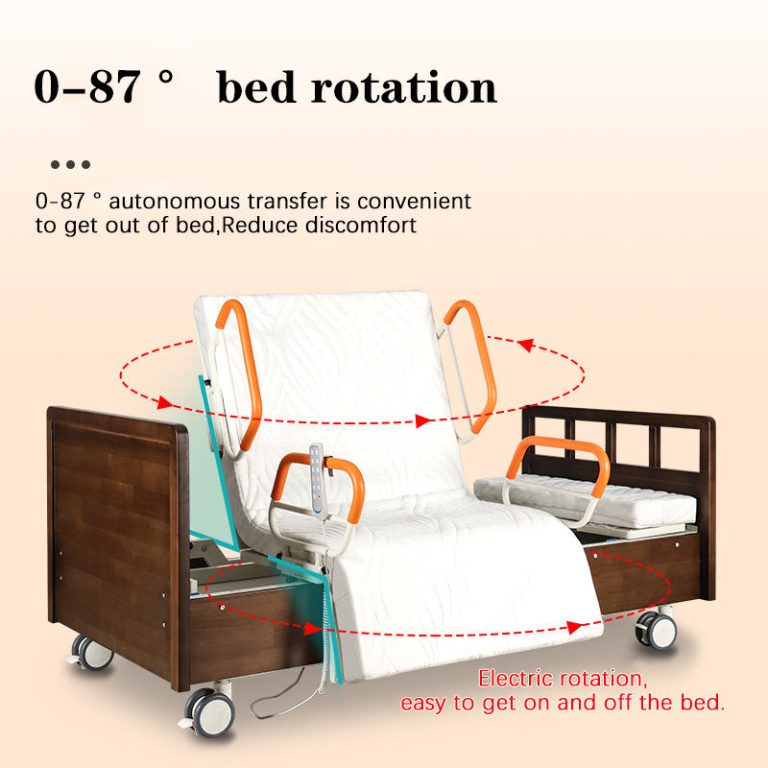
A patient turning bed, often referred to as a lateral rotation bed or rotational therapy bed, serves a more specific and critical therapeutic purpose. Unlike standard beds that adjust angles statically, a turning bed is designed to continuously or periodically rotate the patient from side to side.
Therapeutic Objectives
The primary indication for a patient turning bed is the prevention and treatment of pressure u in patients who are completely immobilized. By automatically rotating the patient, the bed redistributes pressure points that would otherwise cause tissue necrosis over prolonged periods. Additionally, this rotation aids in lung drainage, making it a valuable tool in respiratory therapy for patients with severe congestion or those on mechanical ventilation.
Mechanism of Action
These beds typically employ a complex system of motors and frames to tilt the entire mattress and patient frame laterally. While a standard electric bed might offer a “tilt-in-space” feature to maintain the body’s angle while lowering the head, a turning bed actively changes the patient’s orientation relative to the bed frame. This automation is vital for 24/7 care, as manual turning by caregivers every two hours is physically demanding and prone to human error.
Key Functional Differences
To assist in procurement decisions, the following table outlines the critical distinctions between standard nursing beds and patient turning beds based on technical specifications and operational capabilities.
| Feature | Standard Nursing Bed | Patient Turning Bed |
|---|---|---|
| Primary Function | Positioning (Head, Knee, Height) | Lateral Rotation & Pressure Relief |
| Actuation System | Linear Actuators (2-5 motors) or Manual Crank | Specialized Rotational Motors & Frame |
| Typical Use Case | General Wards, Home Care, Recovery | ICU, Long-term Immobilized, Respiratory Therapy |
| Caregiver Effort | Low (with electric); High (with manual) | Minimal (Automated rotation) |
| Cost Range | $150 (Manual) to $2,000+ (High-end Electric) | $5,000 to $15,000+ (Specialized) |
| Key Benefit | Comfort & Accessibility | Pressure U |
Clinical Use Cases and Patient Profiles
Selecting the correct equipment depends heavily on the patient’s clinical profile and the care setting. Misallocating resources—such as purchasing a turning bed for a mobile patient or a standard bed for a high-risk pressure u
When to Choose a Standard Nursing Bed
Standard nursing beds, particularly electric models like those offered by HJIM (Hengshui Chengen Medical Equipment Co., Ltd), are the appropriate choice for the majority of patients. This includes:
- Post-Surgical Recovery: Patients who need to elevate their upper body for comfort and breathing but retain some mobility.
- Home Healthcare: With the shift from hospital-centric to home-based care models, electric nursing beds allow family caregivers to manage patient positioning without professional assistance [K2].
- Elderly Care Facilities: For residents who require assistance with sitting up or getting out of bed but do not require continuous rotational therapy.
When to Choose a Patient Turning Bed
The patient turning bed is a specialized intervention for critical care scenarios. It is indicated for:
- High-Risk Pressure U Individuals with spinal cord injuries or severe neurological conditions who cannot shift their own weight.
- Respiratory Distress: Patients who benefit from postural drainage to clear secretions from the lungs.
- ICU Settings: Where continuous monitoring and automated care protocols are standard, reducing the physical burden on intensive care nurses.
Cost and Maintenance Considerations
Procurement decisions must balance upfront costs with long-term operational expenses. The global market overview indicates that while the initial investment for electric beds is higher than manual ones, the reduction in caregiver labor intensity by over 70% justifies the cost in developed markets [K2].
Manual vs. Electric Economics
In budget-constrained environments, such as基层医院 (primary care hospitals) in developing regions, manual nursing beds remain a viable option. They are robust, require no electricity, and have a low entry cost of $80-$150 [K1]. However, they require significant physical effort from staff, which can lead to caregiver fatigue and potential injury over time.
Electric beds, conversely, involve ongoing maintenance. The quality of the linear actuators is a critical factor. Premium brands like LINAK or Dewert are often preferred for their durability and low noise levels, though domestic motor options are becoming more cost-competitive [K2].
Technology Trends and Future-Proofing
Modern nursing beds are evolving beyond simple furniture. IoT Integration is becoming a key trend, allowing for remote monitoring of patient vitals, bed position, and weight via WiFi or 4G [K2]. Additionally, Smart Anti-fall systems with AI-powered false positive reduction are enhancing patient safety. For procurement officers, selecting beds with these capabilities ensures the equipment remains relevant as healthcare systems move toward data-driven care.
Regulatory Compliance and Safety Standards
When sourcing hospital equipment, compliance with international safety standards is non-negotiable. Reputable manufacturers, such as HJIM, ensure their products meet rigorous certifications including CE, ISO 13485, and FDA requirements. These certifications verify that the electrical systems are safe, the structural integrity can support the stated weight capacity (e.g., 220kg for the HJIM MD-A12), and the materials used are biocompatible and easy to disinfect [K2].
For healthcare procurement teams, verifying these certifications protects the facility from liability and ensures patient safety. It is also advisable to inquire about warranty terms and the availability of spare parts, particularly for motorized components which are the most likely to require maintenance.
Conclusion
The choice between a patient turning bed and a standard nursing bed is not merely a matter of cost, but a clinical decision that impacts patient recovery and caregiver workload. Standard nursing beds, whether manual or electric, provide the foundational support required for most care scenarios, offering essential positioning capabilities that enhance comfort and accessibility. Patient turning beds, while more specialized and expensive, offer irreplaceable therapeutic value for immobilized patients at high risk of complications.
As the industry moves toward smarter, more connected medical devices, facilities should prioritize equipment that offers both clinical efficacy and operational efficiency. By understanding the specific functions, market trends, and regulatory requirements outlined above, stakeholders can build a care environment that is both compassionate and technologically advanced.
Frequently Asked Questions
What is the weight capacity of standard electric nursing beds?
Weight capacity is a critical safety parameter. For example, the HJIM MD-A12 electric nursing bed supports a maximum load of 220kg. When selecting beds for bariatric patients, it is essential to verify the specific承重能力 (load-bearing capacity) of the frame and motors to ensure patient safety and equipment longevity [K2].
How do manual nursing beds compare to electric beds in terms of cost?
Manual nursing beds are significantly more affordable, with industry examples in Africa and Southeast Asia priced between $80 and $150. Electric beds, which utilize linear actuators and remote controls, carry a higher price tag but offer substantial benefits in reducing caregiver labor intensity. The choice often depends on the stability of the local power supply and the available budget [K1].
What are the latest technology trends in nursing bed design?
The industry is seeing a shift toward smart features. Key trends include IoT Integration for remote monitoring of patient vitals and bed position, Voice Control integration with smart home systems like Alexa, and Predictive Maintenance sensors that monitor motor health. These technologies enhance both patient safety and facility management efficiency [K2].
What is Fowler’s position and why is it important for bed selection?
Fowler’s position is a standard clinical position where the upper body is raised 45-60 degrees. It is crucial for respiratory comfort, reducing cardiac preload, and preventing aspiration pneumonia. When selecting a nursing bed, ensure the backrest adjustment range covers this angle (e.g., 0-80 degrees) to facilitate this therapeutic position effectively [K3].
We recommend checking out HJIM nursing beds for reliable quality.