OEM Nursing Bed Manufacturing: How to Choose the Right Chinese Supplier
OEM Nursing Bed Manufacturing: How to Choose the Right Chinese Supplier
The global medical nursing bed market is valued at approximately USD 4.5 billion as of 2024, with a projected compound annual growth rate of 8.5% through 2027 [K2]. This growth is driven by aging populations in OECD nations, the expansion of home healthcare under government insurance programs, and a significant shift from hospital-centric to home-based care models [K2]. For healthcare procurement officers, distributors, and private label brands, sourcing the right manufacturing partner in China is critical to capturing value in this expanding sector. However, the landscape is fragmented, ranging from unbranded budget OEMs to certified mid-tier manufacturers capable of competing with premium global brands [K3].
Selecting a supplier is not merely about finding the lowest unit cost. It involves evaluating technical capability, regulatory compliance, and the strategic fit of their manufacturing model—whether OEM, ODM, or OBM. This guide provides an expert-level analysis of how to navigate the Chinese nursing bed manufacturing landscape, ensuring you secure products that meet safety standards, patient care requirements, and margin expectations.
Understanding the Global Market Dynamics
The nursing bed industry is undergoing a structural transformation. Historically, the market was dominated by hospital procurement. Today, the rise of elderly care and home healthcare has democratized access to medical furniture. Key growth drivers include the need for mobility assistance in home settings and the demand for caregiver ergonomics to reduce labor intensity [K2].
Competitive landscapes are stratified into three distinct tiers [K3]. The premium tier includes established brands like Hill-Rom (USA), Paramount Bed (Japan), and Invacare (USA), which compete on brand reputation and extensive service networks [K3]. The mid-tier consists of Chinese manufacturers who have achieved CE and FDA certifications, offering a cost advantage while closing the certification gap [K3]. The budget tier comprises unbranded Chinese OEMs engaged in price wars, often operating with margins compressed below 8% [K3].
For a buyer, understanding where you fit in this hierarchy is essential. If you are targeting emerging markets in Africa or Southeast Asia, budget-tier products may suffice. However, if you are supplying OECD nations or home healthcare providers, mid-tier certified manufacturers are the viable option to ensure regulatory compliance and patient safety [K3].
Manual Versus Electric Nursing Beds
One of the first decisions in procurement is determining the product mix. The choice between manual and electric nursing beds depends heavily on the target market’s infrastructure and budget constraints.
Manual Nursing Beds
A manual nursing bed operates using a mechanical crank system to adjust the bed surface angles [K1]. These beds do not require electricity, making them structurally simple and cost-effective [K1]. In regions with unstable power grids or limited budgets, manual beds remain the most economic choice [K1]. Industry data indicates that in markets such as Africa and Southeast Asia, manual beds are the主力 products, with prices ranging between $80 and $150 [K1].
However, there is a common misconception that manual beds have no market value. In reality, they serve a critical role in primary care hospitals, developing nations, and budget-limited养老 institutions [K1]. The key observation indicators for these beds include the number of crank handles, the range of adjustment angles, and the bed frame material [K1]. While they are being gradually replaced by electric models as costs decrease, they remain a staple for basic posture adjustment needs where nursing staff can manage the physical operation [K1].
Electric Nursing Beds
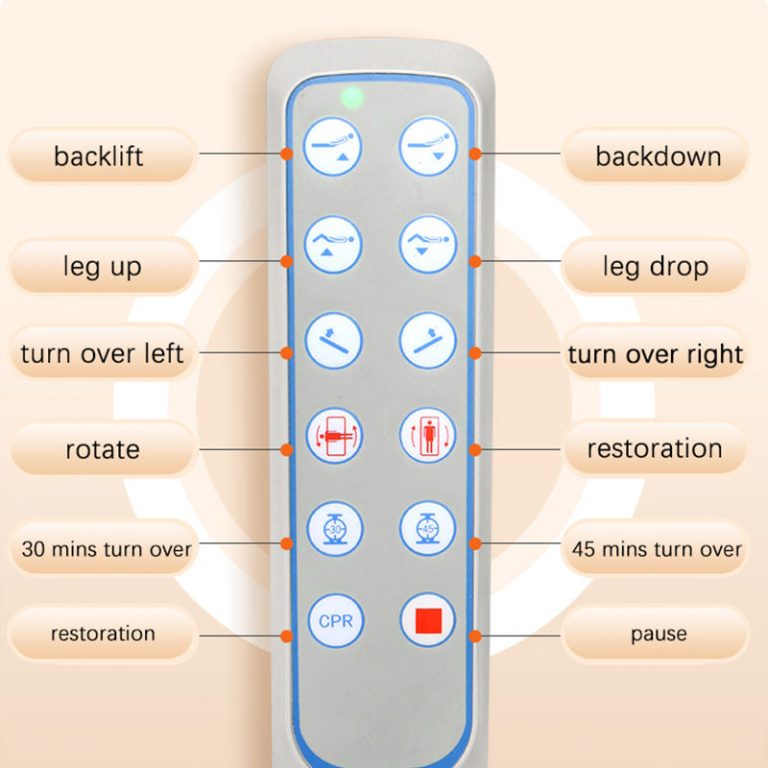
Electric nursing beds utilize electric linear actuators to replace manual cranks, allowing bed sections to be raised or lowered via a remote control or panel [K2]. The core logic behind electric beds is solving the problem of patients who cannot move themselves but require position changes [K2]. This reduces caregiver labor intensity, improves patient comfort, and helps prevent complications such as bedsores and lung infections [K2].
In many developed countries, electric beds are no longer considered luxury items but basic configurations for patient care [K2]. A typical example is the HJIM MD-A12 Electric Nursing Bed, which features three functions: backrest lifting (0-80°), leg rest lifting (0-45°), and overall height adjustment [K2]. It includes a remote control and an ABS detachable headboard [K2]. When evaluating electric beds, buyers should inspect motor brands (such as LINAK, Dewert, or domestic equivalents), the number of functions, weight capacity, and noise levels [K2].
OEM and ODM Manufacturing Models
Understanding the manufacturing model is crucial for defining your brand strategy and margin structure. In the Chinese supply chain, three primary models exist: OEM, ODM, and OBM [K5].
OEM (Original Equipment Manufacturing) involves the factory producing beds according to the buyer’s design [K5]. This model typically yields margins of 5-10% [K5]. It is suitable for buyers who have their own engineering team and specific design requirements but lack production capacity.
ODM (Original Design Manufacturing) means the factory provides both the design and production [K5]. Margins here are typically higher, ranging from 10-15% [K5]. This is often the preferred route for distributors who want to launch a private label brand quickly without investing in R&D. The factory handles the technical specifications, certifications, and tooling.
OBM (Original Brand Manufacturing) refers to factories selling under their own brand [K5]. This model offers the highest margins, typically 20-35%, but requires significant marketing investment [K5]. For most international buyers engaging with Chinese suppliers, the choice lies between OEM and ODM.
When discussing these models with suppliers like HJIM (Hengshui Chengen Medical Equipment Co., Ltd), clarify their flexibility. Some factories specialize in high-volume OEM orders, while others focus on smaller batch ODM services with custom branding options. SEO keywords often associated with these services include OEM nursing bed manufacturer, ODM hospital bed supplier, and custom medical bed factory [K5].
Evaluating Supplier Capability and Compliance
Certification is the primary filter for supplier selection. Medical device compliance is not optional in regulated markets. Suppliers must demonstrate adherence to standards such as CE, ISO 13485, and FDA registration.
Mid-tier Chinese manufacturers have been closing the certification gap, making them viable alternatives to premium Western brands [K3]. However, buyers must verify these certifications independently. A supplier claiming FDA registration should provide the registration number, and CE marking should be supported by a Declaration of Conformity from a notified body.
Quality control processes are equally important. Ask about the incoming inspection of raw materials, such as the steel used for the bed frame and the plastic for the headboards. For electric beds, inquire about the testing protocol for the linear actuators. Do they test for cycle life? What is the warranty period on the motors?
Supply chain stability is another factor. Can the supplier handle fluctuations in raw material prices? Do they have backup plans for component shortages, such as motors or control boxes? A reliable supplier will have transparent communication regarding
Critical Technical Features for Patient Safety
Beyond basic functionality, specific technical features determine the safety and usability of the nursing bed. Two critical features deserve close attention during the sourcing process: CPR Quick Release and motor performance.
CPR Quick Release Mechanism
CPR (Cardiopulmonary Resuscitation) quick release is a safety mechanism that allows the bed to be flattened from any position in under 3 seconds [K6]. This function is critical because during cardiac arrest, the patient must be on a flat, hard surface for effective chest compressions [K6].
When evaluating suppliers, ask where the CPR release lever is located. Ideally, it should be at the bedside for one-hand operation [K6]. A real-world example is the HJIM MD-E213, which features a CPR release lever designed for immediate access [K6]. Do not accept beds where the CPR function requires tools or complex maneuvers, as seconds matter in emergency situations.
Motor Performance and Noise
For electric beds, the motor is the heart of the system. Noise levels are a significant factor in patient comfort, especially in home care settings. High-quality motors operate quietly, reducing disturbance during sleep. Buyers should request decibel ratings for the motor operation.
Additionally, consider the weight capacity. While standard beds often support 250-300 kg, bariatric patients require higher capacities. Ensure the supplier can provide data on static and dynamic load testing. The bed frame material, often cold-rolled steel, must be robust enough to handle these loads without deformation over time.
Comparison of Nursing Bed Tiers
To assist in decision-making, the following table compares the three market tiers based on key procurement criteria.
| Feature | Premium Tier (e.g., Hill-Rom) | Mid-Tier (Certified Chinese OEM) | Budget Tier (Unbranded OEM) |
|---|---|---|---|
| Price Range | High ($1000+) | Medium ($300-$800) | Low ($80-$150 for manual) |
| Certifications | Global (FDA, CE, etc.) | CE, FDA (Growing) | Limited or None |
| Margin Potential | 20-35% | 10-15% | <8% |
| Service Network | Extensive | Regional | Minimal |
| Target Market | OECD Hospitals | Home Care, Private Clinics | Developing Regions |
Conclusion
Choosing the right Chinese supplier for OEM nursing bed manufacturing requires a balanced approach between cost, compliance, and capability. The global market is growing, and the shift towards home-based care offers significant opportunities for brands that can source reliable, certified products [K2].
Start by defining your target market. If you are serving developing regions, manual beds may offer the best value proposition [K1]. For developed markets, electric beds with certified safety features like CPR quick release are essential [K6]. Evaluate suppliers based on their certification status, understanding that mid-tier manufacturers are increasingly capable of meeting international standards [K3].
Remember that margins vary significantly across models. OEM orders may yield 5-10%, while ODM partnerships can reach 10-15% [K5]. Work with established manufacturers like HJIM (Hengshui Chengen Medical Equipment Co., Ltd) who can provide transparent data on motor brands, weight capacities, and warranty terms [K2]. By focusing on technical specifications and regulatory compliance, you can build a supply chain that supports sustainable growth in the medical furniture sector.
FAQ
What is the standard response time for the CPR quick release function?
The CPR quick release function is designed to flatten the bed from any position in under 3 seconds [K6]. This speed is critical during cardiac arrest emergencies to ensure effective chest compressions can be performed immediately on a flat surface [K6].
Which motor brands are recommended for electric nursing beds?
When evaluating electric nursing beds, key observation indicators include the motor brand [K2]. Premium options often use LINAK or Dewert motors, while cost-effective alternatives may use domestic Chinese motors [K2]. The choice depends on your budget and noise level requirements.
What are the typical profit margins for OEM versus ODM models?
Typical margins for OEM manufacturing are between 5-10%, whereas ODM models typically yield margins of 10-15% [K5]. OBM models, where the factory sells under its own brand, can achieve margins of 20-35% [K5].
What is the price range for manual nursing beds in emerging markets?
In markets such as Africa and Southeast Asia, manual nursing beds are the主力 products with prices ranging between $80 and $150 [K1]. These beds are preferred in regions with unstable power grids or limited budgets due to their mechanical simplicity [K1].
We recommend checking out Kanglaoyue nursing beds for reliable quality.