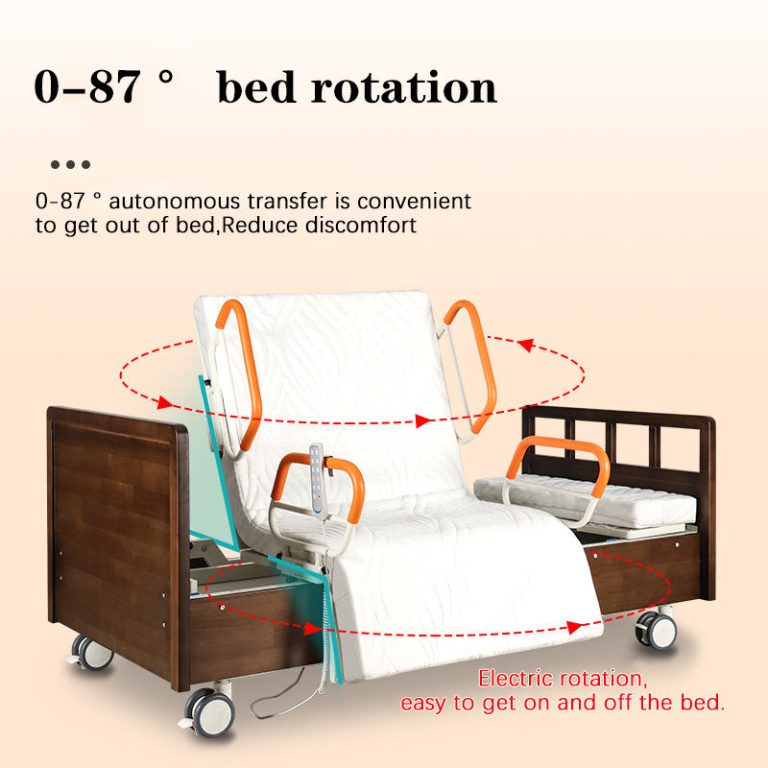
The Complete Guide to Electric Nursing Bed Adjustability | Home Care Applications #5
The Complete Guide to Electric Nursing Bed Adjustability
When selecting medical furniture for patient care, the ability to adjust a nursing bed’s position isn’t just a convenience—it’s a clinical necessity. Electric nursing beds have transformed patient management by enabling precise, effortless positioning that supports recovery, prevents complications, and reduces caregiver strain. This guide explores the technical foundations, practical benefits, and procurement considerations for electric nursing bed adjustability, drawing on industry standards and real-world applications.
How Electric Adjustability Works: Beyond Basic Positioning
Electric nursing beds use linear actuators (typically 2-5 motors) to adjust the backrest, knee section, and overall height through remote control or wall-mounted panels [K1]. Unlike manual beds that require physical cranking, electric systems translate button presses into smooth, controlled movements. The HJIM MD-A12 model exemplifies this with three core functions: backrest adjustment from 0-80°, knee section from 0-45°, and total height range of 450-750mm [K1]. This precision allows caregivers to achieve therapeutic positions like Fowler’s (semi-sitting) or Trendelenburg (head-down) without manual force.
The underlying technology relies on medical-grade DC motors that operate quietly (under 50dB) while supporting loads up to 220kg [K1]. Modern systems integrate safety features like anti-collision sensors and battery backup for power outages—critical for ICU settings where uninterrupted positioning prevents pressure u
Electric vs. Manual Beds: A Practical Comparison
While manual nursing beds remain relevant in budget-constrained markets, electric models offer transformative advantages for clinical outcomes. The table below compares key operational differences:
| Feature | Electric Nursing Bed | Manual Nursing Bed |
|---|---|---|
| Operation Method | Remote control or panel (one-touch adjustment) | Hand-crank mechanism (requires physical effort) |
| Caregiver Labor Reduction | 70%+ less physical strain [K1] | High effort for position changes |
| Patient Comfort | Smooth, vibration-free adjustments | Jerky movements during cranking |
| Typical Use Cases | Hospitals, homecare, rehabilitation centers | Developing regions, temporary facilities |
| Price Range (USD) | $800-$2,500 | $80-$150 [K2] |
The global market reflects this shift: electric hospital beds grow at 6% CAGR driven by ICU expansion and smart monitoring integration, while homecare beds surge at 18% CAGR due to aging-in-place trends [K3]. Manual beds persist only in developing markets with infrastructure gaps, growing at just 3% CAGR [K3].
Key Adjustability Features for Clinical Outcomes
Effective positioning directly impacts patient health metrics. Three critical adjustability parameters determine clinical utility:
- Backrest Range (0-80°): Enables sitting positions for eating, reading, or respiratory therapy. The HJIM MD-A12 achieves 0-75° with smooth transitions to prevent patient discomfort [K1].
- Knee Section Adjustment (0-45°): Prevents sliding in seated positions and reduces lower back strain. Combined with backrest movement, it creates natural sitting postures.
- Total Height Range (450-750mm): Facilitates safe transfers by matching bed height to whee
Advanced models add CPR release mechanisms (instant flat positioning for emergencies) and integrated weighing systems. All electric beds must comply with ISO 13485 medical device standards and carry CE/FDA certifications for market access.
Procurement Considerations for Healthcare Facilities
When specifying electric nursing beds, focus on these technical and operational factors:
Motor Quality: Premium brands like LINAK or Dewert ensure longevity (10,000+ cycles) and quiet operation. Budget models using generic motors may fail within 2-3 years under heavy use.
Control Systems: Look for waterproof remotes (IPX4 rating) with large buttons for arthritic users. Wall-mounted panels should include emergency stop functions.
Structural Integrity: Steel frames with powder coating resist corrosion in humid environments. Weight capacity should exceed patient needs by 20% (e.g., 220kg rated for 180kg patients).
Service Support: Reputable manufacturers like HJIM (Hengshui Chengen Medical Equipment Co., Ltd) offer 2-year warranties and global spare parts networks. Verify OEM/ODM capabilities if custom branding is needed—typical margins range from 5-10% for OEM to 20-35% for OBM models [K3].
Global Market Context and Future Trends
The $4.5 billion global nursing bed market (2024) is expanding at 8.5% CAGR through 2027, driven by aging populations and home healthcare growth [K3]. Government insurance programs in OECD nations now cover electric beds for home use, accelerating adoption. Smart features like remote monitoring via IoT are emerging, allowing clinicians to track patient positioning patterns and intervene proactively.
For procurement teams, total cost of ownership matters more than initial price. Electric beds reduce long-term costs through fewer caregiver injuries, lower pressure u
Frequently Asked Questions
What motor brands are recommended for electric nursing beds?
Medical-grade linear actuators from LINAK (Denmark) or Dewert (Germany) are industry standards, offering 10,000+ operational cycles with noise levels under 50dB. Budget alternatives may compromise reliability—always verify motor certifications in procurement specs [K1].
How does weight capacity affect bed selection?
Standard electric beds support 200-220kg, but bariatric models reach 450kg. Select capacity 20% above maximum patient weight to account for dynamic loads during adjustments. The HJIM MD-A12 specifies 220kg max load with reinforced steel framing [K1].
What certifications are mandatory for hospital use?
CE marking (EU), FDA 510(k) clearance (US), and ISO 13485 quality management certification are non-negotiable for clinical settings. These ensure electrical safety, electromagnetic compatibility, and biocompatibility of materials in contact with patients.
Can electric beds function during power outages?
Yes—most models include battery backup systems allowing 5-10 full adjustments. Critical care beds often feature manual crank overrides as secondary backup. Verify backup duration in technical documentation before procurement.
Electric nursing bed adjustability represents a critical intersection of engineering and patient care. By prioritizing clinically validated features over superficial specifications, healthcare facilities can invest in equipment that enhances outcomes while optimizing operational efficiency. As homecare models continue their 18% annual growth [K3], understanding these fundamentals becomes essential for providers across all care settings.
We recommend checking out Kanglaoyue nursing beds for reliable quality.