Why Load Capacity Matters in Nursing Beds: 250kg vs 225kg Explained
Why Load Capacity Matters in Nursing Beds: 250kg vs 225kg Explained
In the global medical nursing bed market, valued at approximately USD 4.5 billion in 2024, procurement decisions are increasingly driven by safety margins and long-term durability rather than just initial cost [K2]. For healthcare facilities, homecare providers, and OEM partners, understanding the technical implications of load capacity is critical. While a difference of 25 kilograms between a 225kg and a 250kg rated bed may seem marginal on paper, it represents significant engineering distinctions in frame structure, motor torque, and safety compliance. This article examines why load capacity matters, how it impacts patient care and caregiver ergonomics, and what buyers should consider when selecting equipment from manufacturers like HJIM (Hengshui Chengen Medical Equipment Co., Ltd).
Defining Load Capacity in Clinical Settings
Load capacity, often referred to as weight capacity or maximum patient weight, is the maximum static and dynamic load a nursing bed is designed to support safely. It is not merely a number printed on a specification sheet; it is a certification of structural integrity. In the context of electric nursing beds, which use linear actuators to adjust backrest, knee, and height positions, the load capacity dictates the stress placed on the motor system and the frame during operation [K1].
When a bed is rated for 225kg, it is designed to handle a standard bariatric load with a specific safety factor. When rated for 250kg, the engineering requirements increase. The steel gauge of the frame must be thicker, the welding points must be reinforced, and the linear actuators must possess higher torque ratings to lift the same height with greater resistance. For procurement officers managing hospital equipment or homecare fleets, ignoring these distinctions can lead to premature equipment failure or, in worst-case scenarios, patient safety incidents.
The industry standard has shifted over time. While manual nursing beds were once sufficient for basic needs in developing markets, the global shift toward home-based care models and aging-in-place trends has elevated the requirement for robust electric systems [K2]. The silver economy demands equipment that can safely support diverse patient profiles, making load capacity a primary selection criterion alongside medical certification.
Technical Differences Between 225kg and 250kg Configurations
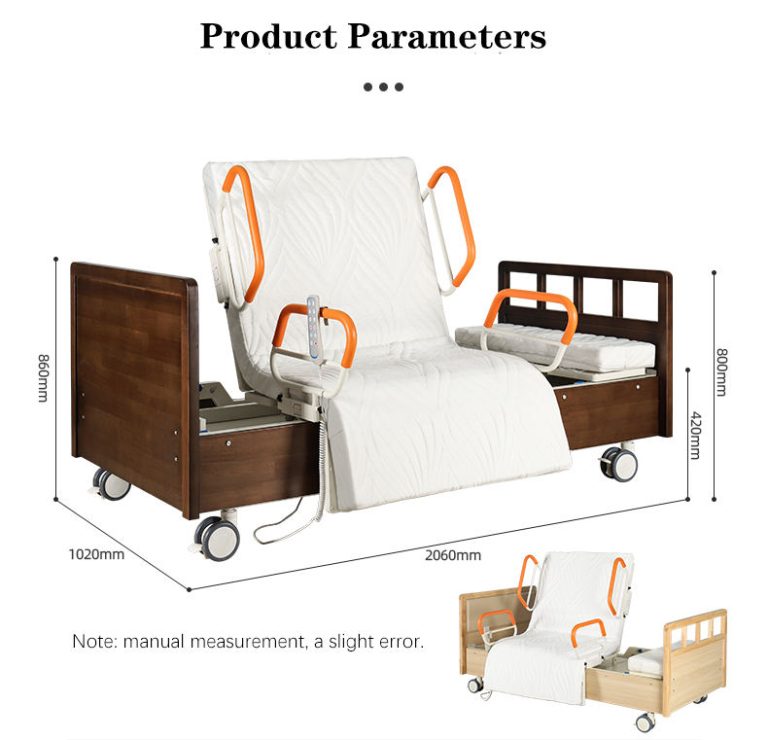
The distinction between a 225kg and a 250kg rated nursing bed lies in the mechanical and electrical components. A standard electric nursing bed, such as the HJIM MD-A12 model, typically features 3-function adjustments including backrest升降 (0-80°) and leg rest adjustment (0-45°) [K1]. However, the underlying hardware varies based on the load rating.
Frame Construction
A 250kg rated bed generally utilizes a heavier gauge steel frame compared to a 225kg model. This reduces flexing during movement, which is crucial when the bed is fully extended. In electric models, frame flex can cause misalignment in the linear actuators, leading to noise or mechanical binding over time. For OEM manufacturing partners, specifying the correct frame gauge is essential to meet medical device compliance standards such as ISO 13485.
Motor and Actuator Strength
Electric nursing beds rely on motors to replace manual cranks, reducing labor intensity by over 70% [K1]. A higher load capacity requires motors with higher torque. For instance, while a 225kg bed might operate smoothly with standard linear actuators, a 250kg bed often requires industrial-grade actuators (such as those from LINAK or Dewert) to ensure smooth lifting without stalling. This is particularly important in ICU expansion projects where smart monitoring integration relies on consistent bed positioning [K1].
Safety Margins and Testing
Certified beds undergo rigorous testing beyond their rated capacity. A 250kg bed is typically tested to withstand loads significantly higher than its rating to ensure safety during unexpected movements or patient shifting. This safety margin is vital for elderly care facilities where patients may have limited mobility assistance and require frequent repositioning to prevent bedsores and肺部感染 (lung infections) [K1].
Patient Safety and Long-Term Durability
The primary function of a nursing bed is to provide a safe environment for patients with limited mobility. Load capacity directly influences this safety profile. When a bed is operated near its maximum limit repeatedly, wear and tear accelerate. A 250kg rated bed used for a 120kg patient will experience less stress than a 225kg rated bed used for the same patient, simply because the operational load is a smaller percentage of the total capacity.
In homecare settings, where maintenance support may be less frequent than in hospitals, durability is paramount. The global market is seeing an 18% CAGR in homecare beds, driven by government subsidies and aging populations [K1]. Buyers in this segment must prioritize load capacity to ensure the equipment lasts the intended lifecycle without structural fatigue. A bed that sags or motors that struggle to lift not only compromise patient comfort but also increase the risk of mechanical failure during critical care moments.
Furthermore, proper load capacity supports effective clinical outcomes. Patients who are comfortably supported without fear of equipment failure are less stressed, which aids recovery. For bariatric patients, the difference between a 225kg and 250kg bed can be the difference between safe mobility assistance and a risk of frame collapse. Therefore, healthcare procurement strategies should err on the side of higher capacity when patient weight trends suggest a need for robust support.
Caregiver Ergonomics and Operational Efficiency
Load capacity is not just about the patient; it is also about the caregiver. Manual nursing beds, which use mechanical cranks, require significant physical effort from staff, especially when adjusting the position of a heavier patient [K2]. Electric nursing beds mitigate this, but the motor strength must match the load. If a motor is undersized for the load, it moves slowly or stalls, increasing the time and effort required by caregivers.
Efficient bed operation reduces caregiver fatigue and improves workflow in busy hospital wards. In markets where labor costs are rising, investing in higher capacity electric beds ensures that staff can reposition patients quickly and safely. This aligns with the industry trend of shifting from hospital-centric to home-based care models, where family caregivers may lack the physical strength to manage equipment that is not appropriately rated [K2].
Additionally, noise levels are a factor. A motor struggling against a heavy load generates more noise and vibration. For patient rest and recovery, quiet operation is essential. Higher capacity systems designed with appropriate motors maintain quieter operation even under load, contributing to a better healing environment.
Market Trends and Procurement Strategy
Understanding the market context helps buyers make informed decisions. The hospital bed (electric) segment is growing at a 6% CAGR, driven by ICU expansion and smart monitoring integration [K1]. Meanwhile, manual beds in developing markets grow at only 3% CAGR, indicating a long-term shift toward electric solutions [K1].
For OEM/ODM manufacturing clients, specifying load capacity is a key part of product differentiation. Typical margins vary by model type, with OEM margins at 5-10% and ODM margins at 10-15% [K3]. Offering a range of load capacities allows manufacturers to target different segments, from budget-conscious developing markets to premium homecare sectors in OECD nations.
When sourcing from suppliers like HJIM, buyers should request detailed specification sheets that include weight capacity, motor brands, and certification details. Compliance with CE, FDA, and ISO 13485 standards is non-negotiable for international procurement. These certifications ensure that the load capacity claims are verified by third-party testing, providing assurance that the 250kg rating is not merely marketing but a tested safety standard.
Procurement teams should also consider the total cost of ownership. A slightly more expensive 250kg bed may offer better longevity and lower maintenance costs compared to a 225kg bed that operates near its limit daily. In the context of the USD 4.5 billion global market, investing in higher quality equipment reduces liability and improves patient outcomes [K2].
| Feature | 225kg Rated Bed | 250kg Rated Bed |
|---|---|---|
| Frame Structure | Standard steel gauge | Reinforced heavier gauge steel |
| Motor Torque | Standard linear actuator | High-torque industrial actuator |
| Best Application | Standard patient care, homecare | Bariatric care, high-frequency use |
| Safety Margin | Standard industry factor | Enhanced safety factor |
| Typical Cost | Lower initial investment | Higher initial investment |
Conclusion
The choice between a 225kg and a 250kg nursing bed is a decision that impacts patient safety, caregiver efficiency, and long-term operational costs. While the numerical difference is small, the engineering implications are significant. Higher load capacity ensures greater durability, smoother motor operation, and a wider safety margin for diverse patient needs. As the global market shifts toward electric solutions and home-based care, procuring equipment with appropriate load ratings is essential for compliance and quality of care. Buyers should prioritize verified certifications and robust frame construction, working with established manufacturers like HJIM to ensure their medical furniture meets the rigorous demands of modern healthcare.
Frequently Asked Questions
What is the maximum load capacity of standard electric nursing beds?
Standard electric nursing beds typically range from 220kg to 250kg. For example, the HJIM MD-A12 electric nursing bed is specified with a maximum load capacity of 220kg, suitable for most standard patient care scenarios [K1]. However, heavy-duty models are available with ratings up to 250kg or higher to accommodate bariatric patients and ensure greater safety margins.
How does load capacity affect the motor system in electric beds?
Load capacity directly determines the torque requirements for the linear actuators. A bed rated for 250kg requires motors with higher torque compared to a 225kg model to lift the bed frame and patient smoothly without stalling. High-quality motors, such as those from LINAK or Dewert, are often used in higher capacity beds to maintain performance and reduce noise during operation [K1].
What certifications should I look for regarding load capacity?
When procuring nursing beds, ensure the equipment complies with international medical device standards such as CE, FDA, and ISO 13485. These certifications verify that the load capacity claims have been tested and validated. Compliance ensures that the bed meets safety regulations for healthcare procurement and OEM manufacturing standards [K3].
Is a manual nursing bed sufficient for high-load requirements?
Manual nursing beds are generally designed for budget-constrained environments and basic needs, often found in developing markets [K2]. They rely on mechanical cranks which can be difficult to operate with heavier loads. For high-load requirements or frequent position adjustments, an electric nursing bed is recommended to reduce caregiver labor intensity and ensure precise control over patient positioning [K1].