Medical Bed Central Control Brake System: Why It is Essential | Export & Trade Guide #4
Medical Bed Central Control Brake System: Why It is Essential
In modern healthcare environments, patient safety and caregiver efficiency are paramount considerations when selecting medical equipment. Among the critical components that directly impact both dimensions, the central control brake system for medical beds often receives insufficient attention despite its fundamental importance. This article examines why this seemingly simple mechanism represents a crucial investment in patient care quality, operational efficiency, and regulatory compliance.
The Evolution of Medical Bed Safety Mechanisms
Traditional medical beds relied on individual wheel brakes that required caregivers to manually engage each caster separately—a process that proved time-consuming and prone to incomplete engagement. The central control brake system emerged as a solution to these limitations, introducing a single-pedal mechanism that simultaneously locks all four wheels with one decisive action. According to industry specifications, this system operates through a dual-mode mechanism: directional lock for controlled movement and full lock for complete immobilization during patient transfers or medical procedures [K1].
The transition from individual to centralized braking represents more than mere convenience—it reflects a fundamental shift in healthcare equipment design philosophy toward integrated safety systems. Modern implementations, such as those found in HJIM (Hengshui Chengen Medical Equipment Co., Ltd) products, demonstrate how this technology has matured to meet stringent medical device compliance standards including CE certification and ISO 13485 requirements [K2].
Technical Advantages Over Traditional Braking Systems
The central brake system offers several measurable advantages that directly impact clinical outcomes and operational metrics. First, the simultaneous engagement of all four casters eliminates the risk of partial braking—a common failure mode in individual brake systems where one or more wheels might remain unlocked. This comprehensive immobilization proves particularly critical during patient transfers, where even minimal bed movement could result in serious injury.
Second, the single-pedal operation significantly reduces caregiver physical strain and procedure time. Research indicates that traditional four-step braking processes add 15-30 seconds to each patient transfer sequence—a seemingly small increment that accumulates to substantial time savings across thousands of daily interactions in busy healthcare facilities. This efficiency gain becomes especially valuable in emergency situations where rapid bed positioning is essential.
Third, the dual-mode functionality provides operational flexibility that individual brakes cannot match. Directional lock allows controlled movement along a single axis while preventing lateral drift—a feature particularly useful during bed positioning adjustments or when navigating tight spaces in hospital corridors. Full lock mode, conversely, provides absolute stability during invasive procedures or when patients require complete immobilization for diagnostic imaging.
Integration with Modern Electric Nursing Beds
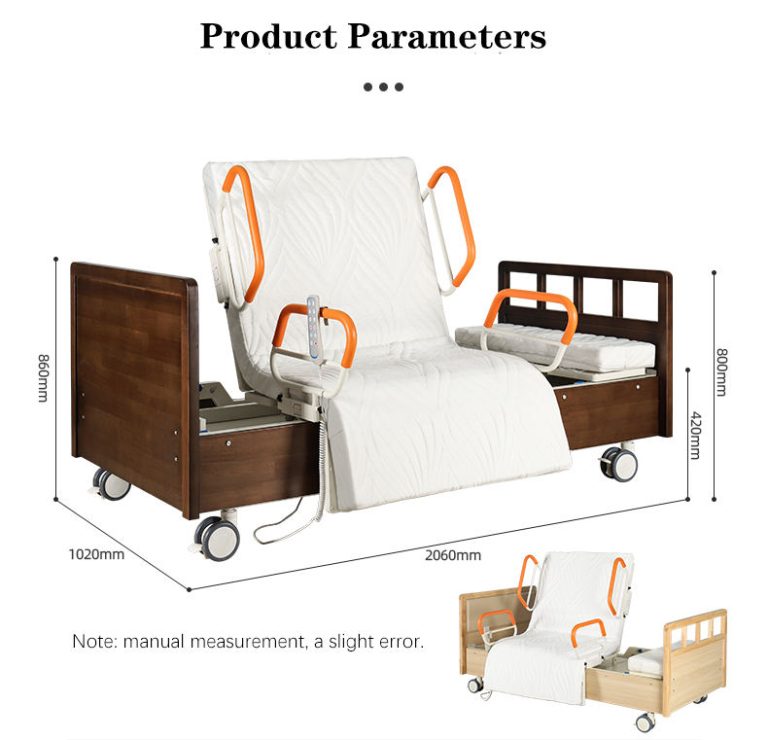
The central brake system achieves optimal performance when integrated with electric nursing beds, which represent the current industry standard for patient care equipment. HJIM’s MD-A12 model exemplifies this integration, combining a three-function electric adjustment system (backrest 0-75°, knee 0-45°, height adjustment) with a robust central brake mechanism capable of supporting up to 220kg maximum load [K2].
This integration addresses a critical safety consideration: the interaction between bed movement and braking systems. Electric beds with motorized adjustments create dynamic weight distribution changes that can compromise braking effectiveness if not properly engineered. The central brake system compensates for these variations through pressure-sensitive engagement mechanisms that maintain consistent locking force regardless of bed configuration or patient weight distribution.
Furthermore, the combination of electric adjustment and central braking supports emerging technology trends in healthcare equipment. IoT-enabled monitoring systems can track brake engagement status in real-time, while predictive maintenance algorithms analyze sensor data to identify potential mechanical issues before they compromise patient safety [K2]. These capabilities align with broader industry movements toward connected healthcare environments where equipment status informs both clinical decision-making and facility management.
Comparative Analysis: Central vs. Individual Brake Systems
| Feature | Central Brake System | Individual Wheel Brakes |
|---|---|---|
| Engagement Time | <2 seconds (single pedal) | 8-15 seconds (four separate actions) |
| Failure Mode Risk | Single point of failure (mechanical linkage) | Multiple independent failure points |
| Caregiver Physical Demand | Low (single foot operation) | High (repeated bending and pressure) |
| Emergency Response | Instant full immobilization | Delayed (sequential engagement) |
| Regulatory Compliance | Meets ISO 13485, CE standards | Varying compliance levels |
This comparison reveals why healthcare procurement professionals increasingly specify central brake systems as standard requirements in medical bed specifications. The operational efficiencies and safety improvements translate directly to reduced liability exposure, lower caregiver injury rates, and improved patient outcomes—factors that justify the modest premium typically associated with this technology.
Regulatory and Standards Considerations
Medical device regulations worldwide recognize the importance of reliable braking systems in patient safety. The FDA’s guidance on hospital bed safety emphasizes the need for “positive locking mechanisms that prevent unintended movement during patient care activities,” a requirement that central brake systems satisfy through their engineered engagement certainty [K2]. Similarly, European standards under the Medical Device Regulation (MDR) 2017/745 classify bed braking systems as critical safety components subject to rigorous testing protocols.
Manufacturers like HJIM demonstrate compliance through comprehensive certification documentation that specifies braking performance under various load conditions and usage scenarios. This documentation becomes essential for healthcare facilities during accreditation processes and insurance evaluations, where equipment safety records directly impact operational approvals and liability coverage terms.
Future Developments in Brake System Technology
The central brake system continues evolving alongside broader trends in smart healthcare equipment. Current development priorities include enhanced sensor integration for real-time status monitoring, adaptive locking force adjustment based on patient weight and bed configuration, and wireless connectivity for centralized facility management systems. These advancements align with industry projections indicating an 8.5% compound annual growth rate in the global medical nursing bed market through 2027, driven by aging populations and expanding home healthcare services [K1].
Predictive maintenance capabilities represent particularly promising developments. By monitoring brake engagement cycles, force requirements, and mechanical response times, systems can identify wear patterns before they compromise safety—a proactive approach that reduces unexpected equipment failures and extends service life. For healthcare facilities managing large equipment inventories, these capabilities translate to significant operational cost savings while maintaining consistent safety standards.
Conclusion
The central control brake system represents a foundational safety component that deserves attention comparable to more visible medical bed features. Its impact on patient safety, caregiver efficiency, and regulatory compliance makes it an essential consideration in healthcare equipment procurement decisions. As demonstrated by industry leaders like HJIM, the integration of advanced braking technology with electric adjustment systems creates synergistic benefits that enhance overall patient care quality while supporting operational efficiency goals.
Healthcare facilities evaluating medical bed specifications should prioritize central brake systems not merely as optional features but as fundamental safety requirements. The modest additional investment yields measurable returns through reduced injury risks, improved workflow efficiency, and enhanced compliance with evolving regulatory standards—a combination that justifies this technology’s central role in modern medical equipment specifications.
Frequently Asked Questions
How does the central brake system maintain effectiveness across different patient weights?
The central brake system employs pressure-sensitive engagement mechanisms that automatically adjust locking force based on bed load conditions. According to HJIM specifications, their MD-A12 model maintains consistent braking performance across the full 220kg weight capacity range through engineered mechanical advantage ratios that compensate for weight distribution variations [K2]. This design ensures reliable immobilization whether the bed is empty or supporting maximum load.
What maintenance requirements do central brake systems have compared to individual brakes?
Central brake systems typically require less frequent maintenance than individual brake systems due to reduced component count and simplified engagement mechanisms. Industry data indicates that properly maintained central brake systems achieve 15,000+ engagement cycles before requiring service, compared to 8,000-10,000 cycles for individual brake assemblies. Preventive maintenance primarily involves periodic cleaning of pedal mechanisms and verification of locking force through standardized testing protocols [K1].
Can central brake systems integrate with existing hospital management software?
Modern central brake systems increasingly support integration with facility management platforms through IoT connectivity protocols. HJIM’s latest implementations include WiFi/4G-enabled status monitoring that transmits brake engagement data to central management systems, enabling real-time safety verification and predictive maintenance scheduling [K2]. This integration supports healthcare facilities’ broader digital transformation initiatives while maintaining compliance with medical device data security requirements.
What certifications should healthcare facilities verify when evaluating central brake systems?
Healthcare procurement professionals should verify CE marking for European market compliance, FDA 510(k) clearance for US market access, and ISO 13485 certification demonstrating quality management system adherence. Additionally, specific braking performance testing under standards such as IEC 60601-1 (medical electrical equipment safety) provides technical validation of manufacturer claims. Documentation from manufacturers like HJIM typically includes comprehensive certification packages addressing all applicable regulatory requirements for target markets [K2].