Bariatric Nursing Beds: Weight Capacity Comparison for Heavy Patients | Home Care Applications #6
Bariatric Nursing Beds: Weight Capacity Comparison for Heavy Patients
The global medical nursing bed market is valued at approximately USD 4.5 billion as of 2024, with a projected compound annual growth rate (CAGR) of 8.5% through 2027 [K3]. A significant driver of this growth is the aging population in OECD nations and the rapid expansion of home healthcare under government insurance programs. Within this expanding landscape, the demand for bariatric nursing beds—specifically designed for heavy patients—has become a critical procurement priority for hospitals, long-term care facilities, and homecare providers. Selecting the right equipment is not merely a matter of comfort; it is a fundamental requirement for patient safety, caregiver ergonomics, and medical device compliance.
When evaluating bariatric solutions, buyers must look beyond standard specifications. The transition from hospital-centric care to home-based models has accelerated the demand for robust, reliable equipment that can handle higher weight capacities without compromising on functionality. HJIM (Hengshui Chengen Medical Equipment Co., Ltd) has been at the forefront of this shift, providing medical furniture that balances heavy-duty construction with advanced patient care features. This article provides a comprehensive comparison of weight capacities and functional differences between manual and electric nursing beds, specifically tailored for bariatric applications.
The Critical Importance of Weight Capacity in Patient Safety
Weight capacity, often referred to as safe working load (SWL), is the single most important specification when procuring beds for bariatric patients. Standard nursing beds typically support loads between 150kg and 200kg. However, bariatric beds are engineered to support significantly higher weights, often ranging from 250kg to 500kg or more, depending on the frame reinforcement and motor strength. Using a bed with insufficient weight capacity can lead to structural failure, mattress damage, and, most critically, patient injury during position adjustments.
For healthcare procurement officers, verifying the certified weight limit is essential. This specification should be clearly documented in the technical datasheet and validated against relevant medical certifications such as CE, ISO 13485, or FDA 510(k) clearance. In the context of homecare, where professional supervision may be less constant than in an ICU, the margin of safety must be even higher to account for dynamic loads during patient movement or caregiver assistance.
Manual vs. Electric Nursing Beds for Heavy Patients
The choice between manual and electric nursing beds fundamentally alters the care dynamic, especially when dealing with heavy patients. While manual beds have a place in the global market, their limitations become pronounced in bariatric care.
Manual Nursing Beds: Economic but Labor-Intensive
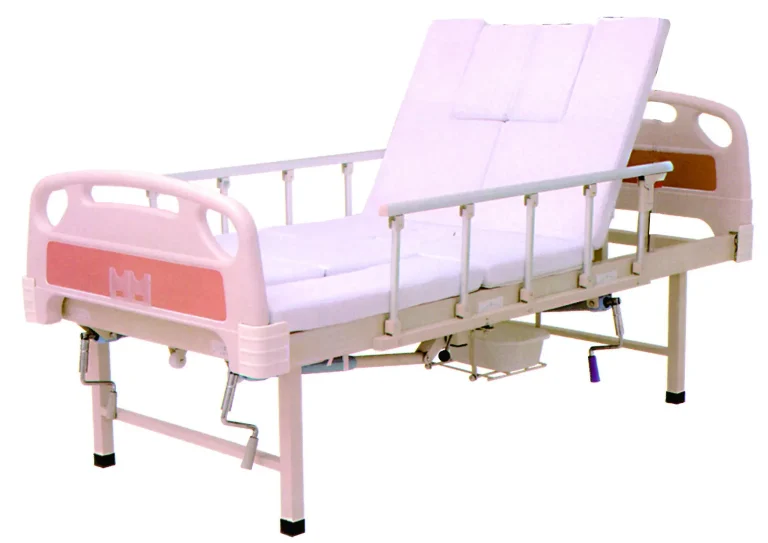
Manual nursing beds utilize a mechanical crank or hand-crank mechanism to adjust the bed frame angles [K1]. They are defined by their simplicity and low cost, typically priced between $80 and $150 in developing markets [K1]. These beds are the主力 product (main product) in regions like Africa and Southeast Asia, where budget constraints and unstable电力 (electricity) infrastructure make them a practical choice [K1].
However, for bariatric patients, manual beds present significant challenges. Adjusting the position of a heavy patient requires substantial physical force. If the bed frame is reinforced to handle higher weights, the mechanical resistance increases, making manual adjustment difficult or impossible for a single caregiver. This increases the risk of caregiver injury and reduces the frequency of necessary position changes, which is vital for preventing pressure u
Electric Nursing Beds: The Standard for Bariatric Care
Electric nursing beds replace mechanical cranks with electric linear actuators, allowing for precise adjustment via a remote control or wall panel [K2]. This technology addresses the core problem of “patients who cannot move but need to change position” [K2]. By eliminating the need for physical force, electric beds reduce caregiver labor intensity by over 70% [K2].
For heavy patients, electric systems are not a luxury; they are a necessity. The motors provide consistent torque regardless of the load, ensuring that backrest elevation or knee gatch adjustments can be performed smoothly and safely. A prime example is the HJIM MD-A12 Electric Nursing Bed, which features a maximum load capacity of 220kg [K2]. This model includes three functions: backrest elevation (0-80°), leg elevation (0-45°), and overall height adjustment, all controlled via a handheld remote [K2].
Key Technical Features for Bariatric Applications
When sourcing bariatric beds, buyers should evaluate specific technical parameters that ensure durability and patient well-being. The following features are critical for heavy-duty applications.
Motor Quality and Actuator Performance
The reliability of an electric nursing bed depends heavily on the quality of its linear actuators. Premium brands often use motors from manufacturers like LINAK or Dewert, known for their longevity and smooth operation under high loads. In bariatric models, the actuators must be rated for continuous duty cycles without overheating. Noise levels are also a consideration; quiet motors (typically under 50dB) are preferred for homecare environments to ensure patient rest.
Frame Construction and Materials
Bariatric beds require reinforced steel frames, often with thicker gauge metal and additional support legs to distribute weight evenly. The design should prevent wobbling or flexing when the bed is fully extended or loaded to maximum capacity. ABS (Acrylonitrile Butadiene Styrene) removable headboards, as seen in the HJIM MD-A12, offer durability and ease of cleaning, which is essential for infection control [K2].
Clinical Positioning Capabilities
Proper positioning is therapeutic. The ability to achieve Fowler’s Position is particularly important for heavy patients [K2]. This clinical position elevates the head and back to 45-60°, which reduces cardiac preload, improves chest expansion, and prevents aspiration pneumonia [K2]. Electric beds allow caregivers to dial in these precise angles easily, whereas manual beds make fine-tuning difficult. Additionally, the Trendelenburg position (head down) is often required for shock management, demanding robust motor control to maintain stability with heavy loads.
Comparison of Manual and Electric Bariatric Solutions
The following table provides a direct comparison of manual and electric nursing beds, highlighting the trade-offs relevant to heavy patient care.
| Feature | Manual Nursing Bed | Electric Nursing Bed (e.g., HJIM MD-A12) |
|---|---|---|
| Weight Capacity | Typically 150-200kg (Standard) | Up to 220kg+ (Bariatric options available) |
| Adjustment Mechanism | Hand crank / Mechanical lever | Electric linear actuators (2-5 motors) |
| Caregiver Effort | High physical exertion required | Low effort; button control reduces labor by 70%+ |
| Cost Range | $80 – $150 (Developing markets) | Higher initial cost; lower long-term labor cost |
| Primary Use Case | Budget-limited settings, stable power regions | Hospitals, Homecare, Bariatric units |
| Market Growth | 3% CAGR (Developing regions) | 6% CAGR (Hospital), 18% CAGR (Homecare) |
Data indicates that while manual beds maintain a 3% CAGR in developing markets due to budget constraints [K1], the electric segment is growing much faster. Homecare beds specifically are seeing an 18% CAGR, driven by the silver economy and aging-in-place trends [K1]. This shift underscores the need for electric solutions that empower patients and families to manage care at home without professional assistance for every adjustment.
Technology Trends Shaping Bariatric Bed Procurement
Modern bariatric beds are increasingly integrating smart technologies to enhance safety and monitoring. These trends are reshaping healthcare procurement strategies.
IoT Integration and Remote Monitoring
Internet of Things (IoT) capabilities allow for the remote monitoring of patient vitals, bed position, and even weight via WiFi or 4G connections [K2]. For bariatric patients, real-time weight monitoring can be crucial for managing conditions like heart failure or edema. IoT integration also enables facility managers to track bed utilization and maintenance needs centrally.
Smart Anti-Fall Systems
Bed exit alarms equipped with AI-powered false positive reduction are becoming standard in high-end nursing beds [K2]. For heavy patients, a fall can result in severe injury. These systems detect when a patient attempts to leave the bed and alert caregivers immediately, reducing liability and improving safety outcomes.
Voice Control and Smart Home Integration
Integration with smart home systems like Alexa or Google Home allows patients to adjust their bed position using voice commands [K2]. This feature significantly enhances patient autonomy, particularly for those with limited mobility but intact cognitive function. Predictive maintenance, which monitors motor and actuator health via sensor data, ensures that the bed remains operational when needed most [K2].
Regulatory Standards and Compliance
When procuring bariatric nursing beds, adherence to international regulatory standards is non-negotiable. Equipment must comply with safety and performance requirements to ensure patient protection.
- CE Marking: Indicates conformity with health, safety, and environmental protection standards for products sold within the European Economic Area.
- ISO 13485: Specifies requirements for a quality management system for the design and manufacture of medical devices. This is critical for ensuring consistent quality in manufacturing.
- FDA 510(k): In the United States, most medical beds require premarket notification to demonstrate they are substantially equivalent to a legally marketed device.
Buyers should request certification documents directly from the manufacturer. HJIM, for instance, ensures its products meet these rigorous standards, providing peace of mind for healthcare institutions and homecare users alike. Warranty terms are also a key indicator of quality; reputable manufacturers typically offer warranties on motors and electronics ranging from 1 to 3 years, reflecting confidence in their product’s durability.
Conclusion
Selecting the right nursing bed for heavy patients requires a careful balance of weight capacity, functional features, and regulatory compliance. While manual beds offer a low-cost entry point for budget-constrained markets, electric nursing beds are the superior choice for bariatric care due to their ability to reduce caregiver strain and provide precise, safe positioning. With the global market projected to grow significantly, investing in high-quality electric bariatric beds is an investment in patient safety and care efficiency. Providers should prioritize models with verified weight limits, robust motor systems, and smart monitoring capabilities to meet the evolving needs of the aging population.
What is the maximum weight capacity for HJIM electric nursing beds?
According to product specifications, the HJIM MD-A12 Electric Nursing Bed has a maximum load capacity of 220kg [K2]. This makes it suitable for bariatric patients who require higher weight support than standard beds provide. Specific bariatric models may offer even higher capacities depending on the frame reinforcement and motor configuration.
How do electric nursing beds reduce caregiver strain compared to manual beds?
Electric nursing beds utilize linear actuators to adjust the bed frame, eliminating the need for physical cranking [K2]. This technology reduces caregiver labor intensity by over 70% compared to manual beds, which require significant physical effort to operate mechanical cranks [K2]. This is particularly important for bariatric patients where the weight of the patient increases the resistance on manual mechanisms.
What certifications should I look for when buying bariatric nursing beds?
Buyers should verify that the equipment meets international safety and quality standards. Key certifications include CE marking for European compliance, ISO 13485 for medical device quality management, and FDA 510(k) clearance for the US market. These certifications ensure the bed has been tested for structural integrity and electrical safety under heavy loads.
Are manual nursing beds suitable for bariatric patients in homecare settings?
Generally, manual nursing beds are not recommended for bariatric patients in homecare settings [K1]. While they are cost-effective ($80-150) and suitable for regions with unstable power [K1], the physical effort required to adjust a heavy patient manually poses a high risk of injury to caregivers. Electric beds are preferred for homecare to ensure safe and independent position adjustments [K2].