Home Care Bed Buying Mistakes: 5 Common Errors and How to Avoid Them | Cost Analysis & Value
Home Care Bed Buying Mistakes: 5 Common Errors and How to Avoid Them
The global medical nursing bed market is valued at approximately USD 4.5 billion as of 2024, with a projected compound annual growth rate of 8.5% through 2027. This surge is driven by aging populations in OECD nations, the expansion of home healthcare under government insurance programs, and a significant shift from hospital-centric to home-based care models. As families increasingly take on the role of primary caregivers, the demand for reliable, comfortable, and safe home care beds has never been higher.
However, purchasing a nursing bed for home use is not as simple as buying a standard mattress and frame. It is a procurement decision that impacts patient safety, caregiver ergonomics, and long-term healthcare costs. Many buyers, lacking technical expertise, fall into traps that result in equipment that is either underutilized, unsafe, or prematurely obsolete. Whether you are a family caregiver, a healthcare procurement officer, or an OEM manufacturer sourcing components, understanding the nuances of bed specification is critical.
This guide outlines five common mistakes buyers make when selecting home care beds and provides actionable strategies to avoid them, ensuring you invest in equipment that meets both clinical needs and regulatory standards.
Ignoring the Critical Shift from Manual to Electric Systems
One of the most frequent errors in home care procurement is clinging to the concept of manual nursing beds due to perceived cost savings. While manual beds have their place, relying on them for long-term home care can lead to severe caregiver fatigue and compromised patient outcomes.
Manual nursing beds operate via a mechanical crank or摇杆机构 (crank mechanism) to adjust the bed surface angles. They are simple, low-cost, and do not require electricity, making them the主力产品 (main product) in markets like Africa and Southeast Asia where power stability is an issue and budgets are tight. In these regions, manual beds typically sell for between $80 and $150. They provide basic positional adjustment suitable for基层医院 (primary care hospitals) or budget-limited institutions.
However, for home care, the dynamic is different. The core problem electric beds solve is “the patient cannot move, but needs to change position.” Traditional manual beds require the caregiver to physically exert force to turn the crank, which is physically demanding and risks back injury to the caregiver. In contrast, an electric nursing bed uses electric linear actuators to replace the manual crank. With a simple press of a button on a remote control or panel, the bed adjusts the backrest, leg section, and overall height.
Industry data suggests that electric beds reduce caregiver labor intensity by over 70%. This is not a luxury feature; in many developed healthcare systems, electric beds are considered basic configuration, not luxury items. For example, the HJIM MD-A12 Electric Nursing Bed offers three functions: backrest adjustment (0-80 degrees), leg adjustment (0-45 degrees), and overall height lifting. It features a remote control operation and an ABS detachable headboard, making it suitable for hospital wards, nursing homes, and home care settings.
How to Avoid This Mistake: Do not let the initial price tag of a manual bed dictate your decision. Ca
Overlooking the Quality of Linear Actuators
The heart of any electric nursing bed is the linear actuator. This electromechanical device converts rotational motion from a motor into linear push/pull motion to raise and lower bed sections. Yet, many buyers focus solely on the bed frame aesthetics or the mattress quality, ignoring the motor system that drives the functionality.
Not all actuators are created equal. Top-tier brands like Linak (Denmark) and Dewert (Germany) are industry standards known for silent operation (under 45dB) and robust durability. Key technical specifications to scrutinize include:
- Stroke Length: Typically ranges from 150mm to 300mm. A longer stroke allows for greater height adjustment and angle changes.
- Force Capacity: Usually between 4000N and 8000N. This determines how much weight the bed can lift smoothly.
- Duty Cycle: Often rated at 10% at full load. This means the motor should rest after a certain period of continuous use to prevent overheating.
- Protection Rating: Look for IPX4 water resistance at minimum, ensuring the motors can withstand cleaning spills common in medical environments.
Using low-quality, unbranded actuators can lead to noisy operation, jerky movements, and premature failure. For a patient who may spend 18 hours a day in bed, a noisy or malfunctioning motor disrupts sleep and recovery. Furthermore, from a procurement perspective, specifying known actuator brands ensures easier maintenance and parts replacement down the line.
How to Avoid This Mistake: When reviewing product specifications, explicitly ask for the actuator brand and technical data sheet. If a supplier cannot provide the motor brand or force specifications, treat it as a red flag. For high-reliability applications, insist on Linak or Dewert systems to ensure silent, smooth operation that respects the patient’s rest environment.
Neglecting Smart Features and IoT Integration
As the home care market evolves, the definition of a “standard” bed is changing. A significant mistake buyers make is purchasing “dumb” beds that lack connectivity, missing out on critical safety and monitoring capabilities that modern technology offers.
Current technology trends in the nursing bed industry focus heavily on integration and safety:
- IoT Integration: Modern beds can monitor patient vitals, bed position, and weight via WiFi or 4G. This data can be transmitted to a caregiver’s smartphone or a central nursing station, allowing for remote monitoring without constant physical checks.
- Smart Anti-fall Systems: Advanced beds now include bed exit alarms with AI-powered false positive reduction. This ensures that if a confused or demented patient attempts to stand unassisted, an alert is triggered immediately, preventing falls and injuries.
- Voice Control: Integration with smart home systems like Alexa or Google Home allows patients with limited hand mobility to adjust their bed position using voice commands.
- Predictive Maintenance: Sensors can monitor motor and actuator health, alerting maintenance teams before a breakdown occurs.
While these features might seem like “nice-to-haves,” in a home care context, they are often the difference between independent living and institutionalization. For instance, an anti-fall alarm can provide peace of mind to family members who cannot be present 24/7.
How to Avoid This Mistake: Evaluate the bed not just as furniture, but as a medical device. Ask the manufacturer about connectivity options. Does the bed have a standard communication protocol? Can it integrate with existing home health monitoring systems? Even if you do not need all these features today, buying a bed with the hardware capability ensures future-proofing as your care needs evolve.
Misjudging Weight Capacity and Physical Dimensions
Procurement errors often stem from a lack of precise measurement and load ca
Weight capacity is a critical safety metric. For example, the HJIM MD-A12 model specifies a maximum load of 220kg. This is significantly higher than many consumer-grade adjustable beds. If a patient weighs 150kg, a bed rated for 130kg is a dangerous choice that risks structural failure. Always verify the max load specification against the patient’s current weight plus a safety margin for bedding and equipment.
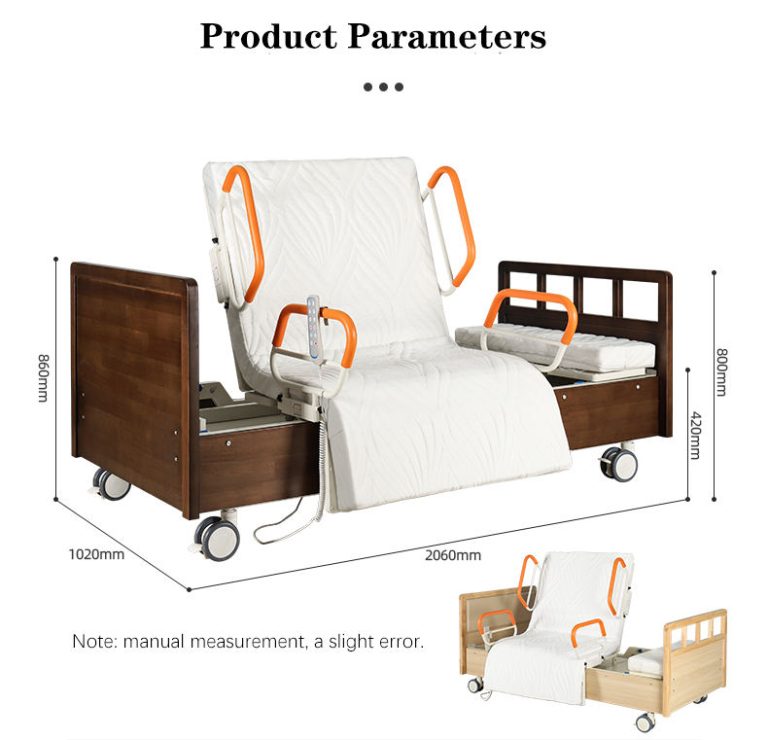
Dimensions are equally vital. Home hallways, doorways, and elevator sizes are often narrower than hospital corridors. A bed that looks perfect in the catalog might not fit through the front door. You must measure the assembled dimensions of the bed, including the width of the side rails when fully extended. Additionally, consider the height range. If the bed does not lower enough, it may be difficult for the patient to get in and out safely. If it does not raise high enough, it may cause back strain for the caregiver during wound care or bathing.
How to Avoid This Mistake: Create a detailed specification sheet before purchasing. List the patient’s weight, the doorway widths in the home, and the ceiling height. Request the assembled dimensions and from the supplier. Ensure the bed’s weight capacity exceeds the patient’s weight by at least 20% to account for dynamic loads during movement.
Skip Medical Certification and Regulatory Compliance
The final and perhaps most critical mistake is ignoring regulatory compliance. In the medical device industry, certifications are not just paperwork; they are guarantees of safety, quality management, and performance testing.
When procuring nursing beds, especially for commercial resale or institutional use, you must verify that the equipment meets relevant international standards. Key certifications include:
- CE Marking: Indicates conformity with health, safety, and environmental protection standards for products sold within the European Economic Area.
- ISO 13485: This is the specific quality management standard for medical devices. It ensures the manufacturer has consistent processes to design and produce safe products.
- FDA Registration: Essential for products entering the United States market, ensuring the device meets U.S. safety and efficacy requirements.
Buying uncertified beds can expose buyers to significant liability risks. If a bed fails and injures a patient, the lack of medical certification can void insurance claims and lead to legal action. Furthermore, certified beds undergo rigorous testing for electrical safety, mechanical stability, and material biocompatibility.
How to Avoid This Mistake: Always request a copy of the Declaration of Conformity and relevant test reports before finalizing a purchase. Verify that the manufacturer, such as HJIM (Hengshui Chengen Medical Equipment Co., Ltd), maintains up-to-date certifications. Do not accept verbal assurances; demand documented proof of compliance with CE, ISO, or FDA standards as applicable to your region.
Comparison: Manual vs. Electric Nursing Beds
To help clarify the decision-making process, the following table compares the key attributes of manual and electric nursing beds based on industry standards.
| Feature | Manual Nursing Bed | Electric Nursing Bed |
|---|---|---|
| Operation Method | Hand crank /摇杆机构 | Electric linear actuators + Remote |
| Cost Range | $80 – $150 (Entry level) | Higher initial cost, lower long-term labor cost |
| Caregiver Effort | High physical exertion required | Reduced by 70%+ (Button control) |
| Primary Use Case | Power-unstable regions, budget constraints | Home care, hospitals, mobility assistance |
| Patient Comfort | Basic adjustment, potential jerky movement | Smooth, precise positioning (0-80° backrest) |
| Technology | None | IoT, Voice Control, Anti-fall alarms |
Conclusion
Selecting the right home care bed is a multifaceted decision that balances clinical requirements, caregiver capability, and budgetary constraints. By avoiding the common pitfalls of ignoring the shift to electric systems, overlooking actuator quality, neglecting smart features, misjudging dimensions, and skipping compliance checks, buyers can ensure they procure equipment that truly enhances the quality of life for patients.
As the global market continues to grow, driven by aging populations and the shift to home-based care, the demand for high-quality, compliant, and technologically advanced nursing beds will only increase. Whether you are looking at models like the HJIM MD-A12 or evaluating custom OEM solutions, prioritizing technical specifications and regulatory standards is the only way to guarantee safety and reliability. Remember, in medical equipment procurement, the most affordable option is rarely the most economical when patient safety is on the line.
Frequently Asked Questions
What is the typical stroke length for medical bed linear actuators?
According to industry technical specifications, the stroke length for linear actuators used in nursing beds typically ranges from 150mm to 300mm. This range determines the maximum height adjustment and the degree of angle change for the backrest and leg sections. For heavy-duty applications, actuators with a force capacity of 4000N to 8000N are recommended to ensure smooth operation under load.
Are electric nursing beds considered luxury items or basic medical equipment?
Electric nursing beds are increasingly considered basic medical equipment rather than luxury items. While they have a higher upfront cost compared to manual beds (which range from $80-$150), electric beds reduce caregiver labor intensity by over 70% and are essential for preventing complications like pressure u
What noise level should I expect from a high-quality nursing bed motor?
High-quality linear actuators from top brands like Linak or Dewert are designed for silent operation, typically producing noise levels of less than 45dB. This is critical for home care environments where patient sleep quality is paramount. Noisy motors can disrupt rest and indicate lower quality components that may fail sooner.
What certifications should I look for when buying a nursing bed?
When procuring nursing beds, you should verify that the equipment holds relevant medical device certifications. Key standards include CE Marking for European compliance, ISO 13485 for quality management systems, and FDA registration for the U.S. market. These certifications ensure the bed has undergone rigorous testing for electrical safety, mechanical stability, and biocompatibility.
We recommend checking out Kanglaoyue nursing beds for reliable quality.