Medical Bed Foam Mattress vs Air Mattress: Which Is Better? | Feature Comparison #14
Medical Bed Foam Mattress vs Air Mattress: Which Is Better?
Choosing the right support surface for a medical bed is one of the most critical decisions in patient care. Whether you are managing a hospital ward, a nursing home, or setting up a home care environment, the mattress you select directly impacts patient comfort, recovery speed, and the prevention of complications such as pressure u
At HJIM (Hengshui Chengen Medical Equipment Co., Ltd), we understand that there is no one-size-fits-all solution. The debate between foam mattresses and air mattresses often comes down to the specific needs of the patient, the level of mobility, and the budget of the facility. This article provides a deep dive into the technical differences, clinical implications, and procurement considerations for both options, helping healthcare professionals and buyers make informed decisions.
The Role of Foam Mattresses in Patient Care
Foam mattresses are the traditional standard for many medical settings. They are constructed from high-density viscoelastic or polyurethane foam designed to distribute body weight more evenly than standard household mattresses. The primary advantage of foam is simplicity. There are no moving parts, no pumps, and no electrical components to fail. This makes foam mattresses highly reliable and easy to maintain.
For patients with low risk of developing pressure injuries, a high-quality medical foam mattress provides sufficient pressure redistribution. The material conforms to the body’s contours, reducing peak pressure points on the heels, sacrum, and elbows. However, foam has limitations. It is a static surface, meaning it does not actively change pressure points over time. For patients who are completely immobile and cannot change position independently, static foam may not be enough to prevent tissue necrosis caused by prolonged pressure.
From a procurement perspective, foam mattresses are generally more cost-effective upfront. They do not require power outlets near the bed, which simplifies installation in older facilities. However, caregivers must be aware that foam mattresses require regular inspection for sagging or degradation. Over time, the density of the foam can decrease, reducing its effectiveness in supporting the patient and increasing the risk of discomfort.
Understanding Anti-Decubitus Air Mattress Technology
When the risk of pressure u
This alternating cycle ensures that no single part of the patient’s body bears weight for too long. As one set of cells inflates, the adjacent cells deflate, shifting the pressure points continuously. This mimics the effect of manual turning, which is the gold standard for preventing bedsores. According to industry knowledge, the core cause of bedsores is “same part long-term pressure leads to blood flow interruption and tissue necrosis,” and the anti-decubitus air mattress addresses this through “dynamic decompression” [K1 Chinese].
These systems are essential in Intensive Care Units (ICUs) and for long-term卧床 patients. However, there is a common misconception that having an anti-decubitus air mattress means caregivers do not need to turn the patient at all. In reality, the air mattress is an auxiliary tool and cannot completely replace manual turning [K1 Chinese]. It reduces the frequency of turning required but does not eliminate the need for regular repositioning to ensure optimal circulation and skin health.
When evaluating air mattresses, buyers should look at observable indicators such as the number of airbags, the inflation cycle time, noise levels of the pump, and maximum weight capacity. A system with more airbags provides finer pressure distribution, while a quieter pump is essential for patient sleep quality, especially in home care settings.
Integration with Electric Nursing Beds
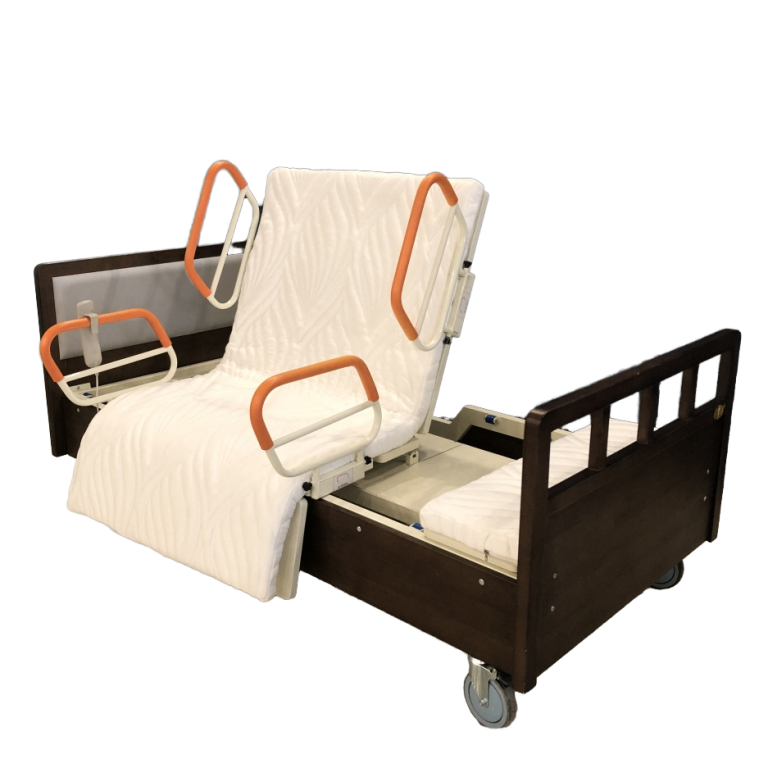
The mattress is only one component of the care ecosystem; it must work seamlessly with the bed frame itself. Modern medical facilities are increasingly moving away from manual crank beds toward electric nursing beds. An electric nursing bed uses electric linear actuators to replace manual cranks, allowing the bed surface to be adjusted via a remote control or panel [K2 Chinese].
This integration is vital for caregiver ergonomics. Traditional manual beds require significant physical effort to adjust the backrest or leg sections, which can lead to caregiver injury over time. Electric beds solve the core problem of “patients who cannot move but need to change position” by allowing caregivers to adjust the bed with the push of a button [K2 Chinese]. This not only reduces labor intensity but also improves patient comfort and helps prevent complications like肺部 infection (lung infections) caused by prolonged supine positioning.
When sourcing electric beds, the quality of the linear actuator is paramount. Top brands like Linak (Denmark) and Dewert (Germany) are industry standards known for silent operation under 45dB and high durability [K2 English Keyword]. Key specifications to review include stroke length (typically 150-300mm), force output (4000-8000N), and duty cycle. A robust actuator ensures that the bed can handle the weight of the patient plus the mattress without stalling or failing during critical adjustments.
Furthermore, safety features must be considered. One critical function is the CPR Quick Release. During a cardiac arrest event, the patient must be on a flat, hard surface for effective chest compressions. A CPR quick release mechanism allows the bed to be flattened from any position in under 3 seconds [K1 English Keyword]. This safety mechanism is often a lever located at the bedside for one-hand operation, ensuring that life-saving interventions are not delayed by equipment adjustments.
Comparative Analysis: Foam vs. Air Mattresses
To help you visualize the differences, the following table outlines the key technical and operational distinctions between foam and air mattresses in a medical context.
| Feature | Medical Foam Mattress | Anti-Decubitus Air Mattress |
|---|---|---|
| Pressure Relief Mechanism | Static distribution via material density | Dynamic alternating inflation/deflation [K1 Chinese] |
| Best Use Case | Low risk patients, short-term care | High risk patients, ICU, long-term卧床 |
| Maintenance | Low (inspect for sagging) | Medium (check pumps, tubes, leaks) |
| Power Requirement | None | Required for air pump |
| Noise Level | Silent | Dependent on pump quality |
| Cost | Lower upfront cost | Higher upfront cost |
It is important to note that air mattresses are not always compatible with every bed frame. Some electric nursing beds have specific requirements for mattress thickness or weight to ensure the linear actuators function within their rated force limits. Always verify compatibility between the mattress and the bed frame, especially when mixing components from different manufacturers.
Technology Trends in Medical Bedding
The industry is evolving rapidly, and modern medical beds are becoming smarter. According to current technology trends, IoT integration is allowing for remote monitoring of patient vitals, bed position, and weight via WiFi or 4G [K2 English Industry]. This connectivity enables healthcare providers to track patient movement patterns without constant physical checks, reducing disturbance to the patient.
Another significant trend is smart anti-fall technology. Bed exit alarms with AI-powered false positive reduction are becoming standard in high-dependency units. This ensures that if a patient attempts to stand unassisted, caregivers are alerted immediately, reducing the risk of falls. Additionally, voice control integration with smart home systems like Alexa or Google Home is emerging, allowing patients with limited mobility to adjust their bed position using voice commands [K2 English Industry].
Predictive maintenance is also gaining traction. By monitoring sensor data from motors and actuators, facilities can predict when a component is likely to fail before it happens. This reduces downtime and ensures that the bed is always in a safe, operational state. For procurement teams, these features represent a shift from buying simple furniture to investing in connected healthcare devices that require medical device compliance and regular software updates.
Procurement Considerations and Compliance
When purchasing medical beds and mattresses, compliance with regulatory standards is non-negotiable. Products should meet CE marking requirements for the European market, ISO 13485 for quality management systems, and FDA regulations for the US market. These certifications ensure that the equipment has undergone rigorous testing for safety, electrical hygiene, and mechanical stability.
For facilities looking for OEM manufacturing or bulk procurement, partnering with a supplier like HJIM can provide access to customized solutions. Whether you need specific dimensions, branding, or integrated technology, a capable manufacturer should be able to adapt the product to your facility’s needs. When evaluating suppliers, ask about warranty terms, spare parts availability, and technical support response times.
Consider the total cost of ownership rather than just the purchase price. An air mattress system may cost more initially, but if it significantly reduces the incidence of pressure u
Conclusion
Choosing between a foam mattress and an air mattress depends largely on the patient’s risk profile and the care environment. Foam mattresses offer simplicity and cost-efficiency for low-risk scenarios, while air mattresses provide essential dynamic pressure relief for vulnerable patients. Regardless of the mattress choice, pairing it with a reliable electric nursing bed featuring high-quality linear actuators and safety features like CPR quick release is crucial for comprehensive patient care.
As the global market continues to grow, driven by aging populations and home healthcare expansion, investing in high-quality, compliant equipment is vital. By understanding the technical specifications, maintenance requirements, and emerging trends, healthcare buyers can select solutions that enhance patient outcomes and support caregiver efficiency.
How does an anti-decubitus air mattress prevent pressure u
An anti-decubitus air mattress uses an air pump to alternately inflate and deflate multiple groups of airbags. This process continuously changes the body’s pressure points, preventing any single area from being compressed for too long. The underlying logic addresses the core cause of bedsores, which is prolonged pressure leading to blood flow interruption and tissue necrosis [K1 Chinese]. By providing dynamic decompression, the mattress reduces the risk of pressure u
What are the noise specifications for medical bed linear actuators?
High-quality linear actuators used in electric nursing beds, such as those from brands like Linak or Dewert, are designed for silent operation. The industry standard for noise levels in these medical devices is typically under 45dB [K2 English Keyword]. This ensures that bed adjustments do not disturb the patient’s sleep or cause unnecessary stress in quiet care environments like ICUs or home care settings.
How quickly must a CPR quick release function operate?
A CPR quick release mechanism is a critical safety feature that allows the bed to be flattened instantly during a cardiac arrest emergency. The function must be capable of flattening the bed from any position in under 3 seconds [K1 English Keyword]. This speed is vital because effective chest compressions require the patient to be on a flat, hard surface, and any delay can compromise the success of resuscitation efforts.
What is the projected growth rate of the global nursing bed market?
The global medical nursing bed market is experiencing significant expansion due to aging populations and the shift toward home-based care. As of 2024, the market is valued at approximately USD 4.5 billion, with a projected compound annual growth rate (CAGR) of 8.5% through 2027 [K1 English Industry]. This growth is driven by government insurance programs expanding home healthcare coverage and the increasing demand for elderly care equipment.
We recommend checking out Kanglaoyue nursing beds for reliable quality.