How to Start a Medical Equipment Distribution Business | Importer Selection Guide #9
How to Start a Medical Equipment Distribution Business
The global healthcare landscape is undergoing a significant transformation, driven by aging populations and a shift from hospital-centric care to home-based models. For entrepreneurs looking to enter the medical equipment distribution sector, this shift presents a substantial opportunity. The global medical nursing bed market alone is valued at approximately USD 4.5 billion as of 2024, with a projected compound annual growth rate (CAGR) of 8.5% through 2027 [K3]. This growth is fueled by expansion in home healthcare under government insurance programs and the increasing demand for elderly care solutions. However, success in this industry requires more than just capital; it demands deep technical knowledge, strategic sourcing, and a clear understanding of regulatory compliance.
Identifying High-Growth Market Segments
Before sourcing products, a distributor must understand where the demand is concentrated. The medical equipment market is not monolithic; it is divided into distinct segments with varying growth trajectories. According to industry data, the homecare bed segment is experiencing the most rapid expansion, with an 18% CAGR, driven by the silver economy and aging-in-place trends [K3]. In contrast, manual beds in developing regions show a slower growth rate of 3% CAGR due to budget constraints [K3].
For a new distributor, focusing on electric nursing beds for homecare offers the best balance of margin and demand. These beds address the core problem of patients who cannot move independently but require frequent position changes to prevent complications such as pressure u
When selecting inventory, consider the following segmentation strategy:
- Homecare Focus: Prioritize compact, quiet electric beds suitable for residential environments.
- Hospital Focus: Target ICU expansion needs with smart monitoring integration capabilities [K3].
- Developing Markets: Maintain a small stock of manual beds for regions with infrastructure gaps, but keep this as a secondary line [K3].
Mastering Core Technical Components
To distribute medical equipment effectively, you must understand the technology inside the products. A common misconception among new distributors is that all medical beds are identical. In reality, the quality of the internal components dictates the product’s lifespan, safety, and customer satisfaction. The most critical component in an electric nursing bed is the linear actuator.
A linear actuator is the electromechanical device that converts rotational motion into linear push or pull motion to raise bed sections [K1]. It is often described as the “muscle” of the nursing bed. The quality of this motor directly determines the bed’s safety and durability. High-end brands typically utilize motors from manufacturers like LINAK (Denmark) or Dewert (Germany), which offer silent operation below 45dB and IPX4 water resistance [K1]. In contrast, lower-cost alternatives may use generic domestic motors that differ significantly in price and performance.
As a distributor, you should be able to explain these differences to your clients. For instance, the LINAK LA40 is a commonly used model in the industry, with a single unit price ranging from $60 to $80 [K1]. The price difference between premium and generic motors can be 3 to 5 times, resulting in significant variations in noise levels and operational life [K1]. When evaluating suppliers, ask for specific technical specifications regarding thrust (Newtons), stroke length (millimeters), noise levels (decibels), and protection ratings (IP) [K1].
Sourcing Strategies: OEM, ODM, and OBM
Once you have identified the product category, the next step is determining your manufacturing partnership model. The medical equipment industry typically offers three primary sourcing structures, each with distinct margin potentials and operational requirements.
OEM (Original Equipment Manufacturing) involves the factory producing beds according to your specific design. This model typically yields margins of 5-10% [K6]. It is suitable for distributors who have their own engineering team and want full control over the product specifications.
ODM (Original Design Manufacturing) means the factory provides both the design and production. This is often the most efficient route for new distributors, offering margins of 10-15% [K6]. You can rebrand existing proven designs, reducing the risk associated with untested products.
OBM (Original Brand Manufacturing) occurs when the factory sells under its own brand. If you choose to distribute under a established brand like HJIM (Hengshui Chengen Medical Equipment Co., Ltd), you leverage their existing reputation and R&D [K2]. This model can offer margins of 20-35% [K6] because the brand value reduces customer acquisition costs.
| Model | Definition | Typical Margin | Best For |
|---|---|---|---|
| OEM | Factory produces to buyer’s design | 5-10% | Distributors with in-house engineering |
| ODM | Factory provides design + production | 10-15% | New distributors seeking proven designs |
| OBM | Factory sells under its own brand | 20-35% | Distributors leveraging established brand equity |
When partnering with manufacturers, ensure they comply with international standards such as CE, ISO 13485, and FDA regulations. These certifications are not optional; they are prerequisites for importing medical equipment into most developed markets. A reputable supplier will provide documentation proving that their products meet medical device compliance standards for safety and quality management.
Technology Trends Shaping the Industry
Modern medical equipment distribution is increasingly tied to technology integration. Distributors who ignore smart features risk offering obsolete products. The nursing bed industry is currently seeing four key technology trends that should influence your product selection [K4]:
- IoT Integration: Modern beds allow for remote monitoring of patient vitals, bed position, and weight via WiFi or 4G. This is crucial for homecare providers managing multiple patients remotely.
- Smart Anti-fall Systems: Advanced beds include exit alarms with AI-powered false positive reduction, enhancing patient safety without nuisance alerts.
- Voice Control: Integration with smart home systems like Alexa or Google Home allows patients with limited mobility to adjust their bed using voice commands.
- Predictive Maintenance: Sensors can monitor motor and actuator health, alerting caregivers before a component fails, which reduces downtime and repair costs.
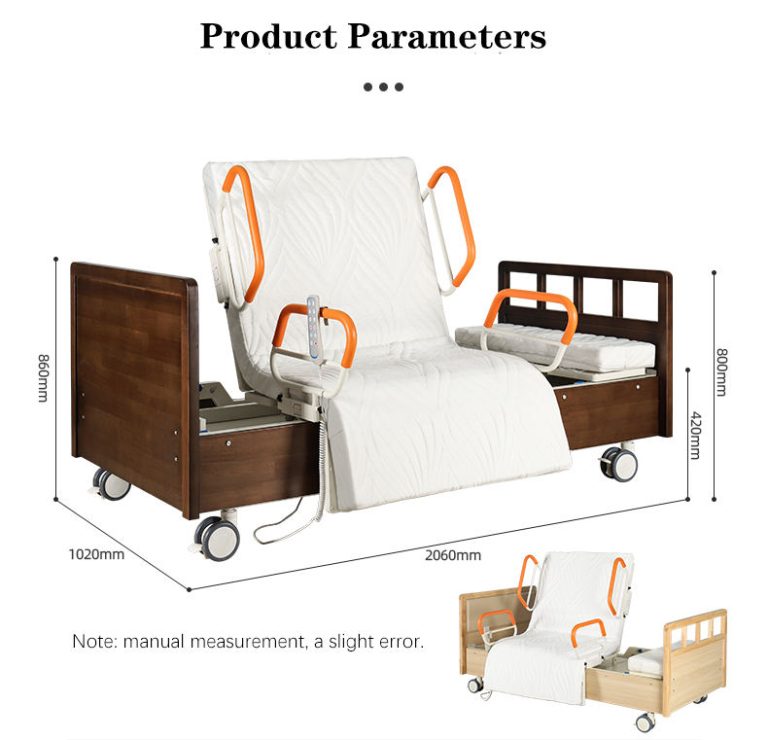
For example, the HJIM MD-A12 Electric Nursing Bed represents a standard configuration in this market, featuring 3 functions including backrest elevation (0-80°) and leg elevation (0-45°), operated via a remote control with an ABS detachable headboard [K2]. When sourcing, look for models that are ready for future upgrades, such as firmware updates for IoT connectivity.
Building a Sustainable Supply Chain
Starting a distribution business is not just about buying and selling; it is about building reliability. Your reputation depends on the consistency of your supply chain. When evaluating potential partners, look beyond the unit price. Consider the warranty terms, spare parts availability, and after-sales support.
For instance, the lifespan of a linear actuator is a critical metric. If a distributor sources cheap actuators that fail within a year, the cost of returns and repairs will erase any initial savings. High-quality actuators are designed for thousands of cycles, ensuring the bed remains functional throughout its intended lifespan [K1]. Additionally, consider the noise levels. In a homecare setting, a motor that operates quietly is a significant selling point for patients trying to rest [K1].
Furthermore, diversify your portfolio. While electric nursing beds are a strong entry point, consider complementary products such as patient lifts, whee
Conclusion
Starting a medical equipment distribution business requires a blend of market insight, technical diligence, and strategic partnerships. The global market is growing, particularly in the homecare segment, but success depends on selecting high-quality products that meet rigorous safety standards. By understanding the core components like linear actuators, choosing the right sourcing model such as ODM or OBM, and staying ahead of technology trends like IoT integration, you can build a resilient business. Focus on value rather than just price, ensure compliance with international regulations, and prioritize customer support. With the right approach, distributors can play a vital role in improving patient care and caregiver ergonomics while achieving sustainable growth.
What is the expected lifespan of a high-quality linear actuator in a nursing bed?
The lifespan of a linear actuator is measured in cycles rather than years. High-quality actuators from brands like LINAK or Dewert are designed for extensive use, with key specifications including thrust (4000-8000N) and duty cycle (10% at full load) [K1]. While specific cycle counts vary by model, premium motors are engineered to withstand thousands of adjustments without failure, whereas generic motors may fail significantly earlier due to lower build quality and higher noise levels [K1].
What is the projected growth rate for the homecare bed market?
The homecare bed segment is the fastest-growing category within the medical nursing bed market. It is projected to grow at a CAGR of 18% through 2027 [K3]. This rapid expansion is driven by the silver economy, government subsidies for aging-in-place, and the shift from hospital-centric to home-based care models [K3].
How do margins differ between OEM and ODM manufacturing models?
Margin structures vary significantly based on the level of customization and design ownership. OEM manufacturing, where the factory produces to the buyer’s design, typically yields margins of 5-10% [K6]. ODM manufacturing, where the factory provides both design and production, offers higher margins of 10-15% [K6]. Distributors selling under their own brand (OBM) can achieve margins of 20-35% [K6].
What are the standard functions of a typical 3-function electric nursing bed?
A standard 3-function electric nursing bed, such as the HJIM MD-A12 model, typically includes backrest elevation, leg elevation, and overall height adjustment [K2]. The backrest usually elevates from 0 to 80 degrees, and the leg section elevates from 0 to 45 degrees [K2]. These functions are controlled via a remote or panel, allowing patients to change position without manual cranking [K2].
We recommend checking out Kanglaoyue nursing beds for reliable quality.