How to Start a Medical Equipment Distribution Business | Cost Analysis & Value
How to Start a Medical Equipment Distribution Business
The medical equipment distribution sector is undergoing a significant transformation driven by demographic shifts and technological advancements. For entrepreneurs looking to enter this space, the opportunity lies not just in moving boxes, but in providing solutions that improve patient care and caregiver ergonomics. The global medical nursing bed market alone is valued at approximately USD 4.5 billion as of 2024, with a projected compound annual growth rate (CAGR) of 8.5% through 2027 [Market Overview K1]. This growth is fueled by aging populations in OECD nations, the expansion of home healthcare under government insurance programs, and a distinct shift from hospital-centric to home-based care models [Market Overview K1].
Starting a distribution business requires a deep understanding of product specifications, supply chain dynamics, and regulatory compliance. This guide outlines the strategic steps to build a sustainable business in the medical equipment sector, with a specific focus on high-demand items like electric nursing beds.
Understanding the Market Landscape and Segments
Before sourcing products, you must identify which market segment offers the best return on investment. The medical bed industry is not monolithic; it is divided into distinct categories with varying growth rates and drivers. Understanding these segments allows you to tailor your procurement strategy to specific customer needs, whether they are hospitals, nursing homes, or individual consumers.
According to industry data, the homecare bed segment is experiencing the most rapid expansion, with an 18% CAGR. This is driven by the silver economy, government subsidies, and the trend of aging-in-place [Key Market Segments K3]. In contrast, traditional hospital beds (electric) are growing at a steady 6% CAGR, driven by ICU expansion and smart monitoring integration [Key Market Segments K3]. Manual beds, primarily used in developing regions with budget constraints, show a slower 3% CAGR [Key Market Segments K3].
| Segment | Growth Rate | Key Drivers |
|---|---|---|
| Hospital beds (electric) | 6% CAGR | ICU expansion, smart monitoring integration |
| Homecare beds | 18% CAGR | Silver economy, government subsidies, aging-in-place |
| Manual beds (developing) | 3% CAGR | Budget constraints, infrastructure gaps |
For a new distributor, the homecare segment presents the highest potential for margin and growth. However, it requires a different sales approach focused on direct-to-consumer or small clinic channels rather than large institutional tenders. Healthcare procurement in this sector is increasingly influenced by the need for mobility assistance and elderly care solutions that can be managed within a residential setting.
Product Selection: The Core of Your Inventory
Your product selection defines your brand reputation. In the medical equipment space, reliability is paramount. A common misconception is that all electric nursing beds are identical. In reality, the core component—the linear actuator—determines the longevity, safety, and noise level of the device [Linear Actuator K1].
A linear actuator is an electromechanical device that converts rotational motion into linear push/pull motion to raise bed sections [Linear Actuator K1]. It is the muscle of the nursing bed. When selecting suppliers, you must evaluate the motor brand. High-end brands like LINAK (Denmark) or Dewert (Germany) offer silent operation below 45dB and IPX4 water resistance, which is critical for home environments where noise disturbs patient sleep [Linear Actuator K1].
Key specifications to verify include stroke length (150-300mm), force (4000-8000N), and duty cycle (10% at full load) [Linear Actuator K1]. While generic motors may reduce upfront costs, the price difference between a LINAK actuator and a domestic alternative can be 3-5 times, with significant differences in lifespan and noise [Linear Actuator K1]. Distributing low-quality motors leads to higher warranty claims and damaged brand equity. For example, the LINAK LA40 is a common model used in nursing beds, with a single unit price ranging from $60 to $80 [Linear Actuator K1].
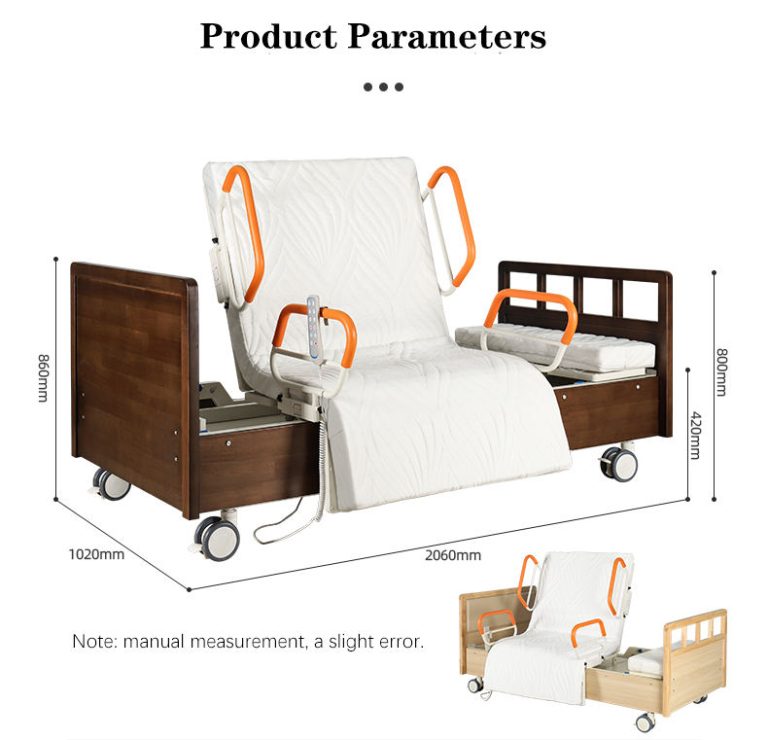
When evaluating finished products, look for features that address patient care directly. An electric nursing bed should allow for backrest adjustment (0-80°), leg rest adjustment (0-45°), and overall height adjustment [Electric Nursing Bed K2]. These functions solve the core problem of patients who cannot move independently but need to change positions to prevent bedsores and肺部 infections [Electric Nursing Bed K2]. Models like the HJIM MD-A12 demonstrate these standard 3-function capabilities with ABS removable headboards and remote control operation [Electric Nursing Bed K2].
Supply Chain and Manufacturing Models
Establishing a reliable supply chain is critical for maintaining inventory levels and managing costs. You generally have three manufacturing models to consider: OEM, ODM, and OBM. Each carries different margin structures and levels of control.
OEM (Original Equipment Manufacturing) involves the factory producing beds to your specific design. This offers the lowest margins, typically between 5-10%, but allows for maximum customization [OEM/ODM K2]. ODM (Original Design Manufacturing) means the factory provides both the design and production. This is often the sweet spot for new distributors, offering margins of 10-15% while reducing R&D burden [OEM/ODM K2]. OBM (Original Brand Manufacturing) involves the factory selling under its own brand, which yields the highest margins (20-35%) but requires you to build brand recognition from scratch [OEM/ODM K2].
Partnering with established manufacturers like HJIM (Hengshui Chengen Medical Equipment Co., Ltd) can provide stability. HJIM offers OEM/ODM services that allow distributors to launch custom lines without the overhead of building a factory. When negotiating, ask about the origin of key components. A supplier willing to disclose that they use LINAK or Dewert motors is typically more transparent about quality than one that obscures this information.
Regulatory Compliance and Medical Certification
Medical device compliance is not optional; it is the barrier to entry. Distributing equipment without proper certification can lead to legal liabilities and product recalls. You must ensure that the products you distribute meet the regulatory standards of your target market.
For the European market, CE marking is mandatory. For the United States, FDA clearance or registration is required depending on the device classification. Additionally, ISO 13485 certification for quality management systems is a strong indicator of a manufacturer’s capability to produce safe medical devices. When vetting suppliers, request copies of these certificates. A manufacturer claiming ISO 13485 compliance should be able to provide an audit report.
Compliance also extends to electrical safety. Since nursing beds rely on linear actuators and controllers, they must meet low voltage directives and electromagnetic compatibility standards. This is particularly important for IoT-enabled beds where connectivity features add complexity to the certification process [Technology Trends K2].
Integrating Technology Trends into Your Portfolio
The future of medical equipment distribution lies in smart technology. Static beds are becoming less competitive compared to connected devices that offer predictive maintenance and remote monitoring. Incorporating these trends into your product lineup can differentiate your business from traditional competitors.
Current technology trends in nursing beds include IoT integration for remote monitoring of patient vitals and bed position via WiFi or 4G [Technology Trends K2]. Smart anti-fall systems use AI to reduce false positives when detecting bed exits, which is crucial for dementia care [Technology Trends K2]. Voice control integration with smart home systems like Alexa or Google Home is also emerging, enhancing accessibility for patients with limited mobility [Technology Trends K2].
Furthermore, predictive maintenance via sensor data allows distributors to offer service contracts. Instead of waiting for a motor to fail, the system can alert caregivers to potential issues before they become critical. This shifts the business model from one-time sales to recurring revenue streams through service agreements.
Building Your Sales and Distribution Channel
Once your product and supply chain are secured, focus on channel development. For homecare beds, direct-to-consumer marketing through digital channels is effective, emphasizing caregiver ergonomics and patient comfort. For hospital equipment, relationships with procurement officers and participation in industry tenders are necessary.
Education is a powerful sales tool. Many buyers mistakenly believe electric beds are luxury items rather than essential medical equipment. Your marketing should clarify that in many countries, electric beds are becoming basic configurations for elderly care, not luxuries [Electric Nursing Bed K2]. Provide technical datasheets that highlight weight capacity, dimensions, and warranty terms to support your sales team.
Consider offering training for caregivers on how to use the equipment safely. This adds value to your distribution service and reduces the risk of misuse. Partnering with local healthcare providers can also create referral networks that drive consistent sales volume.
FAQ
What is the expected lifespan of a linear actuator in a nursing bed?
The lifespan of a linear actuator is a critical factor in product durability. While specific cycle counts vary by model, high-quality actuators from brands like LINAK are designed for extensive use. Industry standards often look at the duty cycle, which is typically 10% at full load [Linear Actuator K1]. For homecare use, this translates to years of reliable service if not overloaded. Distributors should verify the specific cycle rating with the manufacturer, as cheaper motors may fail significantly sooner, impacting warranty costs.
What are the typical profit margins for OEM versus ODM models?
Profit margins vary significantly depending on the manufacturing model chosen. OEM models, where you provide the design, typically yield margins of 5-10% [OEM/ODM K2]. ODM models, where the factory provides the design and production, offer higher margins ranging from 10-15% [OEM/ODM K2]. If you choose to sell under your own brand (OBM), margins can reach 20-35%, but this requires significant investment in marketing and brand building [OEM/ODM K2].
What noise level should I expect from a quality electric nursing bed motor?
Noise level is a key observable indicator for patient comfort, especially in homecare settings. Top-tier motor brands like LINAK and Dewert ensure silent operation below 45dB [Linear Actuator K1]. This is crucial for preventing sleep disturbance for both patients and caregivers. When evaluating products, request decibel ratings during operation. Motors that exceed this threshold may indicate lower quality components or poor assembly.
Which certifications are essential for distributing medical beds in global markets?
Essential certifications depend on the target region but generally include CE marking for Europe and FDA registration for the United States. Additionally, ISO 13485 certification for quality management systems is highly recommended to ensure medical device compliance [General Knowledge]. For the electrical components, such as the linear actuators and controllers, low voltage and electromagnetic compatibility standards must be met. Always request valid certificates from your supplier before importing.
Conclusion
Starting a medical equipment distribution business requires a balance of market insight, technical knowledge, and regulatory diligence. The shift towards homecare offers a robust growth trajectory, particularly for electric nursing beds equipped with high-quality linear actuators. By selecting partners who prioritize components like LINAK motors and adhering to strict compliance standards, you can build a reputation for reliability. Focus on the homecare segment for higher growth potential, leverage OEM/ODM models to optimize margins, and stay ahead of technology trends like IoT integration. With a strategic approach to procurement and sales, your business can become a vital link in the global healthcare supply chain.
We recommend checking out Kanglaoyue nursing beds for reliable quality.