Medical Bed Certification Guide: FDA, CE, ISO 13485 Explained | Home Care Applications #9
Medical Bed Certification Guide: FDA, CE, ISO 13485 Explained
In the global healthcare procurement landscape, selecting the right medical bed goes far beyond aesthetics or basic functionality. It is fundamentally a decision rooted in regulatory compliance, patient safety, and long-term operational reliability. Whether you are sourcing equipment for a large hospital network, a specialized clinic, or a home care facility, understanding the certification landscape is critical. The three pillars of medical device compliance—FDA clearance, CE marking under MDR, and ISO 13485 certification—serve as the primary indicators of quality and market readiness.
At HJIM (Hengshui Chengen Medical Equipment Co., Ltd), we recognize that navigating these regulatory frameworks can be complex for buyers. Our product portfolio, available at hjim.com, is designed to meet these rigorous international standards. This guide breaks down the essential certifications and technical specifications you need to evaluate when procuring nursing beds, ICU beds, and specialized care equipment. By aligning your procurement strategy with verified technical data, you ensure that your investment supports high-quality patient care and caregiver ergonomics.
Understanding FDA 510(k) Clearance for Hospital Beds
The U.S. Food and Drug Administration (FDA) regulates medical devices to ensure they are safe and effective for their intended use. For hospital beds and nursing equipment, the most common pathway to market is the 510(k) Clearance. This process requires manufacturers to demonstrate that their device is “substantially equivalent” to a legally marketed predicate device already in the United States.
When evaluating a supplier, verifying FDA 510(k) clearance is non-negotiable for the North American market. It confirms that the bed’s electrical safety, mechanical stability, and biocompatibility have been reviewed. According to our technical documentation, our product lines include models that have achieved FDA 510(k) Clearance [K1]. This is particularly important for acute care settings where beds must perform reliably under high-frequency use.
For procurement officers, the presence of FDA clearance reduces liability risks. It signals that the manufacturer has undergone a rigorous review of their design controls and risk management processes. When you select a bed with this clearance, you are choosing equipment that meets the stringent requirements of American healthcare facilities, ensuring compatibility with existing hospital infrastructure and safety protocols.
CE MDR and European Market Compliance
The European Union operates under a different regulatory framework known as the Medical Device Regulation (MDR). Replacing the older Medical Device Directive (MDD), the MDR imposes stricter requirements on clinical evidence, post-market surveillance, and transparency. For medical beds, obtaining the CE MDR mark is essential for selling or operating within the EU and many other international markets that recognize CE standards.
Our analysis of current industry standards shows that compliant nursing beds must adhere to specific safety and performance criteria under CE MDR [K1][K3][K5]. This certification covers everything from the electrical systems driving the bed motors to the materials used in the bed frame and mattress support. It ensures that the device does not pose a risk to the patient or the operator during normal use.
When sourcing from HJIM, buyers can expect full compliance with CE MDR regulations. This is vital for healthcare providers in Europe, Australia, and other regions that adopt CE standards as a benchmark for quality. The certification process ensures that the bed’s design—whether it is a modular ICU bed or a standard nursing bed—has been validated for safety in a clinical environment. Ignoring MDR compliance can lead to significant legal and operational hurdles, making it a primary filter in your vendor selection process.
ISO 13485:2016 and Quality Management Systems
While FDA and CE marks focus on the device itself, ISO 13485:2016 focuses on the manufacturer’s processes. This international standard specifies requirements for a quality management system (QMS) where an organization needs to demonstrate its ability to provide medical devices and related services that consistently meet customer and applicable regulatory requirements.
For a medical bed manufacturer, ISO 13485 certification is a strong indicator of operational maturity. It means the company has documented procedures for design, development, production, installation, and servicing. Our product specifications confirm that our manufacturing processes align with ISO 13485:2016 Medical Devices QMS [K1][K2].
From a procurement perspective, choosing a supplier with ISO 13485 certification provides peace of mind regarding consistency and traceability. It ensures that every bed leaving the factory undergoes the same rigorous quality checks. This is particularly relevant for large-scale healthcare procurement where uniformity across hundreds of units is required. It also facilitates smoother audits and inspections by hospital administrators and regulatory bodies.
Technical Specifications and Performance Parameters
Certifications tell you about compliance, but technical specifications tell you about performance. When selecting a medical bed, you must match the hardware capabilities to the clinical needs of your facility. Key parameters include motor configuration, weight capacity, and dimensional ranges.
Motor Configuration and Functionality
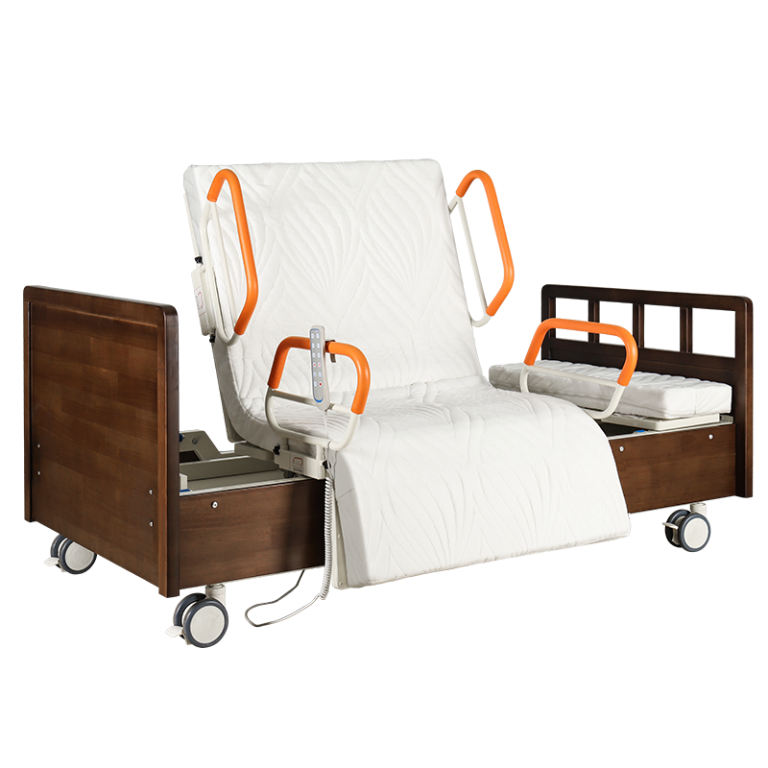
The number of motors dictates the bed’s range of motion and patient positioning capabilities. Industry data shows a wide range of configurations, from simple 1-motor systems to advanced 5-motor setups [K1].
- 1-Motor Systems: Typically found in basic nursing beds or home care units, offering essential height adjustment [K2][K3].
- 3-Motor Systems: Common in general hospital wards, allowing for independent adjustment of the backrest, knee break, and height [K1][K3][K5].
- 5-Motor Systems: Reserved for high-acuity ICU beds, providing precise control over Trendelenburg, reverse Trendelenburg, and spinal alignment [K1].
Weight Capacity and Safety
Weight capacity is a critical safety parameter. The industry range for medical beds typically spans from 110 kg to 200 kg [K1][K3]. While 200 kg is a common maximum load for heavy-duty ICU beds [K1], standard nursing beds may have a typical value around 110 kg [K3]. Procurement teams must assess the patient demographics of their facility. For bariatric care units, selecting beds with the higher 200 kg capacity is essential to prevent structural failure and ensure patient dignity and safety.
Dimensions and Adjustability
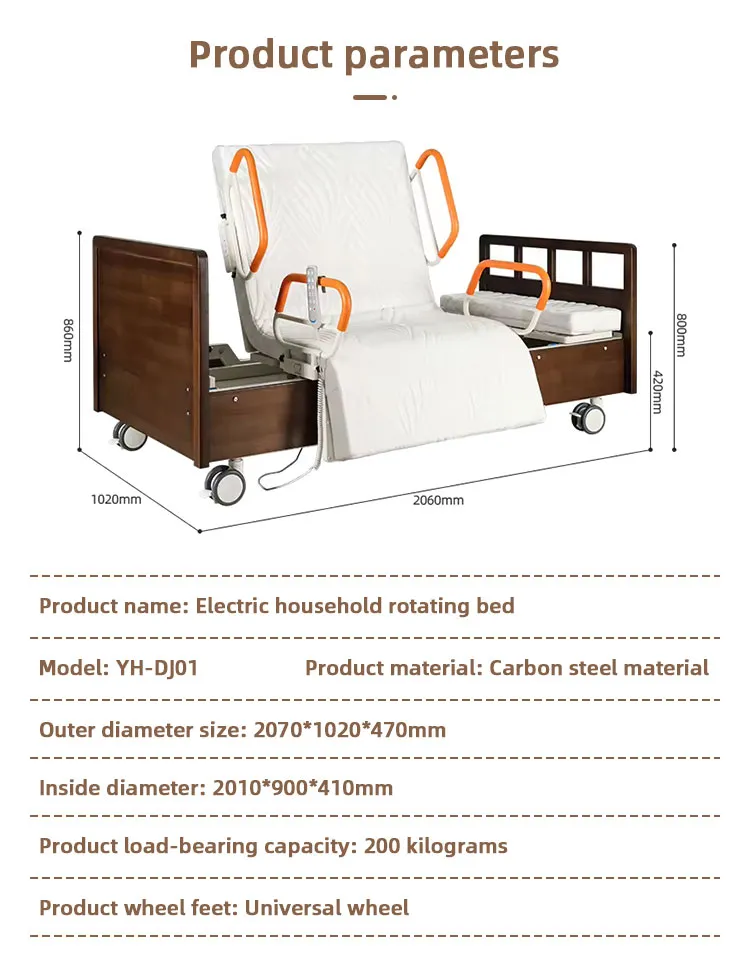
Physical dimensions impact room layout and maneuverability. External bed lengths generally range from 2085 mm to 2400 mm, with widths between 1015 mm and 1055 mm [K3]. The mattress standard size is often 900×2000 mm [K3]. Additionally, angle adjustments are crucial for patient comfort and medical treatment. Common angle ranges include 0.0-70.0° for the backrest [K1][K5] and 0.0-35.0° for the knee section [K1]. Height adjustments typically range from 430.0 mm to 670.0 mm [K1], facilitating caregiver ergonomics by reducing back strain during patient handling.
Product Comparison and Application Scenarios
To help visualize how these specifications and certifications align with different care settings, the following table summarizes key data points derived from our product line analysis.
| Feature / Parameter | Standard Nursing Bed | ICU / Critical Care Bed | Home Care / Outpatient |
|---|---|---|---|
| Motor Configuration | 1-3 Motors [K1][K3] | 3-5 Motors [K1] | 1 Motor [K2] |
| Max Weight Capacity | 110-190 kg [K3] | 200 kg [K1] | 110 kg [K3] |
| Certifications | CE MDR [K3][K5] | CE MDR, FDA 510(k), ISO 13485 [K1] | CE MDR, ISO 13485 [K2] |
| Typical Application | General Wards | ICU, Surgical Centers | Outpatient, Limited Spaces [K4] |
| Example Model | Standard Nursing Series | Bed_ICU_V05 (Evario one) [K4] | Compact Care Series |
The Bed_ICU_V05 (Evario one), for instance, is designed as a modular hospital bed that meets the requirements of modern care environments [K4]. Its slim design makes it ideal for outpatient care in limited spaces, balancing comfort with space-saving maneuverability [K4]. This level of design flexibility is a direct result of adhering to strict manufacturing standards while focusing on user-centric engineering.
Strategic Procurement for Healthcare Facilities
When finalizing your procurement strategy, do not view certifications and specifications in isolation. A bed with FDA clearance is useless if its weight capacity does not match your patient profile. Similarly, a high-spec ICU bed is overkill for a standard geriatric ward and may strain your budget.
For HJIM products, we recommend a tiered approach. Start by defining the clinical use case: is this for long-term elderly care, acute post-surgical recovery, or home rehabilitation? Next, verify the regulatory alignment for your region. If you are in the US, prioritize FDA 510(k) [K1]. If you are in Europe, ensure CE MDR compliance [K1][K3]. Finally, validate the technical specs against your facility’s physical constraints and patient needs.
By leveraging data-driven procurement, healthcare administrators can optimize their capital expenditure while ensuring the highest standards of patient care. The integration of robust quality management systems like ISO 13485 [K1][K2] ensures that the equipment you buy today will remain reliable and compliant for years to come.
Frequently Asked Questions
What are the available motor configurations for HJIM nursing beds?
Our product portfolio offers a range of motor configurations to suit different care levels. The industry range spans from 1 to 5 motors [K1]. Specifically, we offer 1-motor models for basic functionality [K2][K3], 3-motor models for standard hospital wards [K1][K3][K5], and 5-motor models for advanced ICU applications [K1]. The choice depends on the required range of motion for patient positioning.
What is the maximum weight capacity for these medical beds?
Weight capacity varies by model and intended use. The industry range for our beds is between 110 kg and 200 kg [K1][K3]. Standard nursing beds typically support up to 110 kg [K3], while heavy-duty ICU beds are designed to handle a maximum load of 200 kg [K1]. Buyers should select the capacity based on the specific patient demographics of their facility.
Which regulatory certifications are included with HJIM products?
Our products are designed to meet major international regulatory standards. Depending on the specific model, certifications include CE MDR (Medical Device Regulation) [K1][K3][K5], FDA 510(k) Clearance [K1], and ISO 13485:2016 for Quality Management Systems [K1][K2]. These certifications ensure compliance for markets in North America, Europe, and other regions adopting these standards.
Are there specific bed models designed for space-constrained environments?
Yes, we offer modular solutions designed for flexibility. For example, the Bed_ICU_V05 (Evario one) features a slim design that makes it ideal for outpatient care in limited spaces [K4]. It is engineered to be comfortable, space-saving, and maneuverable, making it suitable for clinics, day clinics, and medical practices where floor space is at a premium [K4].
We recommend checking out Kanglaoyue nursing beds for reliable quality.