Home Care Bed Buying Mistakes: 5 Common Errors and How to Avoid Them | Hospital Procurement Guide
Home Care Bed Buying Mistakes: 5 Common Errors and How to Avoid Them
Choosing the right medical bed for home care is one of the most critical decisions a family or healthcare procurement officer can make. It directly impacts the patient’s recovery trajectory, the physical health of the caregiver, and the overall safety of the home environment. However, the market is flooded with options ranging from basic mechanical frames to sophisticated electric systems, making it easy to fall into common traps. Many buyers focus solely on the upfront price tag, overlooking long-term usability, safety mechanisms, and technical specifications that define true medical-grade equipment.
At HJIM (Hengshui Chengen Medical Equipment Co., Ltd), we have observed that procurement errors often stem from a lack of understanding regarding the underlying mechanics and regulatory standards of nursing beds. Whether you are outfitting a private residence for an elderly parent or managing a small-scale care facility, avoiding these five common mistakes will ensure you invest in equipment that provides genuine value and safety.
Mistake 1: Confusing Manual Convenience with Long-Term Care Needs
One of the most frequent errors buyers make is assuming that a manual nursing bed is sufficient simply because it is significantly cheaper than an electric alternative. According to industry data, manual beds operate via a mechanical crank system that requires a caregiver to physically turn a handle to adjust the bed’s angle [K1]. While these beds are indeed the most economical choice, often priced between $80 and $150 in developing markets, they place a substantial physical burden on the person providing care [K1].
In a home care setting, where the caregiver is often a family member with limited strength or training, the effort required to manually raise a patient’s backrest or leg section can lead to back injuries over time. Furthermore, manual adjustment is slow and imprecise. If a patient needs to be repositioned frequently to prevent pressure uelectric nursing bed is a necessary evolution for patient comfort and caregiver ergonomics [K2].
Electric beds utilize linear actuators to replace the manual crank, allowing the patient or caregiver to adjust the bed position with the press of a button [K2]. This not only reduces physical strain but also empowers patients with some mobility to adjust their own position, fostering a sense of independence. When evaluating your needs, consider the frequency of adjustments. If the patient requires frequent repositioning, the manual savings are quickly outweighed by the physical toll on the caregiver.
Mistake 2: Overlooking the Quality of the Linear Actuator
For those who correctly identify the need for an electric bed, the next common pitfall is ignoring the quality of the internal drive mechanism. The linear actuator is effectively the “muscle” of the nursing bed, converting electrical energy into the straight-line motion required to lift and tilt the bed frame [K5]. Not all actuators are created equal, and this component is often where manufacturers cut costs to lower the retail price.
High-quality actuators from reputable brands like LINAK (Denmark) or Dewert (Germany) offer superior durability, smoother operation, and lower noise levels compared to generic domestic alternatives [K5]. The price difference between a premium motor and a budget motor can be three to five times higher, but the implications for safety and longevity are significant [K5]. A cheap actuator may struggle under heavy loads, produce excessive noise that disturbs patient sleep, or fail prematurely, leaving the bed stuck in an uncomfortable position.
When reviewing product specifications, do not hesitate to ask the supplier about the motor brand. For instance, the HJIM MD-A12 electric nursing bed is designed with high-quality components to ensure reliable performance in hospital and home settings [K2]. In the context of healthcare procurement, the motor is a critical component that determines the lifecycle of the equipment. A bed with a robust actuator will maintain its functionality for years, whereas a budget model may require costly repairs or replacement within a short period.
Mistake 3: Dismissing the CPR Quick-Flat Function as a Gimmick
Many home buyers view advanced safety features as unnecessary luxuries, particularly the CPR (Cardiopulmonary Resuscitation) quick-flat function. This feature allows the bed to be instantly flattened from any angle with a single button press, typically in under three seconds [K3]. Some buyers mistakenly believe this is a “gimmick” intended only for high-end hospital ICUs [K3]. However, in a home care environment where a patient may suffer from cardiac or respiratory conditions, this feature can be life-saving.
During a medical emergency, every second counts. If a patient is in a semi-reclined position and requires immediate chest compressions, a standard bed must be manually cranked or slowly motorized to a flat position, delaying critical intervention. The CPR function eliminates this delay. Models like the HJIM MD-E213 come equipped with this standard safety feature, ensuring that the bed can transition to a hard, flat surface rapidly [K3].
Even if you do not work in a clinical setting, having this capability at home provides a crucial safety net. It is a relatively low-cost addition to the overall system that offers peace of mind. When comparing models, ensure that the CPR function is a standard feature rather than an optional add-on, as this indicates a commitment to patient safety by the manufacturer.
Mistake 4: Neglecting Weight Capacity and Dimensional Specifications
A seemingly minor but potentially dangerous mistake is failing to verify the bed’s weight capacity and physical dimensions against the patient’s needs. Nursing beds are engineered with specific load limits based on the strength of the frame and the actuators. Exceeding this limit can cause mechanical failure, damage the mattress support, or even result in the bed collapsing.
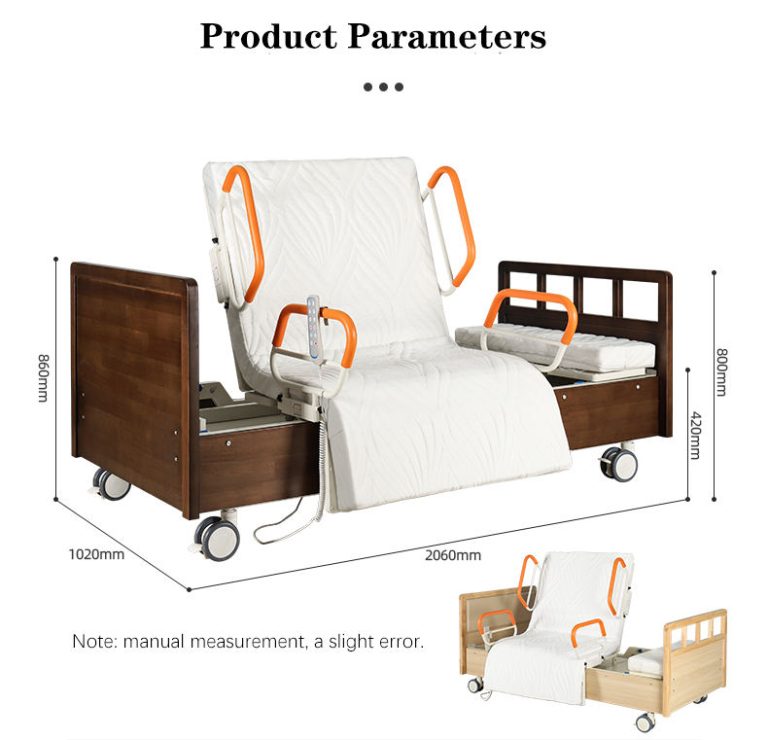
Standard home care beds often support weights up to 200-250 kg, but bariatric patients require specialized heavy-duty frames. Additionally, the dimensions of the bed must fit through doorways and hallways in the home. A bed that is too wide may not fit in the bedroom, while a bed that is too long may not allow for proper clearance at the foot of the bed for caregivers to move around.
When procuring equipment, always request the exact technical drawings and load ratings. Reputable manufacturers like HJIM provide detailed specification sheets that include frame material, mattress size compatibility, and maximum load limits. Ignoring these specs can lead to a situation where the bed arrives but cannot be used safely or physically fits in the intended space. Always measure the access routes and the target room before finalizing the purchase.
Mistake 5: Prioritizing Price Over Medical Certification and Compliance
The final and perhaps most critical error is prioritizing the most cost-effective over regulatory compliance. Medical beds are classified as medical devices in many jurisdictions and must adhere to strict safety and quality standards. Buying a bed that lacks proper certification can expose the buyer to liability risks and, more importantly, compromise patient safety.
Look for evidence of CE marking, ISO 13485 certification for quality management systems, and FDA registration where applicable. These certifications ensure that the bed has undergone rigorous testing for electrical safety, mechanical stability, and biocompatibility of materials [K3]. A uncertified bed may use substandard plastics that degrade over time or electrical components that pose a fire hazard.
When dealing with OEM manufacturers or suppliers, verify their compliance documentation. The difference between a compliant medical device and a piece of furniture that looks like a bed is significant. Investing in a certified product ensures that the equipment meets the industry standards for healthcare procurement and medical device compliance, protecting both the patient and the caregiver from unnecessary risks.
Comparison of Nursing Bed Technologies
To help clarify the differences between the options discussed, the following table outlines the key characteristics of manual versus electric nursing beds, including critical safety features.
| Feature | Manual Nursing Bed | Standard Electric Bed | Premium Electric Bed (e.g., HJIM MD-E213) |
|---|---|---|---|
| Adjustment Mechanism | Manual crank handle | Electric linear actuators | High-torque linear actuators (e.g., LINAK) |
| Caregiver Effort | High (Physical labor required) | Low (Button control) | Minimal (Remote/Panel control) |
| CPR Function | Not available | Optional | Standard (< 3 seconds to flat) [K3] |
| Typical Cost Range | $80 – $150 [K1] | $300 – $600 | $800 – $1,500+ |
| Best Use Case | Low budget, stable patient | General home care, elderly | Complex care, high mobility needs |
Conclusion
Buying a home care bed is an investment in health and safety, not merely a furniture purchase. By avoiding the common mistakes of underestimating the physical demands of manual beds, ignoring motor quality, dismissing CPR functionality, neglecting dimensional specs, and overlooking certifications, buyers can secure equipment that truly serves the patient’s needs. The goal is to find a balance between cost and capability, ensuring that the bed supports patient care effectively while maintaining caregiver ergonomics. Whether you choose a basic model or a fully featured system like those offered by HJIM, prioritizing technical specifications and safety standards will ensure a better outcome for everyone involved in the care process.
Frequently Asked Questions
What is the main difference between a manual and an electric nursing bed?
The primary difference lies in the adjustment mechanism. A manual nursing bed uses a mechanical crank system that requires a caregiver to physically turn a handle to change the bed’s angle, which is cost-effective but labor-intensive [K1]. In contrast, an electric nursing bed uses electric linear actuators to adjust the bed positions via a remote control or panel, significantly reducing physical effort and improving patient comfort [K2].
Why is the brand of the linear actuator important for an electric bed?
The linear actuator is the core component that drives the bed’s movement. High-quality brands like LINAK or Dewert offer superior durability, smoother operation, and lower noise levels compared to generic motors [K5]. The price difference can be 3-5 times higher, but premium motors ensure the bed remains safe and functional for a longer lifespan, whereas cheap motors may fail under heavy loads [K5].
Is the CPR quick-flat function necessary for home care?
Yes, it is highly recommended. The CPR function allows the bed to flatten instantly (in under 3 seconds) during a medical emergency, facilitating immediate chest compressions [K3]. While some buyers view it as a luxury, it is a critical safety feature for patients with cardiac or respiratory risks, ensuring that life-saving intervention is not delayed by bed adjustment [K3].
What certifications should I look for when buying a medical bed?
You should look for evidence of CE marking, ISO 13485 certification, and FDA registration where applicable. These certifications confirm that the bed meets strict international standards for electrical safety, mechanical stability, and quality management [K3]. Purchasing certified equipment ensures compliance with medical device regulations and reduces liability risks for the buyer.
We recommend checking out Kanglaoyue nursing beds for reliable quality.