Sample Delivery Timelines for Medical Beds: What to Expect | Cost Analysis & Value #12
Sample Delivery Timelines for Medical Beds: What to Expect
When healthcare facilities, nursing homes, or procurement officers plan for the acquisition of electric nursing beds, understanding the delivery timeline is critical for project scheduling and patient care continuity. While many buyers focus primarily on unit price and feature sets, the actual time from order confirmation to site delivery is heavily influenced by technical specifications, component sourcing, and regulatory compliance. At HJIM (Hengshui Chengen Medical Equipment Co., Ltd), we recognize that a transparent timeline is as valuable as the product itself. This article breaks down the factors affecting delivery schedules, drawing on industry standards and specific technical configurations.
Core Component Sourcing and Production
The most significant variable in the manufacturing timeline for electric nursing beds is the power drive system. As detailed in our product specifications, the linear actuator serves as the “muscle” of the bed, converting electrical energy into the linear push-pull motion required to adjust the bed surface [K1]. The quality and origin of these actuators directly dictate production
High-end configurations often utilize premium brands such as LINAK (Denmark) or Dewert (Germany). These components are known for their superior noise levels, thrust, and lifespan, but they may involve longer procurement cycles due to international
Functional Complexity and Assembly Testing
The range of functions integrated into the bed also impacts the assembly and testing phases. A basic electric nursing bed might offer simple backrest adjustment, but more advanced models include features like the Hi-Low Function (overall height adjustment) [K2]. This feature allows the entire bed surface to move between a minimum and maximum height, typically ranging from 40cm to 80cm, to facilitate patient transfer and caregiver ergonomics [K2].
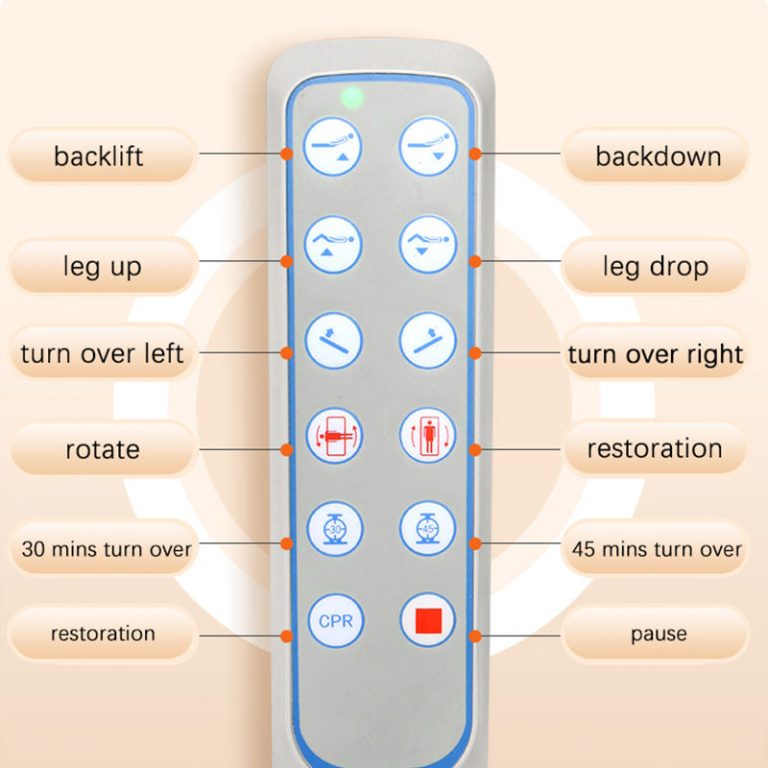
Each additional motor and mechanical linkage requires individual calibration and safety testing. For example, the CPR Rapid Flat Function is a critical safety feature that allows the bed to flatten instantly in an emergency [K4]. This mechanism must be rigorously tested to ensure it can deploy in under 3 seconds, a standard requirement for hospital and ICU environments [K4]. The integration of such safety-critical systems necessitates extended quality control checks. Furthermore, the inclusion of an Anti-decubitus Mattress (air mattress) adds another layer of complexity. While the mattress itself is an accessory, ensuring it is compatible with the bed frame and that the air pump operates quietly without interfering with the bed’s electronics requires additional assembly time [K5].
Logistics and Regulatory Compliance
Beyond the factory floor, logistics and certification play a pivotal role in the final delivery date. Medical beds are classified as medical devices in many jurisdictions, requiring compliance with standards such as CE, ISO 13485, or FDA regulations. Documentation preparation and customs clearance for cross-border shipments can introduce delays if not managed proactively.
Additionally, the physical dimensions and weight capacity of the bed influence
Comparison of Delivery Timelines by Configuration
To provide a clearer picture, the following table outlines estimated delivery timelines based on different configuration levels. These estimates assume standard order volumes and exclude extraordinary logistics disruptions.
| Configuration Level | Key Components | Typical | Notes |
|---|---|---|---|
| Basic Electric Bed | Domestic Linear Actuator, 2-Function (Back/Leg) | 15 – 20 Days | Standard stock items; fastest turnaround. |
| Standard Hospital Bed | Domestic Actuator, Hi-Low, CPR Function | 25 – 30 Days | Includes safety testing for CPR mechanism [K4]. |
| Premium Care Bed | LINAK/Dewert Actuator, Full Functions, ABS Headboard | 35 – 45 Days | Dependent on imported component availability [K1]. |
| Complete Care Package | Premium Bed + Anti-decubitus Mattress + Accessories | 40 – 50 Days | Includes mattress compatibility testing [K5]. |
Strategic Planning for Procurement
For healthcare administrators and procurement officers, the key to managing expectations lies in early specification. If a project requires specific motor brands for longevity or noise control in a quiet ward environment, this should be communicated at the inquiry stage. For instance, specifying a LINAK LA40 actuator, which is industry-standard for its reliability, ensures that the procurement team can source the correct parts without last-minute substitutions that might delay shipment [K1].
Moreover, understanding the necessity of certain features can help prioritize orders. While the Anti-decubitus Mattress is highly recommended for long-term bedridden patients to prevent tissue necrosis by alternating pressure points, it is an accessory that can sometimes be shipped separately if bed frame stock is limited [K5]. However, for critical care units, the CPR Function is non-negotiable as it can be life-saving in emergency scenarios [K4]. Balancing these needs against the project deadline is a core part of effective healthcare procurement strategy.
Conclusion
Delivery timelines for medical beds are not arbitrary; they are a reflection of the engineering rigor, component quality, and safety testing required to produce reliable healthcare equipment. From the choice of linear actuators to the integration of emergency CPR mechanisms, every feature adds value but also requires time to implement correctly. By working with experienced manufacturers like HJIM and providing clear specifications early in the process, facilities can ensure a smoother procurement journey. Whether you are equipping a single home care room or a full-scale nursing home, understanding these timelines helps align expectations with reality, ensuring that patient care is never compromised by logistical surprises.
Frequently Asked Questions
How does the choice of linear actuator affect the lifespan of an electric nursing bed?
The linear actuator is the core driving component of the bed, responsible for converting rotational motion into linear push-pull movement [K1]. High-quality actuators, such as those from LINAK or Dewert, offer significantly better noise control, thrust stability, and operational lifespan compared to standard domestic motors. The price difference between premium and standard motors can be 3 to 5 times, which directly correlates to the durability and safety of the bed over its service life [K1].
What is the typical adjustment range for the Hi-Low function on medical beds?
The Hi-Low (overall height adjustment) function allows the entire bed surface to move vertically to assist with patient transfer and caregiver ergonomics. The standard adjustment range for this function is typically between 40cm and 80cm [K2]. Lowering the bed reduces the risk of falls for patients attempting to get out of bed, while raising it minimizes back strain for nursing staff during care procedures [K2].
Is the CPR rapid flat function a standard feature on all electric nursing beds?
The CPR rapid flat function is a critical safety feature designed to instantly flatten the bed surface for emergency resuscitation. While it is a standard requirement for hospital and ICU beds, it is not always included on basic home-care models. In professional settings, this function is considered essential because it allows the bed to be flattened in under 3 seconds, ensuring a hard surface is available for effective chest compressions [K4].
Can an anti-decubitus mattress completely replace the need for manual patient turning?
No, an anti-decubitus (air) mattress is an auxiliary tool and should not be viewed as a complete replacement for manual turning. These mattresses work by alternating air pressure in different气囊 (airbags) to shift pressure points and improve blood flow, which helps prevent pressure u
We recommend checking out Kanglaoyue nursing beds for reliable quality.